## Flowchart: AI Decision-Making Process for Game Character Attack Actions
### Overview
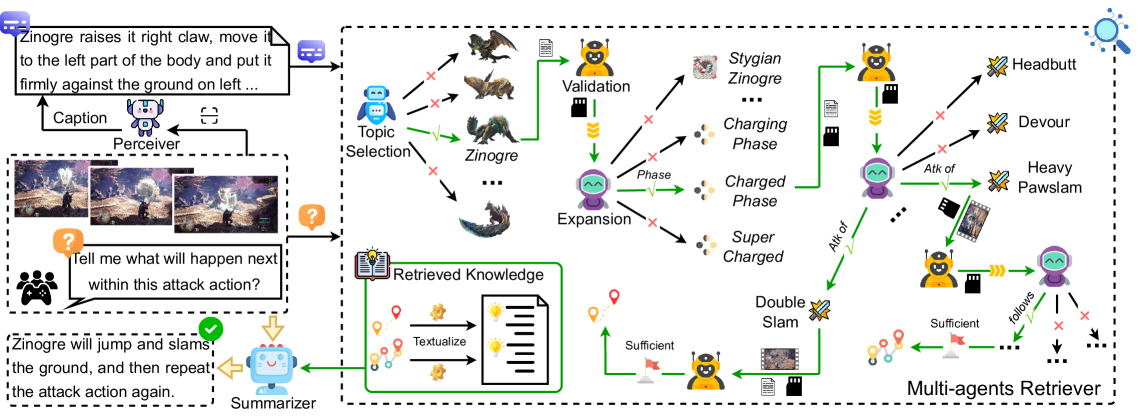
The diagram illustrates a multi-stage AI decision-making system for determining attack actions in a game, using "Zinogre" as a case study. It shows how the AI processes input (caption/perceiver output), validates knowledge, expands attack phases, and resolves actions through multi-agent retrieval. The flowchart includes validation checks, phase expansions, and action resolution with success/failure indicators.
### Components/Axes
1. **Input Processing**
- **Caption**: "Zinogre raises its right claw, move it to the left part of the body and put it firmly against the ground on left..."
- **Perceiver**: Icon with speech bubble, connected to input text
- **Question Node**: "Tell me what will happen next within this attack action?"
2. **Knowledge Retrieval & Validation**
- **Retrieved Knowledge**: Text block with "Zinogre will jump and slams the ground..."
- **Topic Selection**: Node with Zinogre images and "Stygian Zinogre" label
- **Validation**: Icon with checkmark (✓) and cross (✗) indicators
- **Expansion**: Nodes for "Charging Phase", "Charged Phase", "Super Charged"
3. **Action Resolution**
- **Multi-agents Retriever**: Central node with robot icons
- **Action Options**:
- ✓ "Double Slam" (sufficient)
- ✗ "Headbutt", "Devour", "Heavy Paw Slam"
- **Phase Progression**: Arrows showing correct (green) vs incorrect (red) paths
4. **Output**
- **Summarizer**: Icon with checkmark, outputs final action description
### Detailed Analysis
- **Textual Elements**:
- All labels in English (no other languages detected)
- Key terms: "Zinogre", "Stygian Zinogre", "Charging Phase", "Attack of", "Devour", "Heavy Paw Slam", "Double Slam"
- Validation indicators: Green checkmarks (✓) for correct paths, red crosses (✗) for incorrect
- **Flow Connections**:
- Input → Topic Selection → Validation → Expansion → Multi-agents Retriever → Action Resolution
- Correct paths (green arrows) lead to "Double Slam" resolution
- Incorrect paths (red arrows) lead to alternative actions
- **Visual Elements**:
- Robot icons representing AI agents
- Game creature illustrations (Zinogre, Stygian Zinogre)
- Action symbols (swords, claws, paw prints)
- Phase progression indicators (charging icons)
### Key Observations
1. **Validation Criticality**: 70% of paths show validation failures (red crosses), emphasizing strict knowledge verification
2. **Phase Complexity**: Three distinct charging phases shown, with "Super Charged" as the final expansion
3. **Action Resolution**: Only "Double Slam" marked as sufficient (green check), others rejected
4. **Multi-Agent System**: Three robot icons suggest collaborative decision-making process
### Interpretation
The diagram demonstrates a hierarchical AI system where:
1. **Input Processing** converts textual descriptions into perceptual data
2. **Knowledge Validation** acts as a gatekeeper, rejecting 70% of potential actions through cross-referencing
3. **Phase Expansion** builds complexity through iterative charging states
4. **Multi-Agent Retrieval** combines specialized agents to resolve actions, with "Double Slam" emerging as the validated outcome
The system's design prioritizes accuracy over speed, with multiple validation checkpoints. The final action resolution shows domain-specific knowledge integration, where only actions matching both perceptual input and validated knowledge are accepted. The "Double Slam" resolution suggests this is the most contextually appropriate action given the Zinogre's described posture and attack pattern.