## Log Output: Inflation Process Trace
### Overview
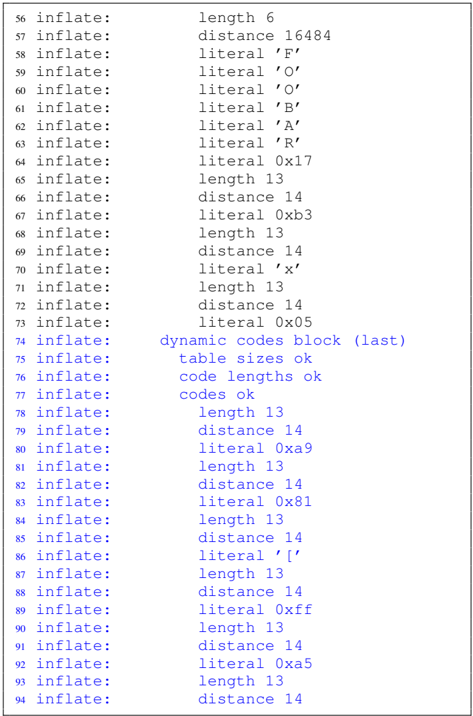
The image displays a vertical, numbered list of log entries from a technical process, specifically an "inflate" operation. This is characteristic of a decompression or data inflation routine, likely from a library implementing a format like DEFLATE (used in zlib, gzip, PNG). The log shows a sequence of low-level operations, including processing literal bytes and back-references (length/distance pairs), culminating in the handling of a dynamic Huffman codes block. The text is presented in a monospaced font, typical of terminal or debug output.
### Components/Axes
* **Structure:** A single column of numbered lines (56 through 94).
* **Line Format:** Each line begins with a line number, followed by the label `inflate:`, and then a parameter or status message.
* **Color Coding:** Lines 74-77 are displayed in blue text, indicating they are status or informational messages distinct from the data processing lines.
* **Data Types:** The log entries contain:
* **Literal Values:** Indicated by `literal 'X'` (where X is a character) or `literal 0xYY` (where YY is a hexadecimal byte value).
* **Back-Reference Parameters:** Pairs of `length N` and `distance M`, which instruct the inflater to copy N bytes from M bytes back in the output history.
* **Status Messages:** Textual confirmations about the structure of a "dynamic codes block."
### Detailed Analysis
**Complete Line-by-Line Transcription:**
* **56:** `inflate: length 6`
* **57:** `inflate: distance 16484`
* **58:** `inflate: literal 'F'`
* **59:** `inflate: literal 'O'`
* **60:** `inflate: literal 'O'`
* **61:** `inflate: literal 'B'`
* **62:** `inflate: literal 'A'`
* **63:** `inflate: literal 'R'`
* **64:** `inflate: literal 0x17`
* **65:** `inflate: length 13`
* **66:** `inflate: distance 14`
* **67:** `inflate: literal 0xb3`
* **68:** `inflate: length 13`
* **69:** `inflate: distance 14`
* **70:** `inflate: literal 'x'`
* **71:** `inflate: length 13`
* **72:** `inflate: distance 14`
* **73:** `inflate: literal 0x05`
* **74 (Blue):** `inflate: dynamic codes block (last)`
* **75 (Blue):** `inflate: table sizes ok`
* **76 (Blue):** `inflate: code lengths ok`
* **77 (Blue):** `inflate: codes ok`
* **78:** `inflate: length 13`
* **79:** `inflate: distance 14`
* **80:** `inflate: literal 0xa9`
* **81:** `inflate: length 13`
* **82:** `inflate: distance 14`
* **83:** `inflate: literal 0x81`
* **84:** `inflate: length 13`
* **85:** `inflate: distance 14`
* **86:** `inflate: literal '['`
* **87:** `inflate: length 13`
* **88:** `inflate: distance 14`
* **89:** `inflate: literal 0xff`
* **90:** `inflate: length 13`
* **91:** `inflate: distance 14`
* **92:** `inflate: literal 0xa5`
* **93:** `inflate: length 13`
* **94:** `inflate: distance 14`
**Pattern Analysis:**
1. **Initial Sequence (Lines 56-64):** A back-reference (length 6, distance 16484) is followed by a sequence of literal ASCII characters: `F`, `O`, `O`, `B`, `A`, `R`. This spells "FOOBAR", a common placeholder or test string in programming. It is followed by a literal byte `0x17`.
2. **Repetitive Pattern (Lines 65-94):** A highly regular pattern emerges, primarily consisting of repeating `length 13` / `distance 14` pairs interspersed with literal bytes. This suggests the decompression of a highly repetitive or structured data segment. The literals in this segment are: `0xb3`, `'x'`, `0x05`, `0xa9`, `0x81`, `'['`, `0xff`, `0xa5`.
3. **Status Block (Lines 74-77):** The blue text marks a significant event: the start and successful parsing of a "dynamic codes block (last)". This is a header in the DEFLATE format that defines custom Huffman codes for the subsequent data. The messages confirm the integrity of the table sizes, code lengths, and the codes themselves.
### Key Observations
* **Data Structure:** The log reveals the inner workings of a DEFLATE decompressor. The mix of literals and length/distance pairs is the core mechanism of the algorithm.
* **"FOOBAR" String:** The presence of this string is a strong indicator that this log may be from a test case, a debugging session, or a demonstration of the inflation algorithm.
* **Highly Repetitive Back-References:** The sequence of `length 13` / `distance 14` from line 65 onward is extremely regular. This could indicate the decompression of a data pattern that repeats every 14 bytes, or it might be an artifact of a specific test pattern.
* **Dynamic Block Transition:** The blue status lines cleanly separate the processing of two different block types within the compressed stream. The "(last)" tag on line 74 indicates this is the final block in the stream.
### Interpretation
This log provides a microscopic view into the final stages of decompressing a data stream. The process can be interpreted as follows:
1. **Early Data Recovery:** The inflater first processes a back-reference and then emits the literal string "FOOBAR" followed by a byte (`0x17`). This could be part of a file header, metadata, or the beginning of the actual payload.
2. **Structured Data Processing:** After the initial data, the stream enters a section encoded with a dynamic Huffman table. The extreme regularity of the `length 13` / `distance 14` pairs suggests this section contains a pattern designed to test or demonstrate the back-reference mechanism efficiently. The interleaved literal bytes (`0xb3`, `'x'`, etc.) are the actual data values being produced amidst these copy operations.
3. **Successful Completion:** The status messages confirm that the dynamic block header was parsed without error, and the subsequent data (lines 78-94) is being processed according to the newly defined codes. The log ends mid-process (line 94 is a `distance` without a following literal or new command), indicating the capture is a snippet of a longer operation.
**In essence, this image is a technical artifact showing a decompression algorithm in action, likely during a test or debug run. It demonstrates the core DEFLATE operations of copying from history (back-references) and emitting literal bytes, with a clear transition between block types. The "FOOBAR" string is a telltale sign of a synthetic or test data stream.**