## Textual Data: Inflate Sequence Log
### Overview
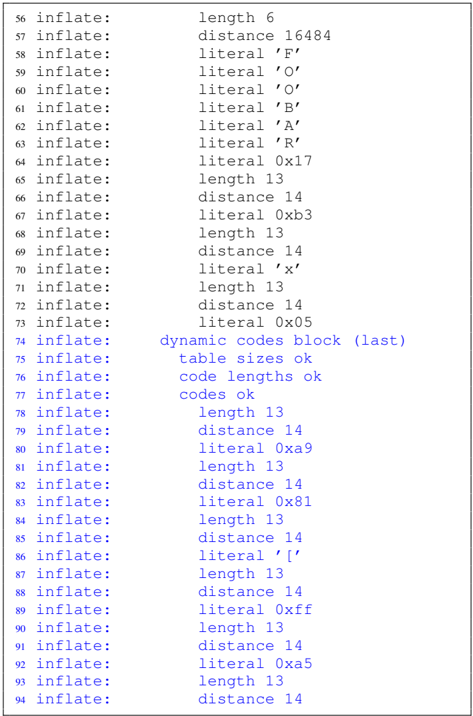
The image presents a log of an "inflate" process, likely related to data compression/decompression (e.g., zlib). It consists of numbered lines, each detailing an operation or data element encountered during the inflation process. The log entries primarily consist of the keyword "inflate:", followed by either a "length" value, a "distance" value, or a "literal" value (often represented in hexadecimal). There are also a few descriptive messages indicating the completion of a block and status checks.
### Components/Axes
There are no axes or traditional chart components. The data is presented as a sequential list. The primary components are:
* **Line Number:** Integers from 56 to 94, indicating the sequence of operations.
* **Operation:** The keyword "inflate:".
* **Parameter:** The value associated with the "inflate:" operation, which can be:
* "length" followed by an integer value.
* "distance" followed by an integer value.
* "literal" followed by a character or hexadecimal value.
* Descriptive text messages (e.g., "dynamic codes block (last)", "table sizes ok").
### Detailed Analysis / Content Details
Here's a transcription of the log entries, with approximate values:
* 56 inflate: length 6
* 57 inflate: distance 16484
* 58 inflate: literal 'F'
* 59 inflate: literal 'O'
* 60 inflate: literal 'O'
* 61 inflate: literal 'B'
* 62 inflate: literal 'A'
* 63 inflate: literal 'R'
* 64 inflate: literal 0x17
* 65 inflate: length 13
* 66 inflate: distance 14
* 67 inflate: literal 0xb3
* 68 inflate: length 13
* 69 inflate: distance 14
* 70 inflate: literal 'x'
* 71 inflate: length 13
* 72 inflate: distance 14
* 73 inflate: literal 0x05
* 74 inflate: dynamic codes block (last)
* 75 inflate: table sizes ok
* 76 inflate: code lengths ok
* 77 inflate: codes ok
* 78 inflate: length 13
* 79 inflate: distance 14
* 80 inflate: literal 0xa9
* 81 inflate: length 13
* 82 inflate: distance 14
* 83 inflate: literal 0x81
* 84 inflate: length 13
* 85 inflate: distance 14
* 86 inflate: literal '['
* 87 inflate: length 13
* 88 inflate: distance 14
* 89 inflate: literal 0xff
* 90 inflate: length 13
* 91 inflate: distance 14
* 92 inflate: literal 0xa5
* 93 inflate: length 13
* 94 inflate: distance 14
### Key Observations
* The log shows a repeating pattern of "length", "distance", and "literal" operations.
* The "distance" values are consistently 14 for a significant portion of the log (lines 66-73, 78-94).
* The "length" values are consistently 13 for a significant portion of the log (lines 65, 68, 71, 78, 81, 84, 87, 90, 93).
* The "literal" values include both ASCII characters (e.g., 'F', 'O', 'B', 'A', 'R', 'x', '[') and hexadecimal representations (e.g., 0x17, 0xb3, 0x05, 0xa9, 0x81, 0xff, 0xa5).
* Lines 74-77 indicate the successful initialization of dynamic Huffman codes.
### Interpretation
This log likely represents the decompression of a data stream using a compression algorithm like zlib. The "length" and "distance" values are used for LZ77-style compression, where repeated sequences of data are replaced with a length and a distance back to a previous occurrence. The "literal" values represent the actual data bytes. The consistent "distance" and "length" values suggest that the compressed data contains many repeated sequences. The "dynamic codes block (last)" message indicates that the Huffman coding tables were dynamically generated and are now finalized. The log provides a detailed trace of the decompression process, which could be useful for debugging or analyzing the compression algorithm's performance. The presence of both ASCII characters and hexadecimal values in the "literal" fields suggests that the original data stream contained a mix of text and binary data.