## Screenshot: Mastermind Game Rules and Example Interaction
### Overview
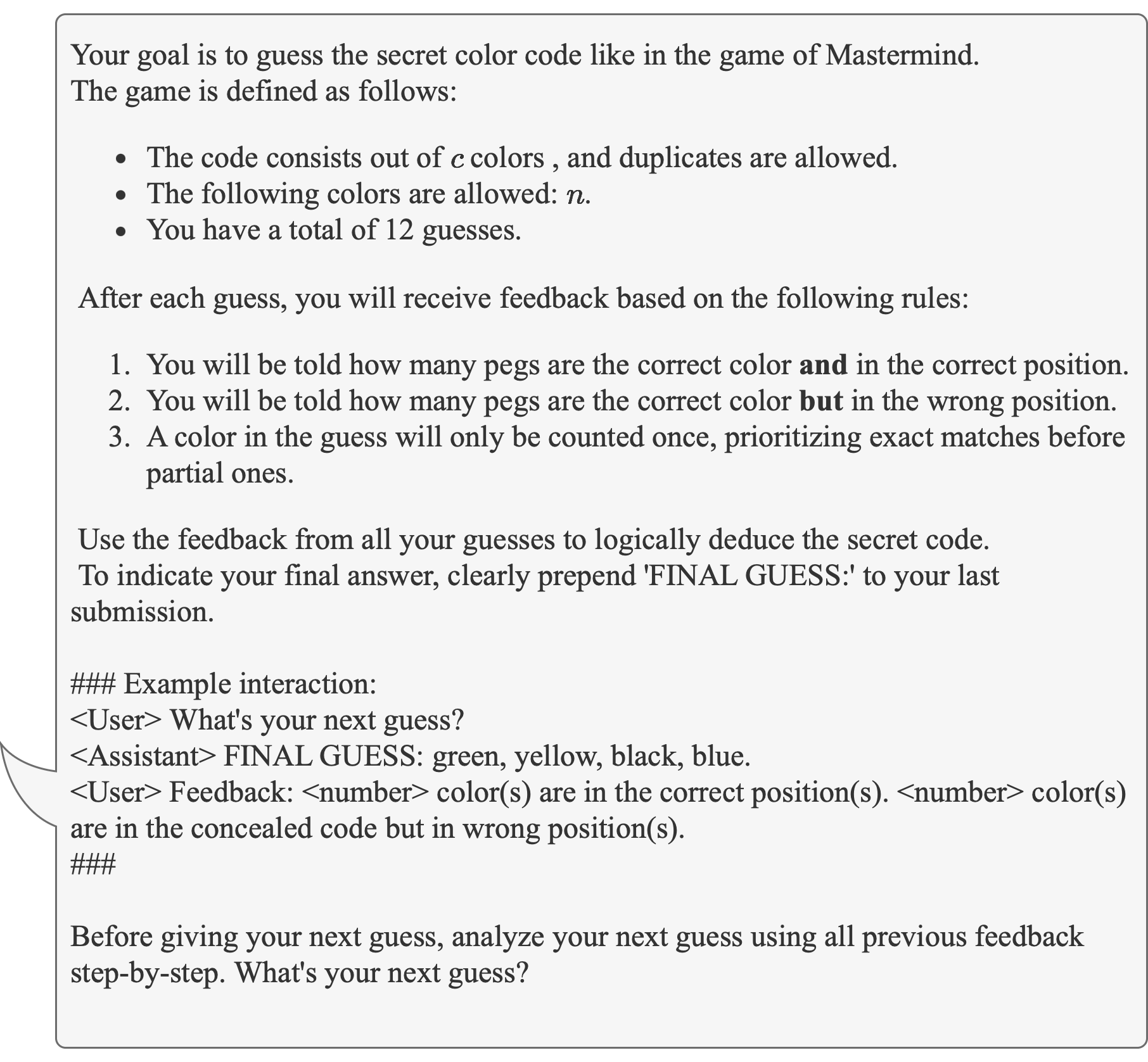
The image depicts a text-based explanation of the Mastermind game rules, including gameplay mechanics, feedback logic, and an example interaction. The content is structured with bullet points, numbered lists, and a simulated dialogue between a user and assistant.
### Components/Axes
- **Text Blocks**:
- **Main Rules**: Describes the game's objective, code structure (c colors, duplicates allowed), allowed colors (n), and 12 guess limit.
- **Feedback Rules**: Three numbered rules for interpreting peg feedback (correct color/position, correct color/wrong position, partial matches).
- **Example Interaction**: A simulated dialogue with `<User>` and `<Assistant>` tags, demonstrating a guess, feedback, and final submission.
- **Prompt**: Instructions to analyze the next guess using prior feedback.
- **Colors**:
- Green, yellow, black, blue (explicitly listed in the example).
### Detailed Analysis
1. **Main Rules**:
- The code consists of `c` colors (unspecified value), duplicates allowed.
- `n` colors are allowed (unspecified value).
- Players have 12 total guesses.
2. **Feedback Rules**:
- **Rule 1**: Pegs indicate correct color **and** position.
- **Rule 2**: Pegs indicate correct color **but** wrong position.
- **Rule 3**: Partial matches (e.g., exact matches prioritized first).
3. **Example Interaction**:
- **User Guess**: "green, yellow, black, blue" (4 colors).
- **Assistant Final Guess**: Same as user's guess.
- **Feedback**:
- `<number> color(s) are in the correct position(s)` (e.g., 2 pegs).
- `<number> color(s) are in the concealed code but in wrong position(s)` (e.g., 1 peg).
4. **Prompt**:
- Players must analyze prior feedback step-by-step before submitting the next guess.
### Key Observations
- The example interaction uses **4 colors** (green, yellow, black, blue) with feedback values of **2** (correct position) and **1** (correct color, wrong position).
- The game emphasizes logical deduction using cumulative feedback.
- No numerical values for `c` or `n` are provided in the text.
### Interpretation
The image outlines a standard Mastermind variant with explicit feedback rules. The example demonstrates how partial matches are prioritized (e.g., exact matches counted first). The lack of specific values for `c` and `n` suggests these are variables determined by the game instance. The feedback mechanism aligns with classic Mastermind logic, where positional accuracy is rewarded first, followed by color matches in incorrect positions. The example interaction highlights the iterative nature of the game, requiring players to refine guesses based on cumulative feedback.