## Game Instructions: Mastermind Color Code
### Overview
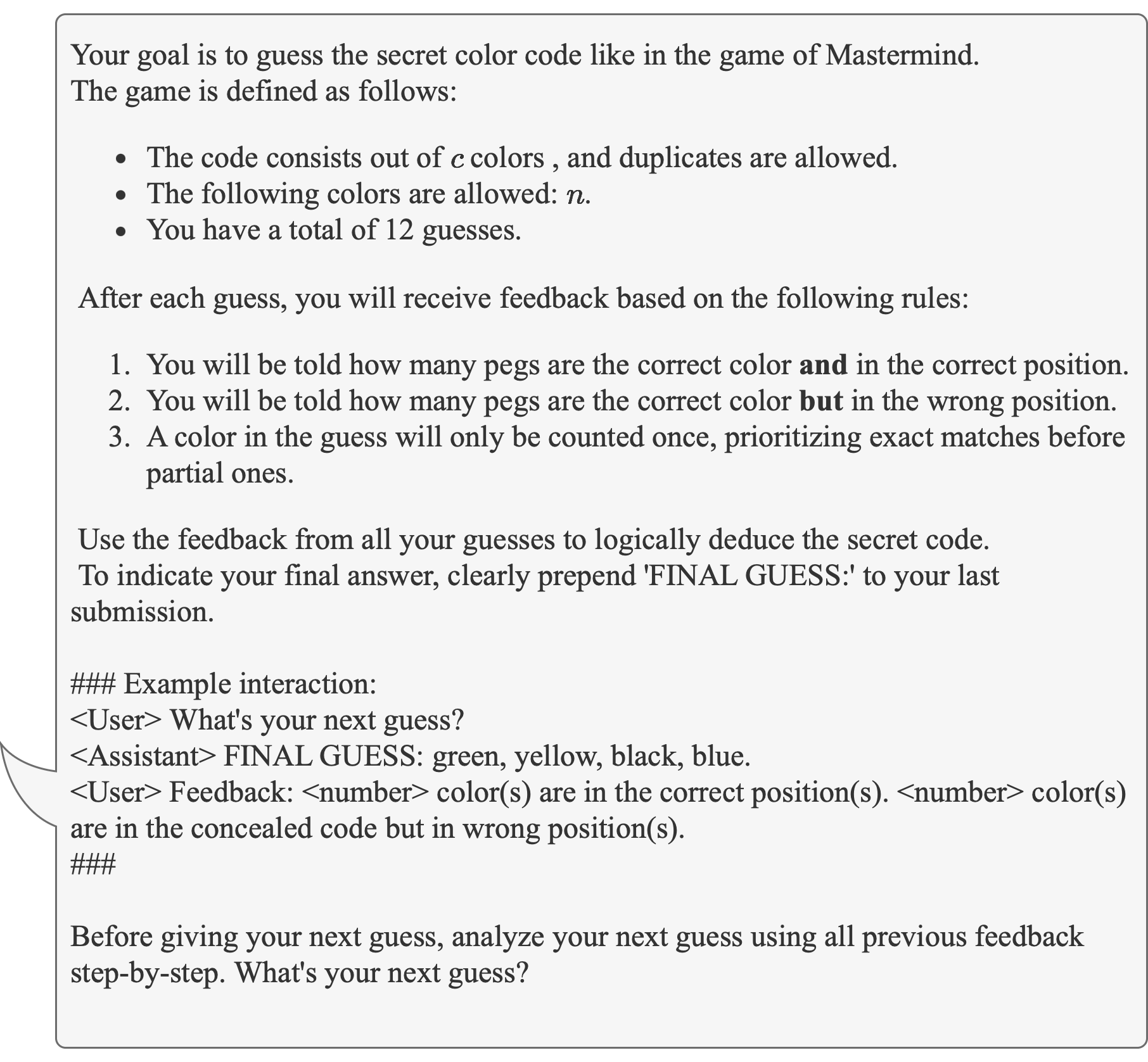
The image provides instructions for playing a Mastermind-like game where the goal is to guess a secret color code. It outlines the rules of the game, including the code's composition, allowed colors, number of guesses, and feedback mechanism. An example interaction is provided to illustrate the game flow.
### Components/Axes
The image consists of the following components:
1. **Game Goal**: A description of the objective: to guess the secret color code.
2. **Game Definition**:
* The code consists of 'c' colors, with duplicates allowed.
* 'n' represents the allowed colors.
* A total of 12 guesses are permitted.
3. **Feedback Rules**:
* Rule 1: Information on the number of pegs with the correct color and position.
* Rule 2: Information on the number of pegs with the correct color but incorrect position.
* Rule 3: A color in the guess is counted only once, prioritizing exact matches.
4. **Guidance**: Instructions to use feedback to deduce the code and to prepend 'FINAL GUESS:' to the final submission.
5. **Example Interaction**:
* User prompt: "What's your next guess?"
* Assistant response: "FINAL GUESS: green, yellow, black, blue."
* User feedback: "<number> color(s) are in the correct position(s). <number> color(s) are in the concealed code but in wrong position(s)."
6. **Final Instruction**: Analyze previous feedback before making the next guess.
### Detailed Analysis or ### Content Details
The game involves guessing a color code of length 'c', where colors can be duplicated. The available colors are represented by 'n'. Players have 12 attempts to guess the code. After each guess, feedback is provided on the number of colors that are both correct and in the correct position, as well as the number of colors that are correct but in the wrong position. Colors are counted only once per guess, with exact matches prioritized. The example interaction demonstrates the exchange between the user and the assistant, including the format for the final guess and the feedback provided.
### Key Observations
* The game parameters 'c' and 'n' are not explicitly defined with numerical values, but rather as variables.
* The feedback mechanism is crucial for deducing the secret code.
* The 'FINAL GUESS:' prefix is essential for identifying the final submission.
### Interpretation
The instructions outline a classic code-breaking game with a clear set of rules and an iterative feedback loop. The game's difficulty depends on the values of 'c' and 'n', which determine the code length and the number of possible colors, respectively. The feedback mechanism allows players to refine their guesses based on the accuracy of their previous attempts. The example interaction provides a template for how the game should be played, emphasizing the importance of logical deduction and strategic guessing.