\n
## Text Document: Mastermind Game Rules
### Overview
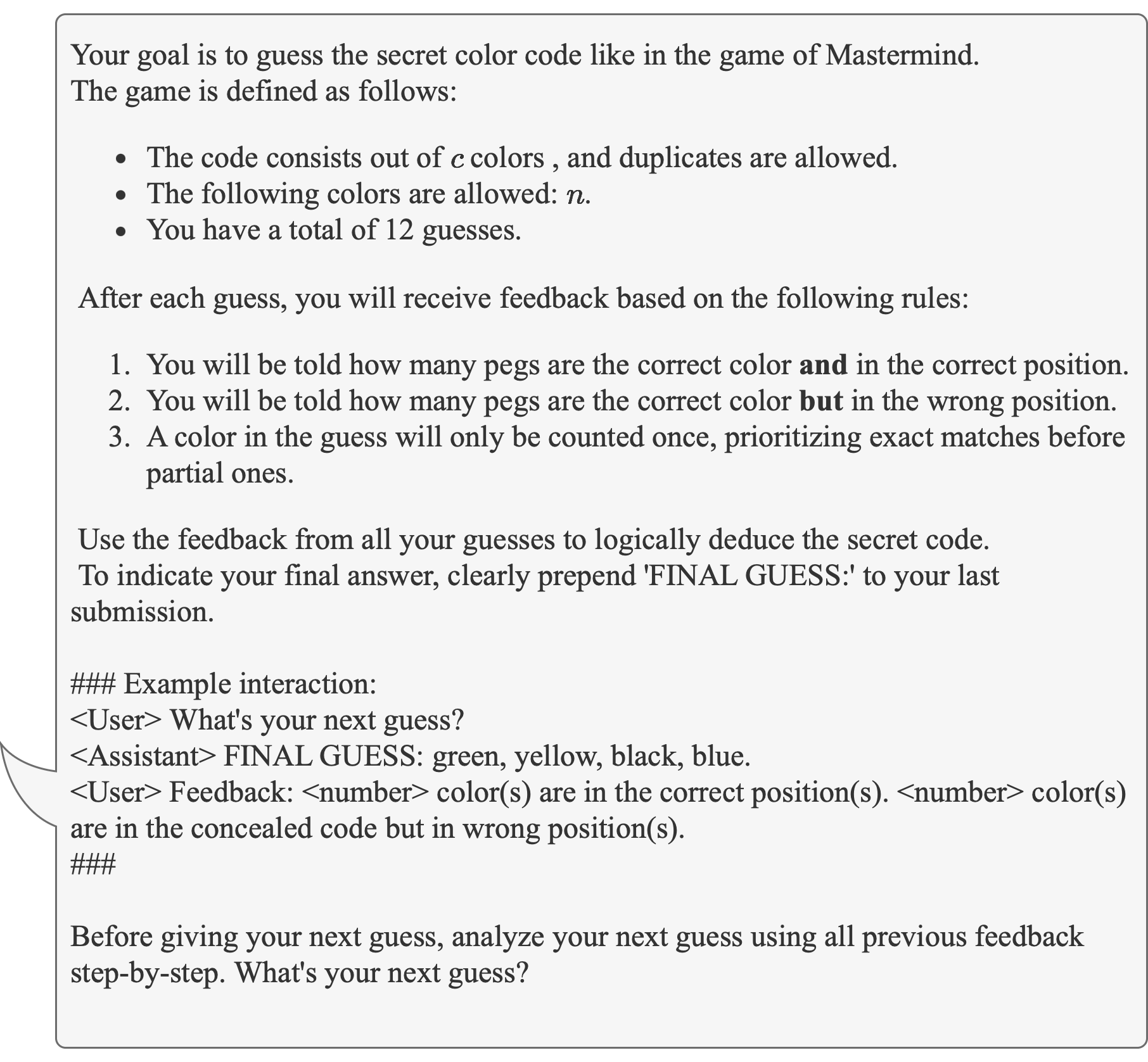
This document outlines the rules for a game resembling Mastermind, where the goal is to deduce a secret code consisting of colors. It details the code's composition, allowed colors, the number of guesses, and the feedback mechanism. It also provides instructions for submitting a final guess and an example interaction.
### Components/Axes
The document consists entirely of text and formatting elements (bullet points, headings, code blocks). There are no axes, charts, or diagrams.
### Detailed Analysis or Content Details
The document can be transcribed as follows:
"Your goal is to guess the secret code like in the game of Mastermind.
The game is defined as follows:
* The code consists of c colors , and duplicates are allowed.
* The following colors are allowed: n.
* You have a total of 12 guesses.
After each guess, you will receive feedback based on the following rules:
1. You will be told how many pegs are the correct color and in the correct position.
2. You will be told how many pegs are the correct color but in the wrong position.
3. A color in the guess will only be counted once, prioritizing exact matches before partial ones.
Use the feedback from all your guesses to logically deduce the secret code.
To indicate your final answer, clearly prepend 'FINAL GUESS:' to your last submission.
### Example interaction:
<User> What's your next guess?
<Assistant> FINAL GUESS: green, yellow, black, blue.
<User> Feedback: <number> color(s) are in the correct position(s). <number> color(s) are in the concealed code but in wrong position(s).
###
Before giving your next guess, analyze your next guess using all previous feedback step-by-step. What's your next guess?"
### Key Observations
The document defines a logic puzzle game. The variables 'c' and 'n' are used to represent the number of colors in the code and the allowed colors, respectively. The feedback mechanism is crucial for solving the puzzle. The example interaction demonstrates the expected format for guesses and feedback.
### Interpretation
This document serves as a set of instructions for a game. The rules are clearly defined, and the example interaction helps to clarify the process. The game relies on logical deduction and pattern recognition. The use of 'c' and 'n' as variables suggests a degree of generality, implying the game can be adapted to different numbers of colors. The emphasis on step-by-step analysis indicates that a systematic approach is essential for success. The document is a functional specification for a game, likely intended for a human player or an AI agent. The document does not contain any data or facts beyond the rules of the game.