## Screenshot: Mastermind Game Instructions
### Overview
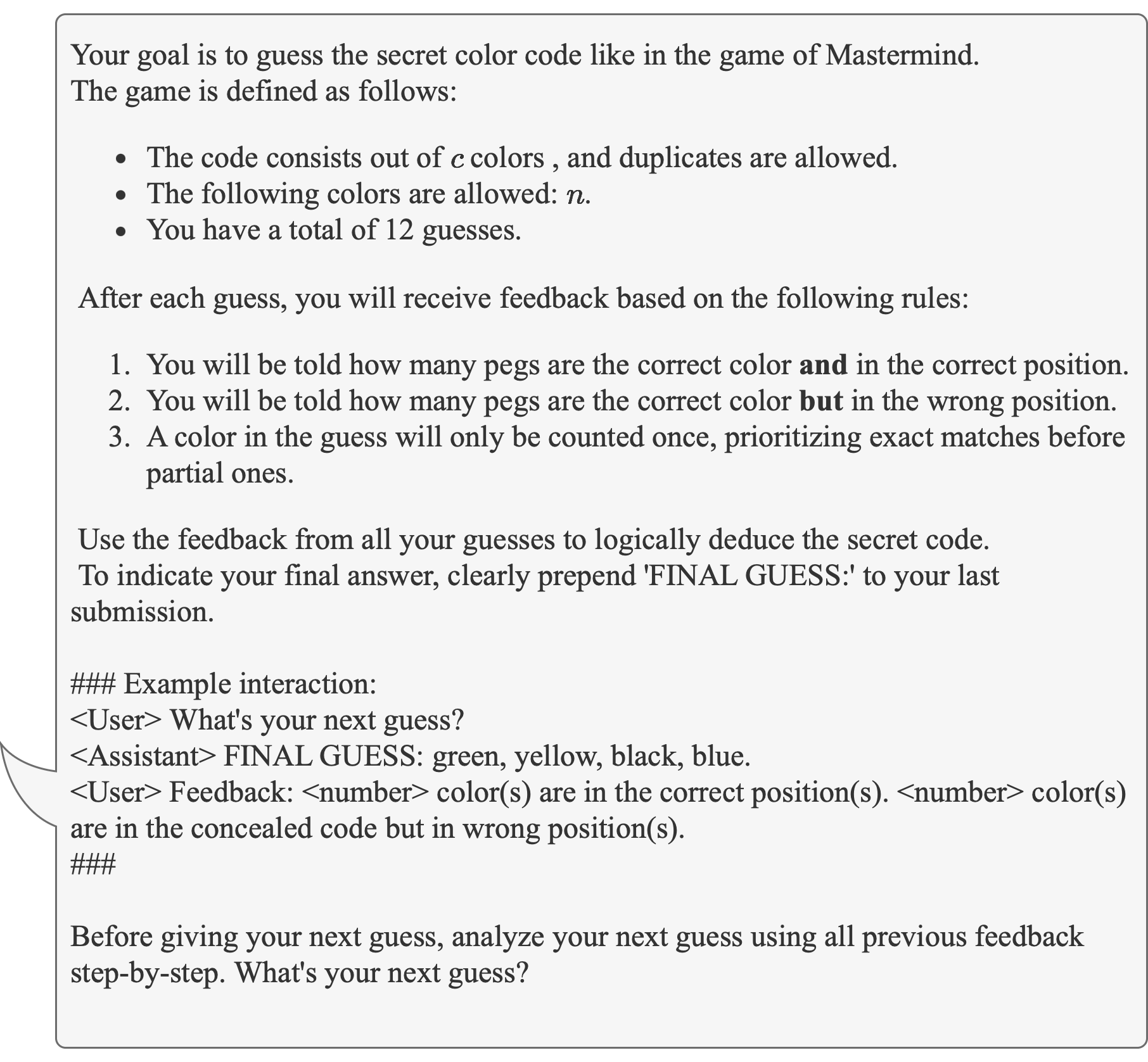
The image is a screenshot of a text block outlining the rules and interaction protocol for a Mastermind-style code-guessing game. The text is presented in a clean, serif font on a light gray background, contained within a subtle border. The content defines the game's objective, parameters, feedback mechanism, and provides an example interaction.
### Components/Axes
The text is structured into several distinct sections:
1. **Game Objective & Parameters**: A bulleted list defining the code structure and guess limit.
2. **Feedback Rules**: A numbered list explaining the two types of feedback provided after each guess.
3. **Deduction & Submission Instruction**: A paragraph explaining how to use feedback and format the final answer.
4. **Example Interaction**: A formatted example showing a sample dialogue between a User and an Assistant.
5. **Final Prompt**: A concluding instruction to analyze previous feedback before making the next guess.
### Detailed Analysis
**Full Text Transcription:**
Your goal is to guess the secret color code like in the game of Mastermind.
The game is defined as follows:
* The code consists out of *c* colors , and duplicates are allowed.
* The following colors are allowed: *n*.
* You have a total of 12 guesses.
After each guess, you will receive feedback based on the following rules:
1. You will be told how many pegs are the correct color **and** in the correct position.
2. You will be told how many pegs are the correct color **but** in the wrong position.
3. A color in the guess will only be counted once, prioritizing exact matches before partial ones.
Use the feedback from all your guesses to logically deduce the secret code.
To indicate your final answer, clearly prepend 'FINAL GUESS:' to your last submission.
#### Example interaction:
`<User>` What's your next guess?
`<Assistant>` FINAL GUESS: green, yellow, black, blue.
`<User>` Feedback: `<number>` color(s) are in the correct position(s). `<number>` color(s) are in the concealed code but in wrong position(s).
####
Before giving your next guess, analyze your next guess using all previous feedback step-by-step. What's your next guess?
### Key Observations
* **Variable Definitions**: The game parameters are defined using variables: *c* for the number of colors in the code, and *n* for the total number of allowed colors. The specific values for *c* and *n* are not provided in this text.
* **Fixed Parameter**: The number of allowed guesses is explicitly set to 12.
* **Feedback Precision**: The feedback system is precise, distinguishing between "correct color and position" and "correct color but wrong position." Rule #3 is critical for logic, stating that each color in the guess is matched at most once, with priority given to exact positional matches.
* **Interaction Protocol**: The example establishes a clear command-line or chat-based interaction format. The assistant must prefix its final answer with "FINAL GUESS:".
* **Analytical Requirement**: The final instruction mandates a step-by-step analysis of previous feedback before each new guess, emphasizing a logical, deductive approach over random guessing.
### Interpretation
This text defines a formal, logic-based deduction game. The core mechanic is the constrained search for a hidden sequence (the code) through iterative hypothesis testing (guesses) and binary feedback (correct/wrong position counts).
* **Logical Framework**: The rules create a system of constraints. Each guess and its associated feedback eliminate a set of possible secret codes. The player's task is to choose subsequent guesses that maximally partition the remaining possibility space, a classic application of information theory and decision trees.
* **Feedback as Information**: The two-number feedback is a form of Hamming distance measurement with a twist. It doesn't reveal *which* pegs are correct, only the counts. This forces the player to use combinatorial reasoning across multiple guesses to triangulate the solution.
* **The Role of Rule #3**: This rule prevents over-counting and is essential for unambiguous feedback. For example, if the secret code is [Red, Blue] and a guess is [Red, Red], the feedback would be "1 correct position, 0 wrong position" (the first Red is matched exactly, and the second Red cannot be matched as a "wrong position" because the color Red has already been accounted for). This rule ensures the feedback is a reliable signal for deduction.
* **Implied Challenge**: The unspecified variables *c* and *n* indicate this is a template for a game of variable difficulty. The complexity (and required number of guesses) scales with the values of *c* and *n*. The 12-guess limit suggests the game is designed to be solvable with optimal or near-optimal play for the intended values of *c* and *n*.