TECHNICAL ASSET FINGERPRINT
a7fe4ae7e9e9fc18e4f98354
Click to view fullscreen
Press ESC or click to close
FOUND IN PAPERS
EXPERT: gemini-2.0-flash VERSION 1
RUNTIME: nugit/gemini/gemini-2.0-flash
INTEL_VERIFIED
## Cognitive Task Examples: Spatial Cognition
### Overview
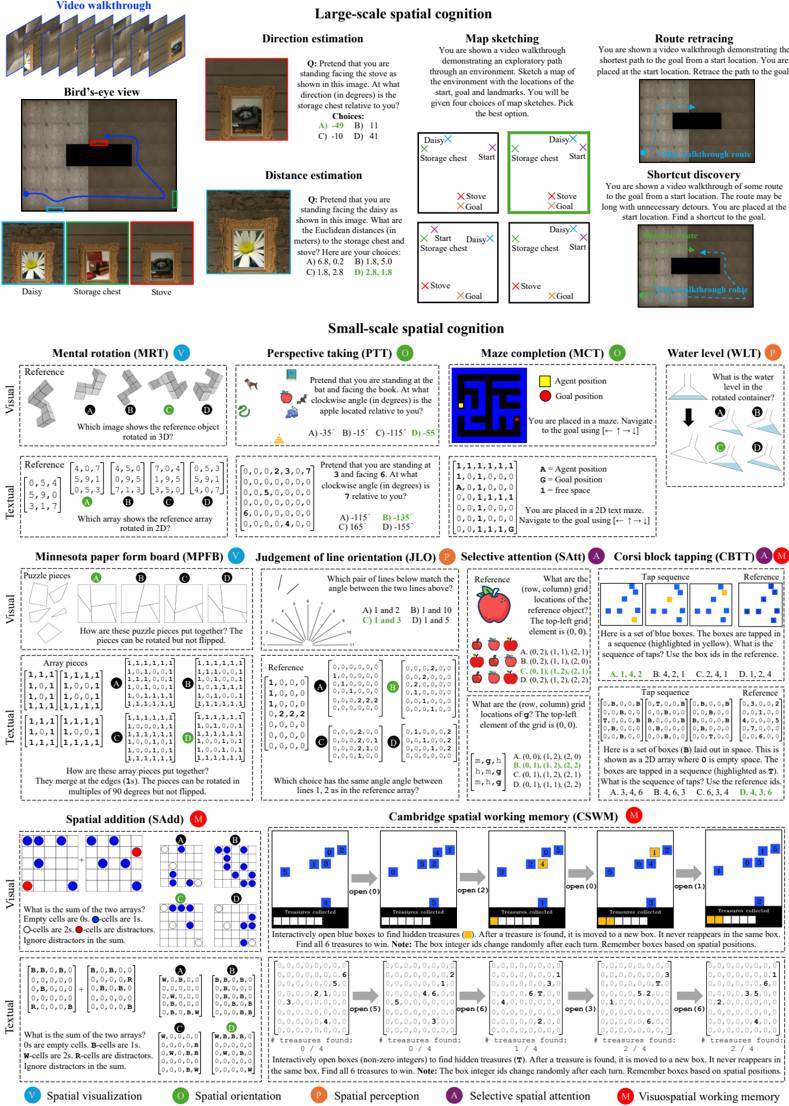
The image presents a collection of cognitive tasks designed to assess spatial cognition. These tasks are divided into two main categories: large-scale spatial cognition and small-scale spatial cognition. Each task is presented with a visual stimulus, a question or instruction, and multiple-choice answers.
### Components/Axes
**1. Large-scale spatial cognition:**
- **Direction estimation:** Assesses the ability to estimate directions relative to a given viewpoint.
- **Distance estimation:** Assesses the ability to estimate distances between objects in a scene.
- **Map sketching:** Assesses the ability to create a cognitive map of an environment.
- **Route retracing:** Assesses the ability to retrace a path in a virtual environment.
- **Shortcut discovery:** Assesses the ability to find shortcuts in a virtual environment.
**2. Small-scale spatial cognition:**
- **Mental rotation (MRT):** Assesses the ability to mentally rotate 3D objects.
- **Perspective taking (PTT):** Assesses the ability to take another person's perspective.
- **Maze completion (MCT):** Assesses the ability to navigate a maze.
- Legend: Yellow = Agent position, Red = Goal position, A = Agent position, G = Goal position, 1 = free space
- **Water level (WLT):** Assesses the understanding of water level in a rotated container.
- **Minnesota paper form board (MPFB):** Assesses the ability to mentally assemble 2D shapes.
- **Judgement of line orientation (JLO):** Assesses the ability to judge the orientation of lines.
- **Selective attention (SAtt):** Assesses the ability to selectively attend to specific objects in a visual scene.
- **Corsi block tapping (CBTT):** Assesses visuo-spatial working memory.
- **Spatial addition (SAdd):** Assesses the ability to perform spatial addition.
- **Cambridge spatial working memory (CSWM):** Assesses spatial working memory.
### Detailed Analysis
**Large-scale spatial cognition:**
* **Direction estimation:**
* Question: Pretend that you are standing facing the stove as shown in this image. At what direction (in degrees) is the storage chest relative to you?
* Choices: A) -49, B) 11, C) -10, D) 41
* **Distance estimation:**
* Question: Pretend that you are standing facing the daisy as shown in this image. What are the Euclidean distances (in meters) to the storage chest and stove? Here are your choices:
* Choices: A) 6.8, 0.2, B) 1.8, 5.0, C) 1.8, 2.8, D) 2.8, 1.8
* **Map sketching:**
* Description: You are shown a video walkthrough demonstrating an exploratory path through an environment. Sketch a map of the environment with the locations of the start, goal and landmarks. You will be given four choices of map sketches. Pick the best option.
* Four map options are presented, each showing the relative positions of "Daisy," "Storage chest," "Stove," "Start," and "Goal."
* **Route retracing:**
* Description: You are shown a video walkthrough demonstrating the shortest path to the goal from a start location. You are placed at the start location. Retrace the path to the goal.
* **Shortcut discovery:**
* Description: You are shown a video walkthrough of some route to the goal from a start location. The route may be long with unnecessary detours. You are placed at the start location. Find a shortcut to the goal.
**Small-scale spatial cognition:**
* **Mental rotation (MRT):**
* Visual: A reference 3D object is shown, along with four rotated versions (A, B, C, D).
* Question: Which image shows the reference object rotated in 3D?
* Textual: Arrays of numbers are presented, representing the reference object and the rotated versions.
* Question: Which array shows the reference array rotated in 2D?
* Reference array: `[[4,0,7],[0,5,4],[5,9,0],[3,1,7]]`
* Array A: `[[4,5,0],[5,9,1],[0,5,3],[7,1,3]]`
* Array B: `[[7,0,4],[0,9,5],[7,1,3],[3,5,0]]`
* Array C: `[[0,5,3],[1,9,5],[3,5,0],[4,0,7]]`
* Array D: `[[0,5,3],[5,9,1],[3,5,0],[4,0,7]]`
* **Perspective taking (PTT):**
* Visual: An image shows a bat, a book, and an apple.
* Question: Pretend that you are standing at the bat and facing the book. At what clockwise angle (in degrees) is the apple located relative to you?
* Choices: A) -35, B) -15, C) -115, D) -55
* Visual: A number 6 is shown.
* Question: Pretend that you are standing at 3 and facing 6. At what clockwise angle (in degrees) is 7 relative to you?
* Choices: A) -115, B) -135, C) 165, D) -155
* Textual: Arrays of numbers are presented.
* `[[0,0,2,3,0,7],[0,0,0,0,0,0,0],[5,0,0,0,0,0,0],[6,0,0,0,0,0,0],[0,0,0,0,4,0,0]]`
* **Maze completion (MCT):**
* Visual: A maze is shown, with a yellow square representing the agent's position and a red square representing the goal position.
* Instruction: You are placed in a maze. Navigate to the goal using [↑ → ↓ ←].
* Textual: A 2D text maze is presented.
* `[[1,1,1,1,1,1],[1,0,1,0,0,0],[A,0,1,0,0,0],[0,0,1,1,1,1],[0,0,1,0,0,0],[0,0,1,0,0,0],[0,0,1,1,1,G]]`
* Instruction: You are placed in a 2D text maze. Navigate to the goal using [↑ → ↓ ←].
* **Water level (WLT):**
* Visual: A rotated container is shown, along with four options (A, B, C, D) representing the water level.
* Question: What is the water level in the rotated container?
* **Minnesota paper form board (MPFB):**
* Visual: Puzzle pieces are shown.
* Question: How are these puzzle pieces put together? The pieces can be rotated but not flipped.
* Textual: Arrays of numbers are presented, representing the puzzle pieces.
* Question: How are these array pieces put together? They merge at the edges (1s). The pieces can be rotated in multiples of 90 degrees but not flipped.
* Array pieces:
* `[[1,1,1,1],[1,0,1,1],[1,0,1,1],[1,1,1,1]]`
* `[[1,1,1,1],[1,0,0,1],[1,0,0,1],[1,1,1,1]]`
* **Judgement of line orientation (JLO):**
* Visual: A reference angle is shown, along with multiple pairs of lines.
* Question: Which pair of lines below match the angle between the two lines above?
* Choices: A) 1 and 2, B) 1 and 10, C) 1 and 3, D) 1 and 5
* Textual: Arrays of numbers are presented, representing the line orientations.
* Question: Which choice has the same angle between lines 1, 2 as in the reference array?
* Reference array: `[[1,0,0,0],[1,0,0,0],[0,2,2,2],[0,0,0,0]]`
* **Selective attention (SAtt):**
* Visual: An image shows an apple and other objects.
* Question: What are the (row, column) grid locations of the reference object? The top-left grid element is (0, 0).
* Choices: A. (0, 2), (1, 1), (2, 1), B. (0, 2), (1, 1), (2, 0), C. (0, 1), (1, 2), (2, 1), D. (0, 2), (1, 2), (2, 2)
* Visual: An image shows g and other objects.
* Question: What are the (row, column) grid locations of g? The top-left element of the grid is (0, 0).
* Choices: A. (0, 0), (1, 2), (2, 0), B. (0, 1), (1, 2), (2, 2), C. (0, 1), (1, 2), (2, 1), D. (0, 1), (1, 1), (2, 2)
* **Corsi block tapping (CBTT):**
* Visual: A set of blue boxes is shown. The boxes are tapped in a sequence (highlighted in yellow).
* Question: What is the sequence of taps? Use the box ids in the reference.
* Choices: A. 1, 4, 2, B. 4, 2, 1, C. 2, 4, 1, D. 1, 2, 4
* Visual: A set of boxes (B) laid out in space. This is shown as a 2D array where 0 is empty space. The boxes are tapped in a sequence (highlighted as T).
* Question: What is the sequence of taps? Use the reference ids.
* Choices: A. 3, 4, 6, B. 4, 6, 3, C. 6, 3, 4, D. 4, 3, 6
* **Spatial addition (SAdd):**
* Visual: Two arrays are shown, with cells containing dots and distractors.
* Question: What is the sum of the two arrays? Empty cells are 0s. -cells are 1s. O-cells are 2s. -cells are distractors. Ignore distractors in the sum.
* Textual: Arrays of numbers are presented, representing the arrays.
* Question: What is the sum of the two arrays? 0s are empty cells. B-cells are 1s. W-cells are 2s. R-cells are distractors. Ignore distractors in the sum.
* **Cambridge spatial working memory (CSWM):**
* Visual: A series of open blue boxes are shown, with treasures hidden inside.
* Description: Interactively open blue boxes to find hidden treasures. After a treasure is found, it is moved to a new box. It never reappears in the same box. Note: The box integer ids change randomly after each turn. Remember boxes based on spatial positions. Find all 6 treasures to win.
* Textual: The number of treasures found is displayed.
* Description: Interactively open boxes (non-zero integers) to find hidden treasures (T). After a treasure is found, it is moved to a new box. Find all 6 treasures to win. Note: The box integer ids change randomly after each turn. Remember boxes based on spatial positions.
### Key Observations
* The tasks cover a wide range of spatial cognitive abilities, from large-scale navigation to small-scale object manipulation.
* The tasks use a variety of visual stimuli, including images, diagrams, and text.
* The tasks are presented with clear instructions and multiple-choice answers.
### Interpretation
The collection of tasks provides a comprehensive assessment of spatial cognitive abilities. The tasks are designed to measure different aspects of spatial cognition, such as spatial orientation, spatial visualization, spatial memory, and spatial reasoning. The results of these tasks can be used to identify individuals with spatial cognitive deficits or to track changes in spatial cognitive abilities over time. The tasks are relevant to a variety of real-world activities, such as navigation, object manipulation, and problem-solving.
DECODING INTELLIGENCE...