## Diagram: Spatial Cognition Tasks & fMRI Activation
### Overview
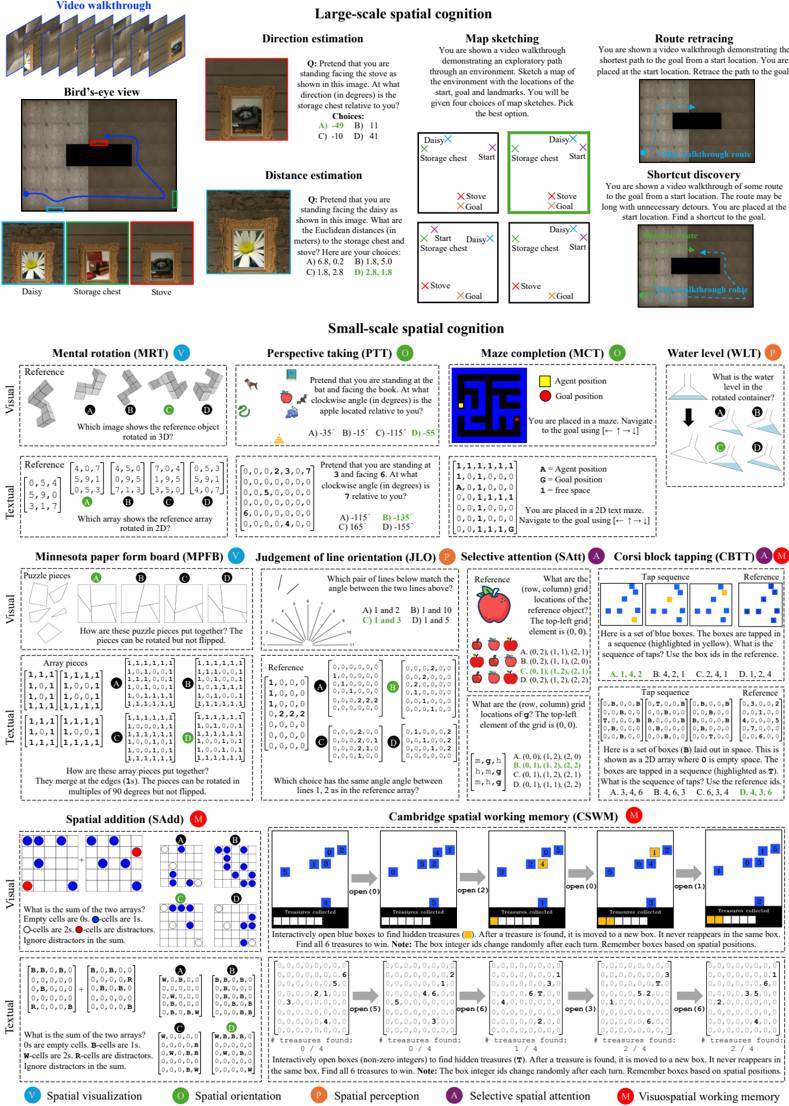
This diagram presents a series of spatial cognition tasks used in an fMRI study, along with corresponding brain activation maps. The tasks are categorized into Large-scale and Small-scale spatial cognition, and further subdivided into specific tests. Each task description is accompanied by a representative brain activation map showing areas of significant activity (red/yellow). The bottom section details the fMRI parameters used in the study.
### Components/Axes
The diagram is structured into several sections:
* **Header:** "Spatial Cognition Tasks & fMRI Activation"
* **Large-scale spatial cognition:** Includes Bird's-eye view, Direction estimation, Distance estimation, Map sketching, and Route retracing.
* **Small-scale spatial cognition:** Includes Mental rotation (MRT), Perspective taking (PTD), Maze completion (MCT), and Water level (WLT).
* **fMRI Parameters:** Details about the scanner, slice thickness, TR, TE, and number of volumes.
* **Brain Activation Maps:** Each task has a corresponding brain activation map displayed in a standardized brain template.
* **Activation Scale:** A color scale indicating the level of activation (from low to high).
### Detailed Analysis or Content Details
**Large-scale spatial cognition:**
* **Bird's-eye view:** Image showing Daisy, Storage chest, and Stove.
* **Direction estimation:** Question: "Pretend you are standing facing the stove as shown in this image. At what direction (in degrees) is the storage chest relative to you?" Choices: A) -10° B) 11° C) 31° D) 41°.
* **Distance estimation:** Question: "Pretend you are standing facing the stove as shown in this image. What is the approximate distance (in meters) to the storage chest and stove?" Choices: A) 1.5, 2.5 B) 1.5, 3.0 C) 1.8, 2.5 D) 1.8, 3.0.
* **Map sketching:** "You are shown a video walkthrough demonstrating the layout of the environment with the locations of the stove, storage chest, and goal. Pick the best option." Four map sketches are shown.
* **Route retracing:** "You are shown videos retracing demonstrating the shortest path to the goal from the start location. Retrace the path to the goal." Image of a walkthrough route.
**Small-scale spatial cognition:**
* **Mental rotation (MRT):** Image showing a reference object and four rotated versions. Question: "Which image shows the reference object rotated in 31°?"
* **Perspective taking (PTD):** Question: "Pretend that you are standing at the bottom of the structure as shown in this image. At what elevation angle (in degrees) do you see the stove relative to you?" Choices: A) 15° B) 30° C) 45° D) 60°.
* **Maze completion (MCT):** "You are placed in a maze. Navigate to the goal position." Image of a maze with "Agent position" and "Goal position" marked.
* **Water level (WLT):** Question: "What is the water level in the pool compared to the roof?" Choices: A) Lower B) Same C) Higher. Image of a building with a pool.
**fMRI Parameters:**
* **Scanner:** 3T Siemens Prisma
* **Slice thickness:** 3 mm
* **TR:** 2 s
* **TE:** 30 ms
* **Volumes:** 350
**Brain Activation Maps:**
Each task has a corresponding brain activation map. The maps show areas of significant activation in red and yellow, with the intensity of the color representing the level of activation. The brain template is in a standardized orientation (left is left). The activation scale is shown at the bottom right, ranging from approximately 0 to 4.5.
### Key Observations
* The activation maps vary significantly across tasks, suggesting that different spatial cognition processes engage distinct brain regions.
* Commonly activated areas include the parietal lobe, frontal lobe, and temporal lobe.
* The fMRI parameters are standard for a 3T scanner.
* The tasks are designed to isolate different aspects of spatial cognition, ranging from large-scale navigation to small-scale object manipulation.
* The questions in the tasks are multiple choice, suggesting a controlled experimental setup.
### Interpretation
This diagram illustrates an fMRI study investigating the neural basis of spatial cognition. The researchers used a series of carefully designed tasks to probe different aspects of spatial processing, and then used fMRI to identify the brain regions involved in each task. The varying activation patterns suggest that spatial cognition is not a single process, but rather a collection of distinct cognitive operations. The study provides insights into how the brain represents and processes spatial information, which is crucial for everyday activities such as navigation, object recognition, and manipulation. The use of both large-scale and small-scale tasks allows for a comprehensive understanding of the neural mechanisms underlying spatial cognition. The fMRI parameters are standard, ensuring the reliability and validity of the results. The multiple-choice format of the tasks likely helps to control for individual differences in strategy and performance. The diagram is a clear and concise representation of the study's design and findings.