## Diagram: Spatial Cognition Assessment Tasks
### Overview
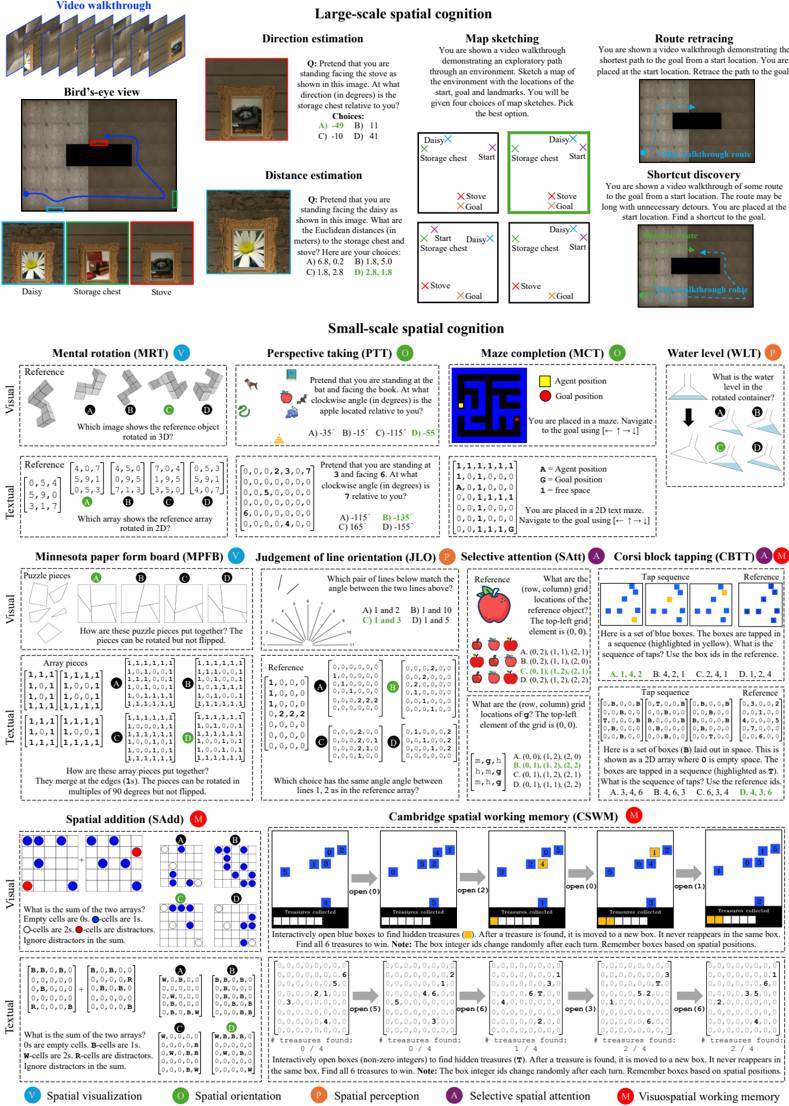
The image depicts a structured diagram categorizing spatial cognition tasks into two primary domains: **Large-scale spatial cognition** and **Small-scale spatial cognition**, with additional specialized tasks. Each task includes a visual component, a question/instruction, and sometimes a legend or color-coded elements. The diagram is organized hierarchically, with tasks grouped by cognitive domain and complexity.
---
### Components/Axes
#### **Large-scale spatial cognition**
1. **Direction estimation**
- Visual: A room with a storage chest and a person facing it.
- Text: *"At what direction (in degrees) is the storage chest relative to you?"*
- Choices: A) -49°, B) 11°, C) -10°, D) 41°.
2. **Distance estimation**
- Visual: A room with a daisy, storage chest, and stove.
- Text: *"What are the Euclidean distances (in meters) to the storage chest and stove?"*
- Choices: A) 6.8, 0.2; B) 1.8, 5.0; C) 1.8, 2.8; D) 2.8, 1.8.
3. **Map sketching**
- Visual: A room with a daisy, storage chest, and stove.
- Text: *"Sketch the environment with the locations of the start, goal, and landmarks."*
- Choices: Four map options with varying object placements.
4. **Route retracing**
- Visual: A room with a storage chest and a person facing it.
- Text: *"Retrace the shortest path to the goal from the start location."*
- Visual: A dotted blue line indicating the route.
5. **Shortcut discovery**
- Visual: A room with a storage chest and a person facing it.
- Text: *"Find a shortcut to the goal from the start location."*
- Visual: A dotted green line indicating the shortcut.
#### **Small-scale spatial cognition**
1. **Perspective taking (PT)**
- Visual: A person facing a book with an apple and banana.
- Text: *"At what clockwise angle (in degrees) is the apple located relative to you?"*
- Choices: A) -35°, B) -15°, C) -115°, D) -55°.
2. **Maze completion (MCT)**
- Visual: A blue maze with a yellow agent and red goal.
- Text: *"Navigate to the goal using [↑ ↓ ↙ ↘]."*
- Grid: 5x5 maze with agent (yellow) and goal (red).
3. **Water level (WLT)**
- Visual: A tilted container with water.
- Text: *"What is the water level in the rotated container?"*
- Choices: A, B, C, D (visual representations of water levels).
#### **Specialized tasks**
1. **Mental rotation (MRT)**
- Visual: A 3D object (e.g., a zigzag shape) rotated in different orientations.
- Text: *"Which image shows the reference object rotated in 3D?"*
- Choices: A, B, C, D (rotated versions of the reference).
2. **Minnesota paper form board (MPFB)**
- Visual: Puzzle pieces labeled A, B, C, D.
- Text: *"How are these puzzle pieces put together? The pieces can be rotated but not flipped."*
3. **Judgment of line orientation (JLO)**
- Visual: Lines with angles labeled 1, 2, 3, 5, 10.
- Text: *"Which pair of lines below match the angle between the two lines above?"*
- Choices: A) 1 and 2; B) 1 and 10; C) 1 and 3; D) 1 and 5.
4. **Selective attention (SAtt)**
- Visual: A grid with red apples and blue boxes.
- Text: *"What are the locations of the top-left element of the grid (0, 0)?"*
- Grid: 3x3 grid with apples (red) and boxes (blue).
5. **Corsi block tapping (CBTT)**
- Visual: A sequence of blue boxes tapped in a specific order.
- Text: *"What is the sequence of taps? Use the box ids in the reference."*
- Choices: A) 1, 4, 2; B) 4, 2, 1; C) 4, 4, 1; D) 1, 2, 4.
6. **Spatial addition (SAdd)**
- Visual: Grids with blue and red circles.
- Text: *"What is the sum of the two arrays? Empty cells are 0s. Blue cells are 1s. Red cells are distractors."*
- Choices: A, B, C, D (summed values).
7. **Cambridge spatial working memory (CSWM)**
- Visual: A grid with blue boxes and yellow treasures.
- Text: *"Find all 6 treasures to win. After a treasure is found, it is moved to a new box."*
- Instructions: *"Remember boxes based on spatial positions."*
---
### Detailed Analysis
- **Large-scale tasks** focus on navigation, spatial reasoning, and environmental mapping (e.g., direction, distance, map sketching).
- **Small-scale tasks** emphasize object manipulation, perspective-taking, and memory (e.g., maze navigation, water level estimation).
- **Specialized tasks** test specific cognitive skills like mental rotation, puzzle assembly, and selective attention.
- **Color coding**: Blue (start), green (goal), red (distractors), yellow (treasures).
---
### Key Observations
1. **Task complexity**: Tasks progress from basic spatial estimation (direction/distance) to complex problem-solving (maze navigation, puzzle assembly).
2. **Visual-textual integration**: Each task combines a visual stimulus with a textual question, requiring cross-modal processing.
3. **Distractors**: Red elements (e.g., in SAdd) are explicitly labeled as distractors, testing attention control.
4. **Dynamic elements**: CSWM introduces a dynamic component where treasures move after being found.
---
### Interpretation
This diagram represents a comprehensive assessment tool for evaluating spatial cognition across multiple domains. The tasks are designed to measure:
- **Large-scale cognition**: Navigation, environmental mapping, and route planning.
- **Small-scale cognition**: Object manipulation, perspective-taking, and memory.
- **Specialized skills**: Mental rotation, attention, and working memory.
The inclusion of both visual and textual components suggests the tool assesses how individuals integrate spatial information across modalities. The dynamic nature of CSWM highlights the importance of adaptive spatial memory in real-world scenarios.
**Notable patterns**:
- Tasks with higher cognitive demand (e.g., CSWM, MPFB) involve more complex instructions and dynamic elements.
- Color coding is consistently used to denote key elements (e.g., start, goal, distractors), aiding in task clarity.
**Why it matters**:
This framework provides a structured way to evaluate spatial cognition, which is critical for applications in psychology, education, and human-computer interaction. The tasks mirror real-world challenges, making them relevant for assessing spatial reasoning in diverse populations.