## Line Graph: Network Protocol Performance Analysis
### Overview
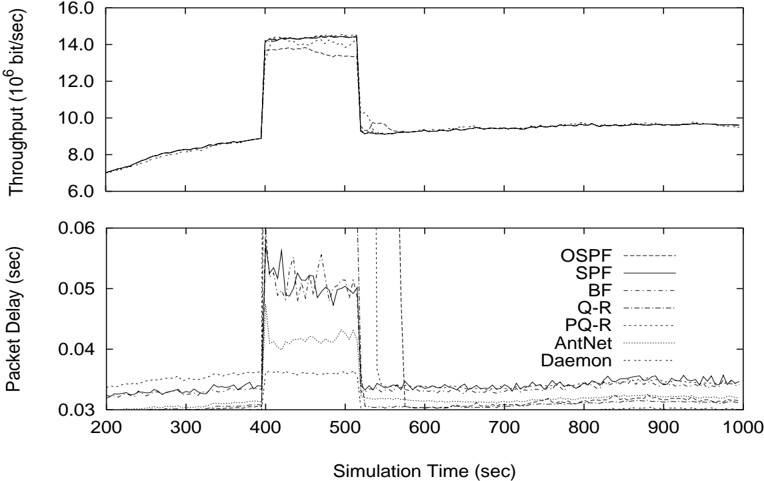
The image contains two vertically stacked line graphs comparing network protocol performance metrics over simulation time. The top graph measures throughput (10⁶ bit/sec), while the bottom graph measures packet delay (seconds). Seven protocols are compared using distinct line styles, with a legend on the right side.
### Components/Axes
- **X-axis (Both Graphs):** Simulation Time (sec) ranging from 200 to 1000 in 100-second increments
- **Y-axis (Top Graph):** Throughput (10⁶ bit/sec) from 6.0 to 16.0
- **Y-axis (Bottom Graph):** Packet Delay (sec) from 0.03 to 0.06
- **Legend (Right Side):**
- OSPF: Solid line
- SPF: Dashed line
- BF: Dotted line
- Q-R: Dash-dot line
- PQ-R: Dotted-dash line
- AntNet: Double-dotted line
- Daemon: Triple-dotted line
### Detailed Analysis
**Top Graph (Throughput):**
- All protocols start at ~6.0×10⁶ bit/sec at 200s
- OSPF (solid) shows sharpest rise to 14.0×10⁶ bit/sec at 400s
- SPF (dashed) peaks at 13.5×10⁶ bit/sec at 400s
- BF (dotted) reaches 12.8×10⁶ bit/sec at 400s
- Q-R (dash-dot) plateaus at 12.2×10⁶ bit/sec
- PQ-R (dotted-dash) shows gradual increase to 11.8×10⁶ bit/sec
- AntNet (double-dotted) remains flat at 11.5×10⁶ bit/sec
- Daemon (triple-dotted) shows minimal increase to 11.2×10⁶ bit/sec
**Bottom Graph (Packet Delay):**
- All protocols start at ~0.03 sec at 200s
- OSPF (solid) shows minimal fluctuation (0.03-0.035 sec)
- SPF (dashed) fluctuates between 0.032-0.038 sec
- BF (dotted) shows moderate spikes (0.035-0.042 sec)
- Q-R (dash-dot) exhibits significant volatility (0.038-0.052 sec)
- PQ-R (dotted-dash) demonstrates erratic behavior (0.04-0.055 sec)
- AntNet (double-dotted) maintains stable 0.038-0.041 sec
- Daemon (triple-dotted) shows highest delay (0.045-0.058 sec)
### Key Observations
1. **Performance Correlation:** Protocols with higher throughput generally exhibit lower packet delay
2. **OSPF Dominance:** Achieves highest throughput (14.0×10⁶ bit/sec) with lowest delay (0.03-0.035 sec)
3. **Daemon Struggles:** Lowest throughput (11.2×10⁶ bit/sec) with highest delay (0.045-0.058 sec)
4. **Volatility Pattern:** Protocols with more complex line styles (Q-R, PQ-R) show greater performance instability
5. **Simulation Artifacts:** Sharp throughput drop at 500s correlates with packet delay spikes across all protocols
### Interpretation
The data suggests OSPF demonstrates optimal network performance characteristics, maintaining high throughput while minimizing packet delay. Daemon protocol exhibits poor scalability, with both throughput and delay metrics significantly underperforming compared to other protocols. The correlation between throughput and delay indicates that efficient protocols maintain better network stability under load. The volatility observed in Q-R and PQ-R protocols suggests potential implementation challenges or sensitivity to network conditions. The sharp performance drop at 500s simulation time may indicate a network congestion event or protocol-specific limitation that warrants further investigation.