## Flowchart: Static Analysis Tools Workflow
### Overview
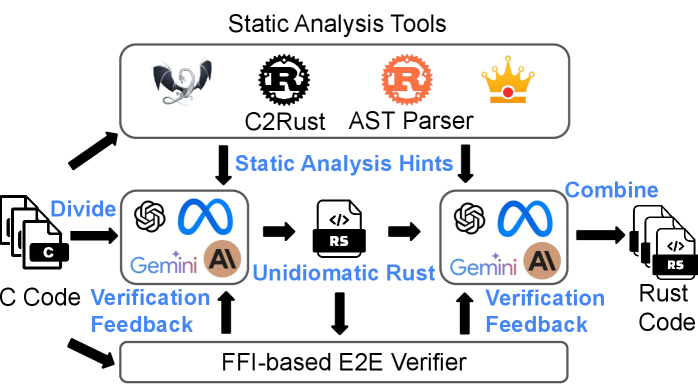
The flowchart illustrates a multi-stage process for static code analysis and verification, integrating tools like C2Rust, AST Parser, and Gemini AI. It emphasizes feedback loops between static analysis hints, code division, and verification to produce Rust code validated by an FFI-based E2E Verifier.
### Components/Axes
- **Main Title**: "Static Analysis Tools" (top-center).
- **Key Boxes**:
1. **Static Analysis Tools**: Contains icons for C2Rust (black dragon), AST Parser (gear with "R"), and a crown (orange).
2. **Static Analysis Hints**: Arrows from the main box to "Gemini AI" and "Unidiomatic Rust."
3. **Gemini AI**: Labeled with a blue infinity symbol and "AI" (bottom-left).
4. **Unidiomatic Rust**: Contains an RSI file icon (center).
5. **FFI-based E2E Verifier**: Bottom-most box, receiving feedback from both Gemini AI and Unidiomatic Rust.
- **Arrows**:
- "Divide" (left arrow from C Code to Gemini AI/Unidiomatic Rust).
- "Combine" (right arrow from Gemini AI/Unidiomatic Rust to Rust Code).
- "Verification Feedback" (upward arrows from both Gemini AI and Unidiomatic Rust to the FFI-based E2E Verifier).
### Detailed Analysis
- **C Code Input**: Divided into two paths:
- **Gemini AI**: Processes code with verification feedback.
- **Unidiomatic Rust**: Processes code with RSI file output and verification feedback.
- **Rust Code Output**: Generated by combining results from Gemini AI and Unidiomatic Rust.
- **FFI-based E2E Verifier**: Receives feedback from both paths, ensuring end-to-end validation.
### Key Observations
- **Feedback Loops**: Both Gemini AI and Unidiomatic Rust contribute verification feedback to the FFI-based E2E Verifier, suggesting iterative refinement.
- **Tool Integration**: C2Rust and AST Parser are upstream tools feeding into the analysis hints.
- **Dual Paths**: Code is split for parallel processing (Gemini AI vs. Unidiomatic Rust), then merged for final output.
### Interpretation
This workflow demonstrates a hybrid approach to static analysis:
1. **Toolchain Synergy**: C2Rust and AST Parser provide foundational analysis, while Gemini AI introduces AI-driven insights.
2. **Code Refinement**: Dividing code into Gemini AI (likely for high-level feedback) and Unidiomatic Rust (for syntax/idiom checks) allows targeted improvements.
3. **Verification Rigor**: The FFI-based E2E Verifier acts as a gatekeeper, ensuring combined outputs meet cross-platform/interoperability standards.
4. **Unidiomatic Rust’s Role**: The RSI file icon suggests a focus on Rust-specific idioms, possibly flagging non-idiomatic patterns for correction.
The process emphasizes modularity, with static analysis tools and AI working in tandem to produce verified, idiomatic Rust code. The crown icon in the Static Analysis Tools box may symbolize "gold-standard" quality assurance.