## Diagram: Static Analysis Workflow
### Overview
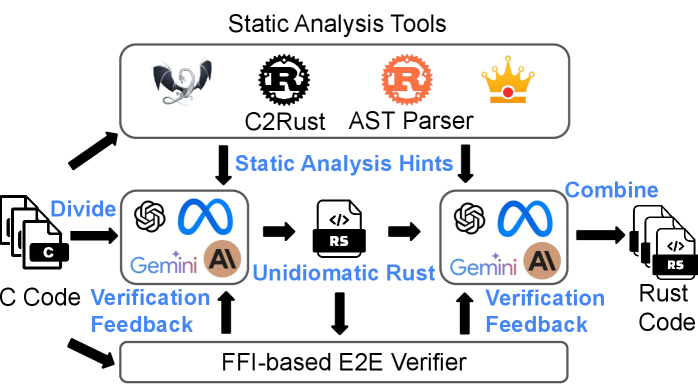
The image depicts a workflow diagram for static analysis of C code and its translation to Rust code. It involves static analysis tools, AI models (Gemini), and an FFI-based end-to-end verifier.
### Components/Axes
* **Title:** Static Analysis Tools
* **Elements:**
* Dragon Icon (Likely representing a static analysis tool)
* C2Rust Logo
* AST Parser
* Crown Icon (Likely representing a static analysis tool)
* **Static Analysis Hints:** Text label indicating the output from the static analysis tools.
* **C Code:** Input C code files.
* **Divide:** Label indicating the action of dividing the C code.
* **Gemini AI:** Represents the Gemini AI model, with logos for OpenAI and Meta AI.
* **Unidiomatic Rust:** Rust code generated by the AI model.
* **Rust Code:** Output Rust code files.
* **Combine:** Label indicating the action of combining the Rust code.
* **Verification Feedback:** Feedback loop from the FFI-based verifier to the Gemini AI model.
* **FFI-based E2E Verifier:** End-to-end verifier using Foreign Function Interface (FFI).
### Detailed Analysis
1. **Top Section: Static Analysis Tools**
* The top section represents static analysis tools. It includes a dragon icon, the C2Rust logo, "AST Parser", and a crown icon. These tools provide "Static Analysis Hints" to the AI model.
2. **Middle Section: C to Rust Translation**
* C code files are input and "Divided" into smaller chunks.
* These chunks are fed into the Gemini AI model, which translates them into "Unidiomatic Rust".
* The Unidiomatic Rust code is then "Combined" to produce the final "Rust Code" output.
3. **Bottom Section: Verification**
* The "FFI-based E2E Verifier" provides "Verification Feedback" to the Gemini AI model, improving the translation process.
### Key Observations
* The diagram illustrates a process where C code is automatically translated to Rust code using AI and static analysis.
* The FFI-based verifier plays a crucial role in ensuring the correctness of the translated Rust code.
* The use of static analysis tools provides hints to the AI model, potentially improving the quality of the translation.
### Interpretation
The diagram presents a system for automatically translating C code to Rust code. The process leverages static analysis tools to provide hints to an AI model (Gemini), which performs the translation. The FFI-based end-to-end verifier ensures the correctness of the translated code by providing feedback to the AI model. This approach aims to automate the process of migrating C codebases to Rust, potentially reducing development time and improving code safety. The "Unidiomatic Rust" label suggests that the initial translation may not be perfectly idiomatic, but the verification feedback loop helps refine the code over time.