\n
## Diagram: C to Rust Code Conversion Process
### Overview
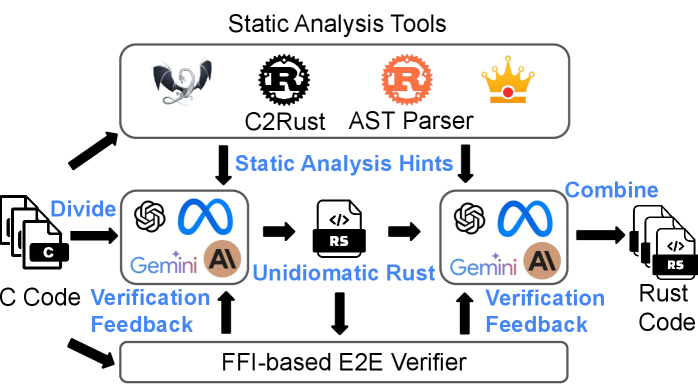
This diagram illustrates a process for converting C code to Rust code, utilizing static analysis tools, an AST parser, and a feedback loop for verification. The process involves dividing C code, converting it to idiomatic Rust, and then verifying the conversion using an FFI-based end-to-end (E2E) verifier. Gemini AI is used to provide verification feedback.
### Components/Axes
The diagram can be divided into three main sections:
1. **Header:** "Static Analysis Tools" containing icons representing different tools.
2. **Main Flow:** The core conversion process with arrows indicating the flow of code and feedback.
3. **Footer:** "FFI-based E2E Verifier"
The key components are:
* C Code
* C2Rust AST Parser
* Unidiomatic Rust
* Rust Code
* Gemini AI (Verification Feedback)
* FFI-based E2E Verifier
The diagram uses arrows to indicate the direction of the process flow.
### Detailed Analysis or Content Details
The process begins with "C Code" (represented by a file icon with a "C" inside) which is "Divided" and sent to the "C2Rust AST Parser". The parser is represented by a rectangular box containing four icons:
* A penguin-like icon (likely representing a specific tool)
* An "R" icon with a curly brace
* An "R" icon with a crown
* A crown icon
The output of the parser is "Static Analysis Hints" which are sent to "Unidiomatic Rust" (represented by a code block icon with "</> RS"). Gemini AI provides "Verification Feedback" to both the C Code and the Unidiomatic Rust. The Unidiomatic Rust is then converted to "Rust Code" (represented by a code block icon with "</> RS"). Gemini AI also provides "Verification Feedback" to the Rust Code. Finally, the Rust Code is "Combined" with the initial C Code through a feedback loop. The entire process is verified by the "FFI-based E2E Verifier" (represented by a rectangular box).
The arrows indicate the following flow:
* C Code -> C2Rust AST Parser
* C2Rust AST Parser -> Static Analysis Hints -> Unidiomatic Rust
* Unidiomatic Rust -> Rust Code
* C Code <- Verification Feedback (from Gemini AI)
* Unidiomatic Rust <- Verification Feedback (from Gemini AI)
* Rust Code <- Verification Feedback (from Gemini AI)
* Rust Code -> Combined with C Code
### Key Observations
The diagram highlights a cyclical process with feedback loops, suggesting an iterative refinement approach to code conversion. The use of Gemini AI for verification feedback indicates an attempt to automate and improve the quality of the conversion. The FFI-based E2E verifier suggests a focus on ensuring functional equivalence between the original C code and the converted Rust code.
### Interpretation
The diagram demonstrates a sophisticated approach to converting C code to Rust, going beyond a simple translation. The inclusion of static analysis, an AST parser, and a verification loop suggests a focus on producing high-quality, idiomatic Rust code. The use of Gemini AI for feedback indicates an attempt to leverage machine learning to improve the conversion process. The FFI-based E2E verifier is crucial for ensuring that the converted Rust code behaves identically to the original C code, which is essential for maintaining functionality and avoiding regressions. The diagram suggests a complex system designed to minimize errors and maximize the quality of the converted code. The cyclical nature of the process implies that the conversion is not a one-time event but rather an iterative process of refinement and verification.