\n
## Diagram: Logical Fallacies & Argument Structure
### Overview
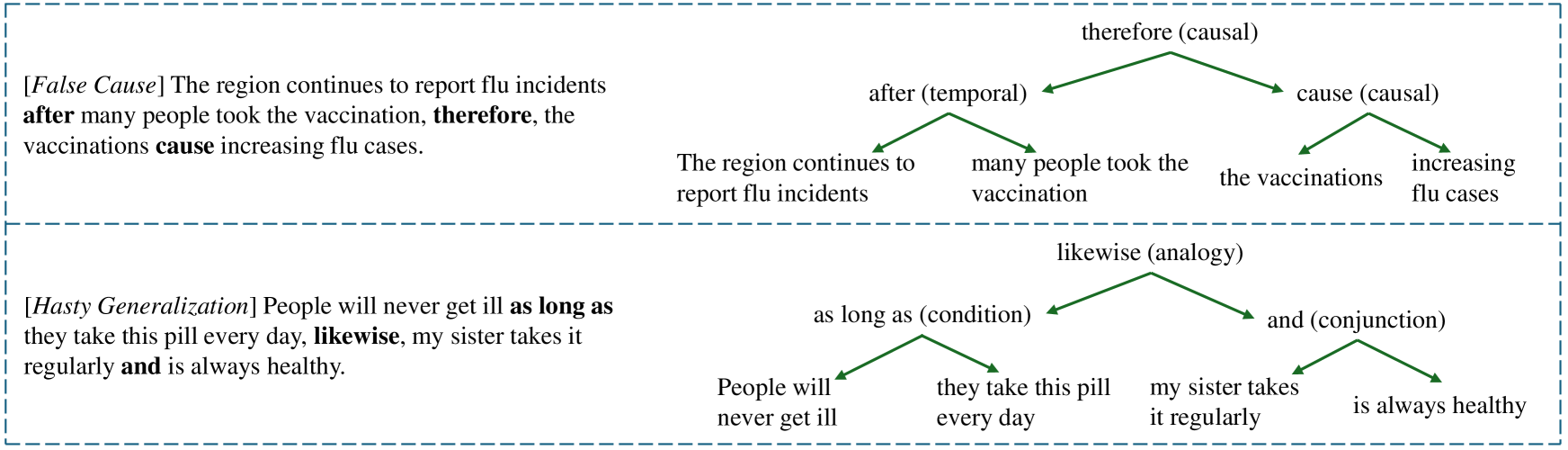
The image presents a diagram illustrating two common logical fallacies: "False Cause" and "Hasty Generalization". Each fallacy is presented with an example sentence and a corresponding tree diagram representing its logical structure. The diagrams visually break down the relationships between the components of each argument, highlighting the flawed reasoning.
### Components/Axes
The diagram is divided into two main sections, each enclosed in a dashed-line rectangle.
* **Top Section:** Illustrates "False Cause" with the example: "The region continues to report flu incidents after many people took the vaccination, therefore, the vaccinations cause increasing flu cases."
* **Bottom Section:** Illustrates "Hasty Generalization" with the example: "People will never get ill as long as they take this pill every day, likewise, my sister takes it regularly and is always healthy."
Each section contains:
* A descriptive title in brackets (e.g., "[False Cause]")
* An example sentence demonstrating the fallacy.
* A tree diagram showing the relationships between the sentence's components.
* Labels indicating the type of logical connection between components (e.g., "therefore (causal)", "as long as (condition)").
### Detailed Analysis or Content Details
**1. False Cause Fallacy:**
* **Example Sentence:** "The region continues to report flu incidents after many people took the vaccination, therefore, the vaccinations cause increasing flu cases."
* **Tree Diagram:**
* **Root:** "therefore (causal)"
* **Branches:**
* "The region continues to report flu incidents"
* "many people took the vaccination"
* "increasing flu cases"
* **Intermediate Connections:**
* "after (temporal)" connects "many people took the vaccination" to "The region continues to report flu incidents"
* "cause (causal)" connects "the vaccinations" to "increasing flu cases"
**2. Hasty Generalization Fallacy:**
* **Example Sentence:** "People will never get ill as long as they take this pill every day, likewise, my sister takes it regularly and is always healthy."
* **Tree Diagram:**
* **Root:** "likewise (analogy)"
* **Branches:**
* "People will never get ill"
* "they take this pill every day"
* "my sister takes it regularly"
* "is always healthy"
* **Intermediate Connections:**
* "as long as (condition)" connects "People will never get ill" to "they take this pill every day"
* "and (conjunction)" connects "my sister takes it regularly" to "is always healthy"
### Key Observations
* The diagrams clearly show how the fallacies create flawed connections between events.
* The "False Cause" diagram highlights a temporal sequence being misinterpreted as a causal relationship.
* The "Hasty Generalization" diagram demonstrates drawing a broad conclusion based on limited evidence (a single anecdotal case).
* The use of tree diagrams effectively visualizes the structure of the arguments and the points where the logic breaks down.
### Interpretation
The diagram serves as an educational tool to illustrate common logical fallacies. It demonstrates how seemingly reasonable arguments can be flawed due to incorrect reasoning. The "False Cause" example points out the danger of assuming correlation implies causation. The "Hasty Generalization" example shows the limitations of drawing conclusions from personal experience or small sample sizes. The diagram's structure, using tree diagrams, is effective in breaking down complex arguments into their constituent parts, making it easier to identify the flawed logic. The use of specific examples makes the concepts more relatable and understandable. The diagram is not presenting data, but rather illustrating concepts. It is a visual aid for understanding the structure of arguments and identifying logical errors.