## Logical Fallacy Diagram: Textual Analysis of Causal and Analogical Reasoning Errors
### Overview
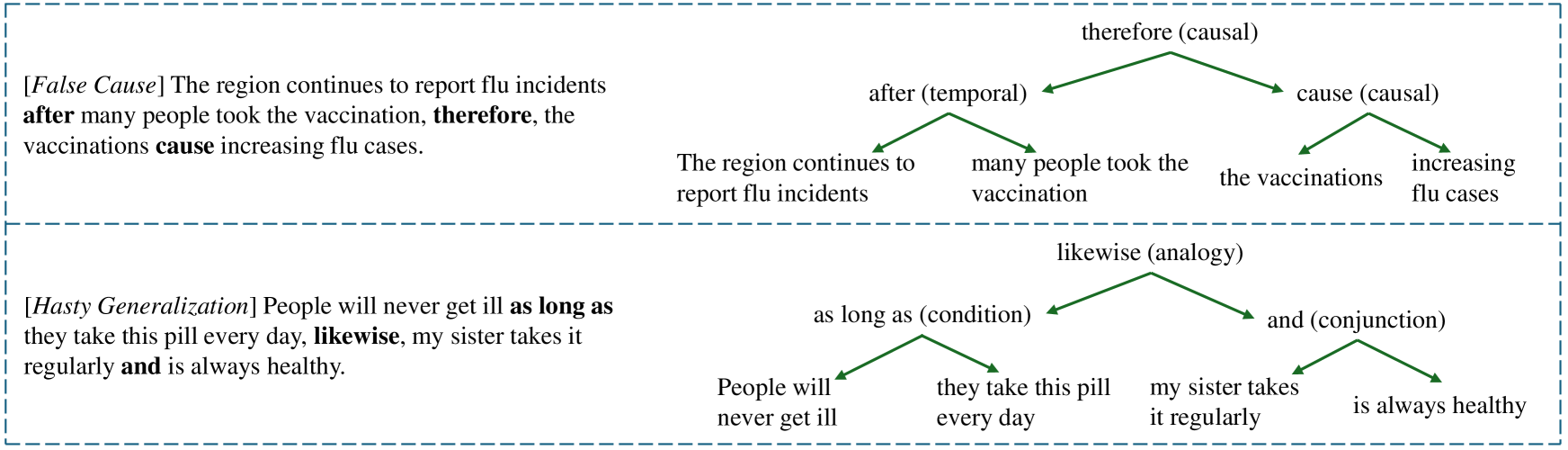
The image presents two examples of logical fallacies ("False Cause" and "Hasty Generalization") with accompanying diagrams illustrating their flawed reasoning structures. Each fallacy is broken down into premise components connected by labeled arrows showing logical relationships.
### Components/Axes
**False Cause Fallacy:**
- **Premise:** "The region continues to report flu incidents after many people took the vaccination"
- **Conclusion:** "therefore, the vaccinations cause increasing flu cases"
- **Logical Connectors:**
- `after (temporal)` → connects "report flu incidents" to "many people took the vaccination"
- `therefore (causal)` → connects premise to conclusion
- `cause (causal)` → connects "vaccinations" to "increasing flu cases"
**Hasty Generalization Fallacy:**
- **Premise:** "People will never get ill as long as they take this pill every day"
- **Analogy:** "likewise, my sister takes it regularly and is always healthy"
- **Logical Connectors:**
- `as long as (condition)` → connects "never get ill" to "take this pill every day"
- `likewise (analogy)` → connects main premise to analogy
- `and (conjunction)` → connects "takes it regularly" to "is always healthy"
### Detailed Analysis
**False Cause Diagram:**
1. Temporal relationship (`after`) incorrectly implies causation between vaccination uptake and flu incidence
2. Causal chain (`therefore → cause`) falsely attributes flu increase to vaccinations
3. Spatial grounding: Arrows flow left→right, with causal connections positioned at the top of the diagram
**Hasty Generalization Diagram:**
1. Conditional relationship (`as long as`) creates a false guarantee of health from pill consumption
2. Analogical connection (`likewise`) improperly extends a personal anecdote to a universal claim
3. Conjunction (`and`) falsely links regularity of pill-taking to health outcomes
4. Spatial grounding: Arrows branch downward from the main premise, with analogy components positioned at the bottom
### Key Observations
- Both fallacies misuse logical connectors to create invalid conclusions
- Temporal correlation is misinterpreted as causation in the first example
- Personal anecdote is inappropriately generalized in the second example
- All logical connectors (therefore, cause, likewise, as long as, and) are explicitly labeled
- Diagrams use consistent arrow directionality (left→right for premises→conclusion, branching for analogies)
### Interpretation
This visualization demonstrates how flawed reasoning structures can be systematically analyzed:
1. **Causal Fallacy Mechanism:** Shows how temporal proximity (`after`) is erroneously converted to causation through `therefore` and `cause` connectors
2. **Analogical Fallacy Mechanism:** Illustrates how personal experience (`likewise`) is improperly scaled to universal claims through `and` conjunctions
3. **Structural Vulnerability:** Both diagrams reveal how logical connectors can be misapplied to create false equivalences or unwarranted generalizations
4. **Educational Value:** The explicit labeling of fallacy types and connectors provides a template for identifying similar errors in real-world arguments
The diagrams serve as educational tools for critical thinking, exposing the gap between apparent surface logic and valid reasoning structures.