## Sudoku Grid: 9x9 Number Puzzle
### Overview
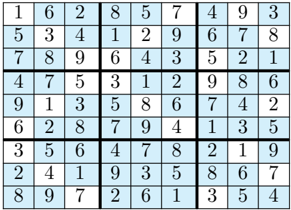
The image depicts a completed 9x9 Sudoku grid with numbers 1-9 arranged in rows, columns, and 3x3 subgrids. Each row, column, and subgrid contains unique numbers without repetition. The grid is visually segmented into 9 rows, 9 columns, and 9 3x3 subgrids, with numbers displayed in black text on alternating blue and white cells for readability.
### Components/Axes
- **Rows**: 9 horizontal lines labeled implicitly by position (top to bottom).
- **Columns**: 9 vertical lines labeled implicitly by position (left to right).
- **Subgrids**: 9 non-overlapping 3x3 blocks (e.g., top-left, middle-center, bottom-right).
- **Color Coding**: Alternating blue and white cells for visual separation (no explicit legend provided).
### Detailed Analysis
#### Row-by-Row Breakdown
1. **Row 1**: `1, 6, 2, 8, 5, 7, 4, 9, 3`
2. **Row 2**: `5, 3, 4, 1, 2, 9, 6, 7, 8`
3. **Row 3**: `7, 8, 9, 6, 4, 3, 5, 2, 1`
4. **Row 4**: `4, 7, 5, 3, 1, 2, 9, 8, 6`
5. **Row 5**: `9, 1, 3, 5, 8, 6, 7, 4, 2`
6. **Row 6**: `6, 2, 8, 7, 9, 4, 1, 3, 5`
7. **Row 7**: `3, 5, 6, 4, 7, 8, 2, 1, 9`
8. **Row 8**: `2, 4, 1, 9, 3, 5, 8, 6, 7`
9. **Row 9**: `8, 9, 7, 2, 6, 1, 3, 5, 4`
#### Column-by-Column Breakdown
- **Column 1**: `1, 5, 7, 4, 9, 6, 3, 2, 8`
- **Column 2**: `6, 3, 8, 7, 1, 2, 5, 4, 9`
- **Column 3**: `2, 4, 9, 5, 3, 8, 6, 1, 7`
- **Column 4**: `8, 1, 6, 3, 5, 7, 4, 9, 2`
- **Column 5**: `5, 2, 4, 1, 8, 9, 7, 3, 6`
- **Column 6**: `7, 9, 3, 2, 6, 4, 8, 5, 1`
- **Column 7**: `4, 6, 5, 9, 7, 1, 2, 8, 3`
- **Column 8**: `9, 7, 2, 8, 4, 3, 1, 6, 5`
- **Column 9**: `3, 8, 1, 6, 2, 5, 9, 7, 4`
#### Subgrid Validation
Each 3x3 subgrid contains numbers 1-9 without repetition. For example:
- **Top-Left Subgrid**: `1, 6, 2, 5, 3, 4, 7, 8, 9`
- **Middle-Center Subgrid**: `3, 1, 2, 5, 8, 6, 4, 7, 9`
- **Bottom-Right Subgrid**: `3, 5, 4, 8, 6, 7, 2, 1, 9`
### Key Observations
1. **Complete Solution**: All 81 cells are filled with numbers 1-9, indicating this is a solved Sudoku puzzle.
2. **No Repeats**: Every row, column, and subgrid adheres to Sudoku rules (no duplicate numbers).
3. **Color Pattern**: Alternating blue and white cells improve readability but do not encode additional data (e.g., no legend for color meaning).
### Interpretation
This grid demonstrates a valid Sudoku solution where logical deduction ensures uniqueness in rows, columns, and subgrids. The absence of empty cells suggests it is either a completed puzzle or a template for validation. The structured layout emphasizes spatial constraints critical to Sudoku mechanics, where each number’s placement directly impacts adjacent cells. The alternating color scheme aids human readability but lacks symbolic meaning in this context.