## [Diagram/Chart Type]: Completed Sudoku Puzzle Grid
### Overview
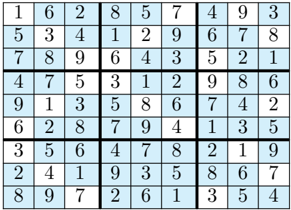
The image displays a fully completed 9x9 Sudoku puzzle grid. The grid is divided into nine 3x3 sub-grids (boxes), each outlined with thicker black lines. Every cell contains a single digit from 1 to 9. The cells have two background colors: a light blue and white, which likely differentiate the initial given numbers (clues) from the solved numbers, though all cells are filled in this completed state.
### Components/Axes
* **Grid Structure:** A standard 9x9 Sudoku grid composed of 81 individual cells.
* **Sub-grids:** The grid is partitioned into nine 3x3 boxes by thicker black lines.
* **Cell Content:** Each cell contains a single, centered digit (1-9).
* **Color Coding:** Cells have either a light blue or white background. The pattern of blue cells is consistent and appears to represent the initial puzzle clues.
* **Labels/Axes:** There are no explicit row/column labels (e.g., A-I, 1-9) or axis titles. The grid is defined solely by its visual structure.
### Detailed Analysis
**Grid Content (Row-by-Row, Left to Right):**
* **Row 1 (Top):** 1 (Blue), 6 (White), 2 (Blue), 8 (Blue), 5 (Blue), 7 (Blue), 4 (Blue), 9 (Blue), 3 (Blue)
* **Row 2:** 5 (Blue), 3 (Blue), 4 (Blue), 1 (Blue), 2 (Blue), 9 (Blue), 6 (Blue), 7 (Blue), 8 (Blue)
* **Row 3:** 7 (Blue), 8 (Blue), 9 (Blue), 6 (Blue), 4 (Blue), 3 (Blue), 5 (Blue), 2 (Blue), 1 (Blue)
* **Row 4:** 4 (Blue), 7 (Blue), 5 (Blue), 3 (Blue), 1 (Blue), 2 (Blue), 9 (Blue), 8 (Blue), 6 (Blue)
* **Row 5:** 9 (Blue), 1 (Blue), 3 (Blue), 5 (Blue), 8 (Blue), 6 (Blue), 7 (Blue), 4 (Blue), 2 (Blue)
* **Row 6:** 6 (Blue), 2 (Blue), 8 (Blue), 7 (Blue), 9 (Blue), 4 (Blue), 1 (Blue), 3 (Blue), 5 (Blue)
* **Row 7:** 3 (Blue), 5 (Blue), 6 (Blue), 4 (Blue), 7 (Blue), 8 (Blue), 2 (Blue), 1 (Blue), 9 (Blue)
* **Row 8:** 2 (Blue), 4 (Blue), 1 (Blue), 9 (Blue), 3 (Blue), 5 (Blue), 8 (Blue), 6 (Blue), 7 (Blue)
* **Row 9 (Bottom):** 8 (Blue), 9 (Blue), 7 (Blue), 2 (Blue), 6 (Blue), 1 (Blue), 3 (Blue), 5 (Blue), 4 (Blue)
**Color Pattern Observation:** The white cells are located at:
* Row 1, Column 2 (Value: 6)
* Row 2, Column 4 (Value: 1)
* Row 3, Column 6 (Value: 3)
* Row 4, Column 8 (Value: 8)
* Row 5, Column 9 (Value: 2)
* Row 6, Column 1 (Value: 6)
* Row 7, Column 3 (Value: 6)
* Row 8, Column 5 (Value: 3)
* Row 9, Column 7 (Value: 3)
All other 72 cells have a light blue background.
### Key Observations
1. **Validity:** The grid represents a valid, solved Sudoku puzzle. Each row, each column, and each of the nine 3x3 sub-grids contains all digits from 1 to 9 exactly once.
2. **Color Distribution:** The white-background cells (9 total) are scattered across the grid, with no two in the same row, column, or 3x3 box. This is a common pattern for the initial "given" numbers in a Sudoku puzzle.
3. **Data Density:** The image is purely a data grid. There are no titles, annotations, charts, or explanatory text beyond the numbers and grid lines.
### Interpretation
This image is a factual representation of a completed Sudoku solution. Its primary purpose is to display the final state of the puzzle. The color coding (blue vs. white) provides meta-information about the puzzle's starting configuration, allowing a viewer to distinguish the original clues from the numbers that were filled in during the solving process. The perfect adherence to Sudoku rules confirms it is a correct solution. The image contains no trends or outliers in a statistical sense, as it is a static, rule-based logical construct. It serves as a clear, unambiguous record of a specific puzzle's answer.