\n
## Chart: Stages of Language Development
### Overview
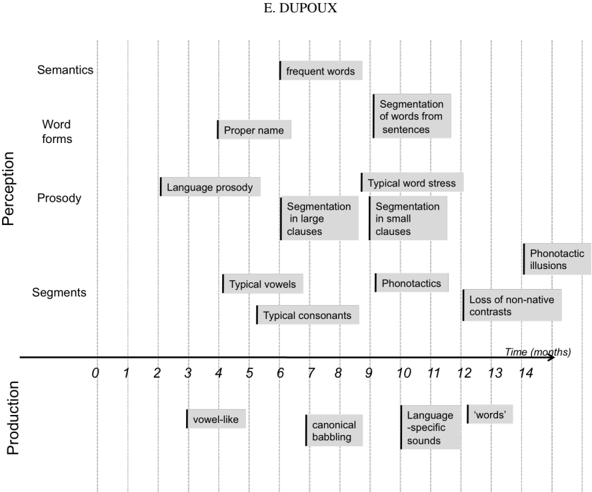
This chart depicts the developmental stages of language acquisition, categorized by perception and production, plotted against time in months. The chart uses horizontal bars to indicate the approximate timeframe for each stage. The author is listed as E. Dupoux at the top of the chart.
### Components/Axes
* **Y-axis (Vertical):** Represents the aspects of language development, with categories: Semantics, Word forms, Prosody, Segments, and Production.
* **X-axis (Horizontal):** Represents time in months, ranging from 0 to 14. The axis is labeled "Time (months)".
* **Bars:** Horizontal bars represent the duration of each developmental stage.
* **Labels:** Each bar is labeled with the name of the stage (e.g., "vowel-like", "typical vowels", "frequent words").
* **Vertical Gridlines:** Numerous vertical gridlines are present, marking each month from 0 to 14.
### Detailed Analysis
The chart is divided into two main sections: Perception (top) and Production (bottom). Each section contains several stages, represented by horizontal bars.
**Perception:**
* **Semantics:** "Frequent words" appears from approximately 9 months to 14 months.
* **Word forms:** "Proper name" appears from approximately 5 months to 9 months. "Segmentation of words from sentences" appears from approximately 9 months to 14 months.
* **Prosody:** "Language prosody" appears from approximately 3 months to 6 months. "Segmentation in large clauses" appears from approximately 7 months to 10 months. "Typical word stress" appears from approximately 9 months to 12 months. "Segmentation in small clauses" appears from approximately 10 months to 13 months.
* **Segments:** "Typical vowels" appears from approximately 4 months to 7 months. "Typical consonants" appears from approximately 5 months to 8 months. "Phonotactics" appears from approximately 10 months to 12 months. "Phonotactic illusions" appears from approximately 12 months to 14 months. "Loss of non-native contrasts" appears from approximately 13 months to 14 months.
* **Production:**
* "vowel-like" appears from approximately 0 months to 3 months.
* "canonical babbling" appears from approximately 6 months to 9 months.
* "Language-specific sounds" appears from approximately 10 months to 12 months.
* "words" appears from approximately 12 months to 14 months.
### Key Observations
* The stages are not necessarily sequential; some overlap in time.
* The production stages generally appear later in development than the perception stages.
* The chart suggests a gradual progression from basic sound production ("vowel-like") to more complex language use ("words").
* The perception of segments (vowels and consonants) begins earlier than the production of language-specific sounds.
* The chart does not provide quantitative data, only approximate timelines.
### Interpretation
This chart illustrates a model of language acquisition, showing how infants develop their ability to perceive and produce different aspects of language over time. The chart suggests that perception precedes production, meaning that infants begin to recognize and understand language elements before they can actively produce them. The overlapping stages indicate that language development is not a linear process, but rather a complex interplay of different skills. The chart is a qualitative representation of developmental milestones, and the exact timing may vary between individuals. The chart is useful for understanding the general sequence of language development and for identifying potential areas of delay. The author, E. Dupoux, likely used this chart to present a theoretical framework for understanding language acquisition. The chart is a simplified representation of a complex process, and further research is needed to fully understand the intricacies of language development.