## Timeline Chart: Infant Language Acquisition Milestones (Perception & Production)
### Overview
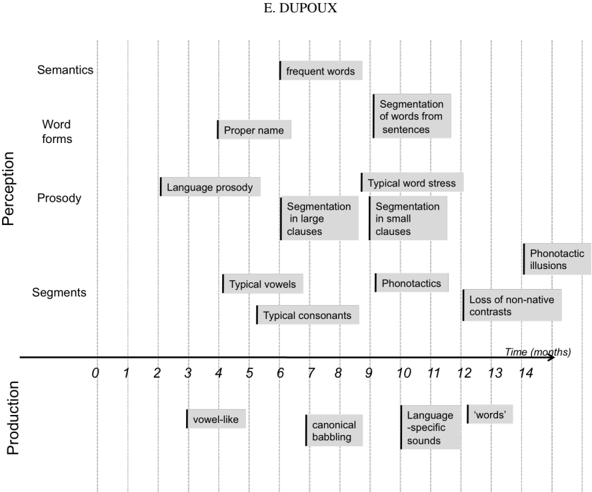
This image is a timeline chart titled "E. DUPOUX" that illustrates the developmental milestones in infant language acquisition, divided into two major domains: **Perception** and **Production**. The chart maps specific linguistic abilities against a timeline measured in months, from birth (0) to 14 months. It visually represents when infants typically begin to perceive or produce various components of language.
### Components/Axes
* **Title/Author:** "E. DUPOUX" (Top center). This is a French name.
* **Primary Vertical Axis (Left):** Two major categories:
1. **Perception** (Top half of the chart)
2. **Production** (Bottom half of the chart)
* **Secondary Vertical Axis (Within Perception):** Four sub-categories, listed from top to bottom:
* Semantics
* Word forms
* Prosody
* Segments
* **Horizontal Axis (Bottom):** **Time (months)**. The axis is marked with integers from 0 to 14, with an arrow pointing to the right indicating progression.
* **Data Representation:** Milestones are represented as gray rectangular text boxes. The left edge of each box aligns with the approximate month on the timeline when the ability emerges. The vertical placement of the box corresponds to its sub-category within Perception or its position within the Production section.
### Detailed Analysis
The chart details the following milestones, organized by domain and sub-category:
**PERCEPTION Domain:**
* **Semantics:**
* `frequent words`: Emerges at approximately **6 months**.
* **Word forms:**
* `Proper name`: Emerges at approximately **4 months**.
* `Segmentation of words from sentences`: Emerges at approximately **9 months**.
* **Prosody:**
* `Language prosody`: Emerges at approximately **2 months**.
* `Segmentation in large clauses`: Emerges at approximately **6 months**.
* `Typical word stress`: Emerges at approximately **9 months**.
* `Segmentation in small clauses`: Emerges at approximately **9 months**.
* **Segments:**
* `Typical vowels`: Emerges at approximately **4 months**.
* `Typical consonants`: Emerges at approximately **5 months**.
* `Phonotactics`: Emerges at approximately **9 months**.
* `Loss of non-native contrasts`: Emerges at approximately **12 months**.
* `Phonotactic illusions`: Emerges at approximately **14 months**.
**PRODUCTION Domain:**
* Milestones are listed vertically in the bottom section, aligned with the timeline:
* `vowel-like`: Emerges at approximately **3 months**.
* `canonical babbling`: Emerges at approximately **7 months**.
* `Language-specific sounds`: Emerges at approximately **10 months**.
* `words`: Emerges at approximately **13 months**.
### Key Observations
1. **Perception Precedes Production:** For comparable linguistic units, perceptual abilities consistently emerge months before productive abilities. For example, perception of "Typical vowels" begins at ~4 months, while the first productive sounds ("vowel-like") appear at ~3 months, but more structured production ("canonical babbling") begins at ~7 months.
2. **Clustering of Milestones:** There is a notable cluster of perceptual milestones around **9 months** (Segmentation of words, Typical word stress, Segmentation in small clauses, Phonotactics), suggesting a critical period for refining speech perception.
3. **Progression from Broad to Specific:** Perception develops from broad prosodic contours (~2 months) to specific segmental details (vowels ~4 months, consonants ~5 months) and finally to complex word and clause segmentation (~9 months).
4. **Late Specialization:** The "Loss of non-native contrasts" at ~12 months indicates a narrowing of phonetic perception to the native language, a process known as perceptual attunement.
5. **Production Trajectory:** Production follows a clear path from reflexive sounds (vowel-like) to practiced articulatory patterns (canonical babbling) to language-specific phonology and finally to symbolic words.
### Interpretation
This chart provides a synthesized, evidence-based model of the typical sequence and timing of language development in the first year of life. It demonstrates that language acquisition is not a single event but a cascade of interlocking skills across multiple levels (sound, word, meaning).
* **What it suggests:** The data underscores the infant's remarkable capacity for statistical learning and pattern extraction from speech input long before they can speak. The early perception of prosody and phonemes provides the foundational data for later segmentation and word learning.
* **Relationship between elements:** The timeline shows a logical dependency. For instance, an infant must first perceive typical vowels and consonants (Segments) and prosodic patterns before they can successfully segment words from continuous speech (Word forms). The production milestones lag behind, reflecting the additional motor planning and coordination required for speech output.
* **Notable implications:** The clustering at 9 months highlights a potential sensitive period for phonological development. The late emergence of "words" in production (~13 months) after extensive perceptual preparation aligns with the "12-month word spurt" often observed in development. This model is crucial for establishing benchmarks in developmental psychology and speech-language pathology.