## Cylinder Diagram
### Overview
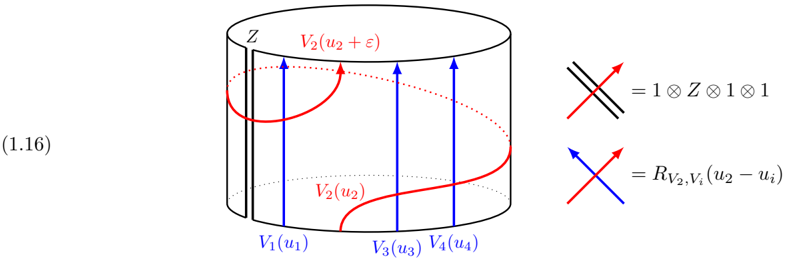
The image depicts a cylindrical diagram with various arrows and labels indicating different velocities and their relationships. The diagram is likely used to illustrate the concept of fluid dynamics or motion in a cylindrical container.
### Components/Axes
- **Z-axis**: The vertical axis labeled "Z" represents the height of the cylinder.
- **Velocity Vectors**: There are four velocity vectors labeled \( V_1(u_1) \), \( V_2(u_2 + \varepsilon) \), \( V_3(u_3) \), and \( V_4(u_4) \). These vectors are shown in red and blue, indicating different directions and magnitudes.
- **Legend**: The legend on the right side of the diagram explains the meaning of the red and blue vectors. The red vector represents \( V_2(u_2 + \varepsilon) \), and the blue vector represents \( V_3(u_3) \).
- **Cross-Product Symbol**: The diagram includes a cross-product symbol \( \times \) with the red and blue vectors, indicating the relationship between the two velocities.
### Detailed Analysis or ### Content Details
- The red vector \( V_2(u_2 + \varepsilon) \) is shown to be perpendicular to the blue vector \( V_3(u_3) \), suggesting a perpendicular relationship between the two velocities.
- The dotted red line represents the path of the red vector, which is curved, indicating a change in direction.
- The blue vector \( V_3(u_3) \) is shown to be parallel to the Z-axis, indicating a constant vertical velocity.
- The cross-product symbol \( \times \) is used to represent the relationship between the two velocities, which is a common way to visualize the perpendicularity of vectors.
### Key Observations
- The diagram illustrates the concept of perpendicular and parallel velocities in a cylindrical container.
- The curved path of the red vector suggests a change in direction, which could indicate a change in velocity or a change in the direction of motion.
- The parallel path of the blue vector suggests a constant velocity in the vertical direction.
### Interpretation
The diagram is likely used to explain the concept of fluid dynamics or motion in a cylindrical container. The perpendicular relationship between the two velocities suggests that the motion in the vertical direction is independent of the motion in the horizontal direction. The curved path of the red vector suggests that the motion in the horizontal direction is changing, which could indicate a change in velocity or a change in the direction of motion. The parallel path of the blue vector suggests that the motion in the vertical direction is constant. The cross-product symbol \( \times \) is used to represent the perpendicularity of the two velocities, which is a common way to visualize the relationship between the two velocities.