## Diagram: Vector Field and Tensor Relationship in Cylindrical Coordinates
### Overview
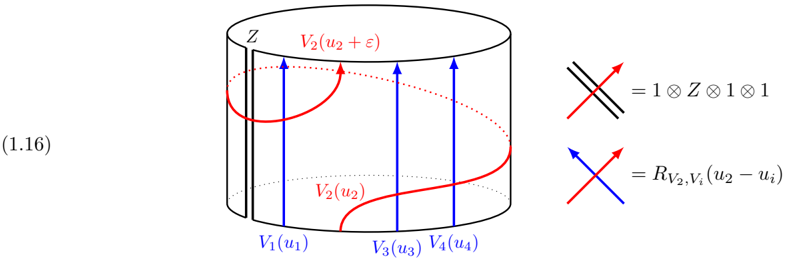
The diagram illustrates a cylindrical coordinate system (labeled **Z**) with vector fields and tensor relationships. Red and blue arrows represent vector components, while equations on the right define mathematical relationships between them. The system appears to model dynamic interactions between vectors in a multidimensional space.
### Components/Axes
- **Cylinder (Z)**: Central structure labeled **Z**, representing the coordinate system.
- **Red Arrows**:
- **V₂(u₂ + ε)**: Dotted red loop at the top of the cylinder, indicating a perturbed vector field.
- **V₂(u₂)**: Solid red loop at the bottom, representing a base vector field.
- **Blue Arrows**:
- **V₁(u₁)**: Vertical arrow on the left side of the cylinder.
- **V₃(u₃)**: Vertical arrow on the right side, slightly offset from the center.
- **V₄(u₄)**: Vertical arrow at the far right, aligned with the cylinder's edge.
- **Equations**:
- **1⊗Z⊗1⊗1**: Crossed arrows (black and red) with tensor product notation.
- **R_{V₂,V_i}(u₂ - u_i)**: Crossed arrows (blue and red) with relative vector notation.
### Detailed Analysis
- **Vector Field Dynamics**:
- The red loop **V₂(u₂ + ε)** suggests a perturbation (ε) in the vector field **V₂**, creating a cyclical path around the cylinder.
- The blue arrows (**V₁, V₃, V₄**) are static vertical components, possibly representing fixed reference vectors.
- **Tensor Relationships**:
- The equation **1⊗Z⊗1⊗1** implies a tensor product involving the coordinate system **Z** and identity components (1), suggesting a transformation or decomposition.
- **R_{V₂,V_i}(u₂ - u_i)** defines a relative vector between **V₂** and **V_i**, indicating a directional difference or interaction.
### Key Observations
1. **Perturbation in V₂**: The ε term in **V₂(u₂ + ε)** highlights a dynamic adjustment to the base vector field.
2. **Tensor Decomposition**: The **1⊗Z⊗1⊗1** equation suggests **Z** is embedded in a higher-dimensional space via tensor products.
3. **Relative Vector Interaction**: **R_{V₂,V_i}(u₂ - u_i)** implies a dependency between **V₂** and other vectors, possibly modeling forces or gradients.
### Interpretation
This diagram likely represents a physical or mathematical system where:
- **Vectors V₁, V₃, V₄** act as static reference frames.
- **V₂** undergoes a perturbation (ε), creating a feedback loop that interacts with the tensor structure **Z**.
- The tensor product **1⊗Z⊗1⊗1** may decompose **Z** into orthogonal components, while **R_{V₂,V_i}(u₂ - u_i)** quantifies the relative influence of **V₂** on other vectors.
The system could model phenomena like fluid dynamics, electromagnetic fields, or quantum state transitions, where perturbations and tensor relationships govern interactions. The vertical blue arrows might represent conserved quantities, while the red loops indicate dynamic adjustments.