## Screenshot: Question Prompt with Activity Label and Context Options
### Overview
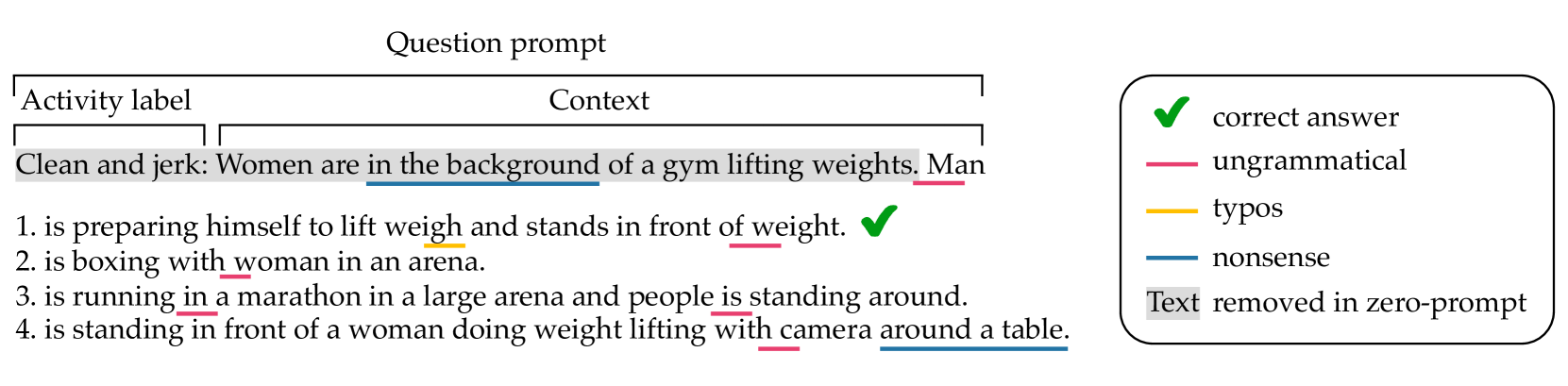
The image displays a question prompt interface with an activity label, contextual text, and four answer options. The correct answer is marked with a green checkmark, while grammatical errors, typos, and nonsensical text are annotated with color-coded underlines. A legend explains the color codes.
### Components/Axes
- **Activity Label**: "Clean and jerk: Women are in the background of a gym lifting weights. Man"
- Text is partially redacted (grayed out) in the zero-prompt version.
- **Context**: Four answer options (1–4) with embedded annotations:
- **Option 1**: "is preparing himself to lift weigh and stands in front of weight."
- "weigh" underlined in yellow (typo).
- "front of weight" underlined in red (ungrammatical).
- Green checkmark indicates this is the correct answer.
- **Option 2**: "is boxing with woman in an arena."
- "woman" underlined in red (ungrammatical).
- Yellow underline under "arena" (typo).
- **Option 3**: "is running in a marathon in a large arena and people is standing around."
- "people is" underlined in red (ungrammatical).
- "marathon" underlined in yellow (typo).
- **Option 4**: "is standing in front of a woman doing weight lifting with camera around a table."
- "weight" underlined in red (ungrammatical).
- "table" underlined in blue (nonsense).
- **Legend**: Located in a rounded rectangle on the right.
- Green checkmark: Correct answer.
- Red underline: Ungrammatical text.
- Yellow underline: Typo.
- Blue underline: Nonsense.
- Gray text: Removed in zero-prompt.
### Detailed Analysis
- **Option 1** contains two errors ("weigh" and "front of weight") but is marked correct, likely due to contextual alignment with the activity label ("gym lifting weights").
- **Option 2** misuses "woman" (singular) and has a typo in "arena" but is irrelevant to the activity label.
- **Option 3** introduces unrelated elements ("marathon," "people is standing") and contains grammatical errors.
- **Option 4** includes a nonsensical reference to a "table" and misuses "weight" (singular).
### Key Observations
- The correct answer (Option 1) retains contextual relevance despite grammatical errors, emphasizing the importance of semantic coherence over syntactic perfection.
- The zero-prompt version removes the activity label entirely, relying solely on the context for inference.
- Color-coding annotations highlight common errors (e.g., subject-verb agreement, typos) and nonsensical additions.
### Interpretation
This interface demonstrates a system for evaluating answer relevance and grammatical accuracy in a question-answering task. The correct answer (Option 1) aligns with the activity label's context ("gym lifting weights") but retains errors, suggesting the system prioritizes contextual relevance over syntactic correctness. The annotations (color underlines) serve as a diagnostic tool to identify specific error types, while the legend provides a clear key for interpretation. The zero-prompt version's removal of the activity label underscores the challenge of context-dependent reasoning in language models.