## Stacked Bar Chart: Questions Answered by Attempt
### Overview
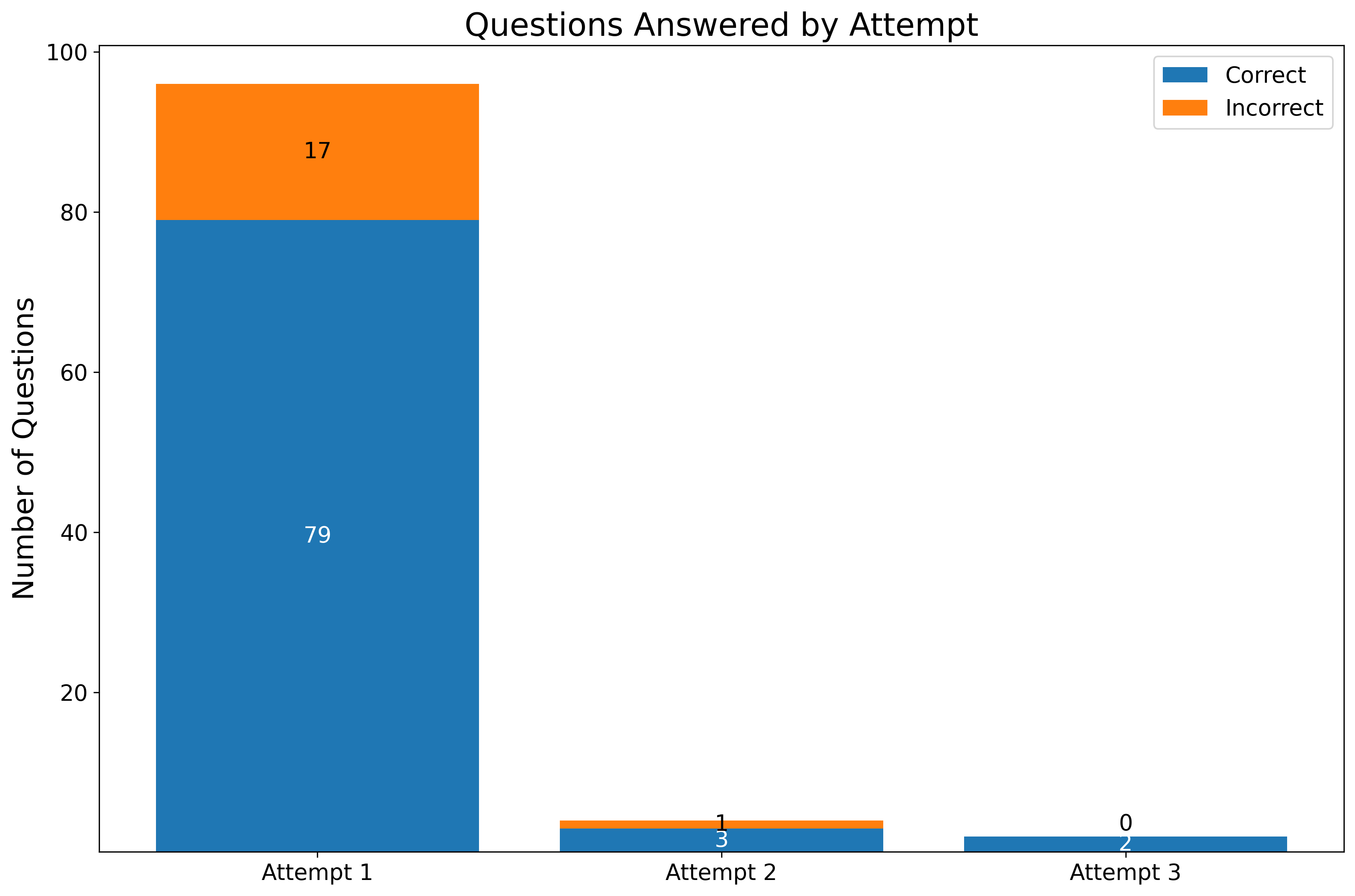
The image displays a stacked bar chart titled "Questions Answered by Attempt." It visualizes the number of questions answered correctly and incorrectly across three sequential attempts. The chart shows a dramatic decrease in the volume of questions attempted from the first to the subsequent attempts.
### Components/Axes
* **Chart Title:** "Questions Answered by Attempt" (centered at the top).
* **Y-Axis:** Labeled "Number of Questions." The scale runs from 0 to 100 in increments of 20 (0, 20, 40, 60, 80, 100).
* **X-Axis:** Represents the attempt number, with three categorical labels: "Attempt 1", "Attempt 2", and "Attempt 3".
* **Legend:** Located in the top-right corner. It defines two data series:
* **Correct:** Represented by a blue color.
* **Incorrect:** Represented by an orange color.
* **Data Labels:** Numerical values are embedded directly within each colored segment of the bars.
### Detailed Analysis
The chart consists of three vertical stacked bars, each representing an attempt. The total height of each bar represents the total number of questions answered in that attempt.
**1. Attempt 1 (Leftmost Bar):**
* **Correct (Blue, bottom segment):** 79 questions.
* **Incorrect (Orange, top segment):** 17 questions.
* **Total Questions:** 79 + 17 = 96.
* **Trend/Visual:** This is by far the tallest bar, indicating the vast majority of questions were addressed in the first attempt. The blue segment is significantly larger than the orange segment.
**2. Attempt 2 (Center Bar):**
* **Correct (Blue, bottom segment):** 3 questions.
* **Incorrect (Orange, top segment):** 1 question.
* **Total Questions:** 3 + 1 = 4.
* **Trend/Visual:** This bar is drastically shorter than the first. The blue segment is still larger than the orange, but both values are very low.
**3. Attempt 3 (Rightmost Bar):**
* **Correct (Blue, bottom segment):** 2 questions.
* **Incorrect (Orange, top segment):** 0 questions.
* **Total Questions:** 2 + 0 = 2.
* **Trend/Visual:** This is the shortest bar. It consists only of a blue segment, as the incorrect count is zero.
### Key Observations
1. **Massive Drop-off in Volume:** There is an extreme, non-linear decline in the number of questions attempted after the first attempt. Attempt 1 accounts for 96 out of 102 total questions (≈94.1%).
2. **High Initial Accuracy:** In Attempt 1, the accuracy rate (Correct / Total) is approximately 82.3% (79/96).
3. **Diminishing Returns:** The subsequent attempts (2 and 3) handle a very small residual set of questions (6 total), with a combined accuracy of 83.3% (5/6).
4. **Perfect Accuracy in Final Attempt:** In Attempt 3, all questions answered (2) were correct.
### Interpretation
This chart likely represents the results of a learning, testing, or problem-solving process where participants (or a system) make multiple attempts at a set of questions.
* **Process Efficiency:** The data suggests a highly efficient first pass. The overwhelming majority of questions were resolved in Attempt 1 with a high success rate. This could indicate effective initial training, clear instructions, or that the questions were generally well-understood.
* **Nature of Residual Questions:** The small number of questions requiring a second or third attempt may represent edge cases, particularly difficult items, or questions that were initially misinterpreted. The perfect score in Attempt 3 implies that with enough tries, all questions in this set were ultimately answerable correctly.
* **Potential Scenarios:** This pattern is common in scenarios like:
* **Educational Testing:** Students answering a quiz, with most getting questions right on the first try, and a few needing retries.
* **Machine Learning Model Evaluation:** A model making predictions, where most are correct initially, and a small subset requires re-evaluation or parameter tuning.
* **Customer Support/Troubleshooting:** A knowledge base where most issues are resolved by the first article/solution, with a few complex cases requiring follow-up attempts.
The chart tells a story of initial competence and efficiency, with a long tail of minor, resolvable exceptions.