## Diagram: Large Language Model Processing
### Overview
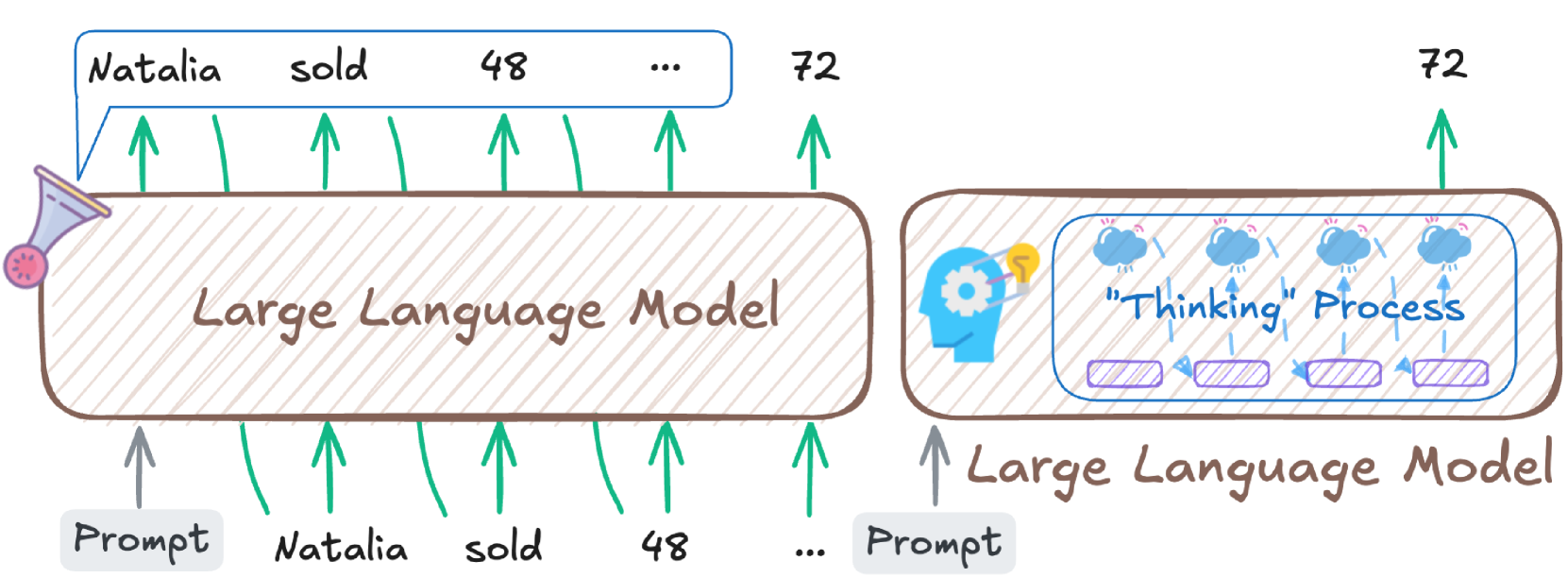
The image illustrates two conceptual models of how a Large Language Model (LLM) processes information. The left side shows a direct input-output model, while the right side depicts a more complex "thinking" process within the LLM.
### Components/Axes
* **Left Side:**
* **Input:** "Prompt Natalia sold 48 ..."
* **Process:** "Large Language Model" (represented as a rounded rectangle with diagonal lines inside)
* **Output:** "Natalia sold 48 ... 72" (contained in a speech bubble)
* **Funnel:** A funnel-shaped object on the left side of the "Large Language Model" box.
* **Right Side:**
* **Input:** "Prompt"
* **Process:** "Large Language Model" (represented as a rounded rectangle with diagonal lines inside)
* **Internal Process:** "Thinking" Process (represented as a rounded rectangle containing a brain icon, clouds, and rectangular blocks with arrows indicating flow)
* **Output:** "72"
* **Arrows:** Green arrows indicate the flow of information from input to output. A grey arrow indicates the initial prompt.
### Detailed Analysis
* **Left Side:**
* The input prompt "Natalia sold 48 ..." enters the Large Language Model.
* The model directly outputs "Natalia sold 48 ... 72".
* The funnel on the left side of the model is connected to the first word "Natalia" of the output.
* **Right Side:**
* The input prompt "Prompt" enters the Large Language Model.
* The model engages in a "Thinking" Process, visualized with a brain icon, clouds, and rectangular blocks.
* The model outputs "72".
* The "Thinking" Process box contains:
* A blue head icon with gears inside and a yellow lightbulb next to it.
* Three blue clouds with small lightning bolts.
* Three purple rectangles with diagonal lines inside, connected by blue arrows.
### Key Observations
* The left side represents a more straightforward, direct processing approach.
* The right side emphasizes the internal "Thinking" Process within the LLM.
* Both models ultimately produce a numerical output ("72").
### Interpretation
The diagram contrasts two ways of understanding how a Large Language Model generates output. The left side presents a simplified view where the model directly transforms the input prompt into an output sequence. The right side offers a more nuanced perspective, highlighting the complex internal "Thinking" Process that occurs within the model before generating the final output. The "Thinking" Process is visualized with elements like a brain, clouds (possibly representing uncertainty or probabilistic reasoning), and interconnected blocks (suggesting a step-by-step computation). The diagram suggests that LLMs are not simply regurgitating information but are engaging in a more sophisticated form of processing to arrive at their outputs. The funnel on the left side may represent the initial input or focus of the model.