\n
## Text-Based Task Sheet: Language & Reasoning Exercises
### Overview
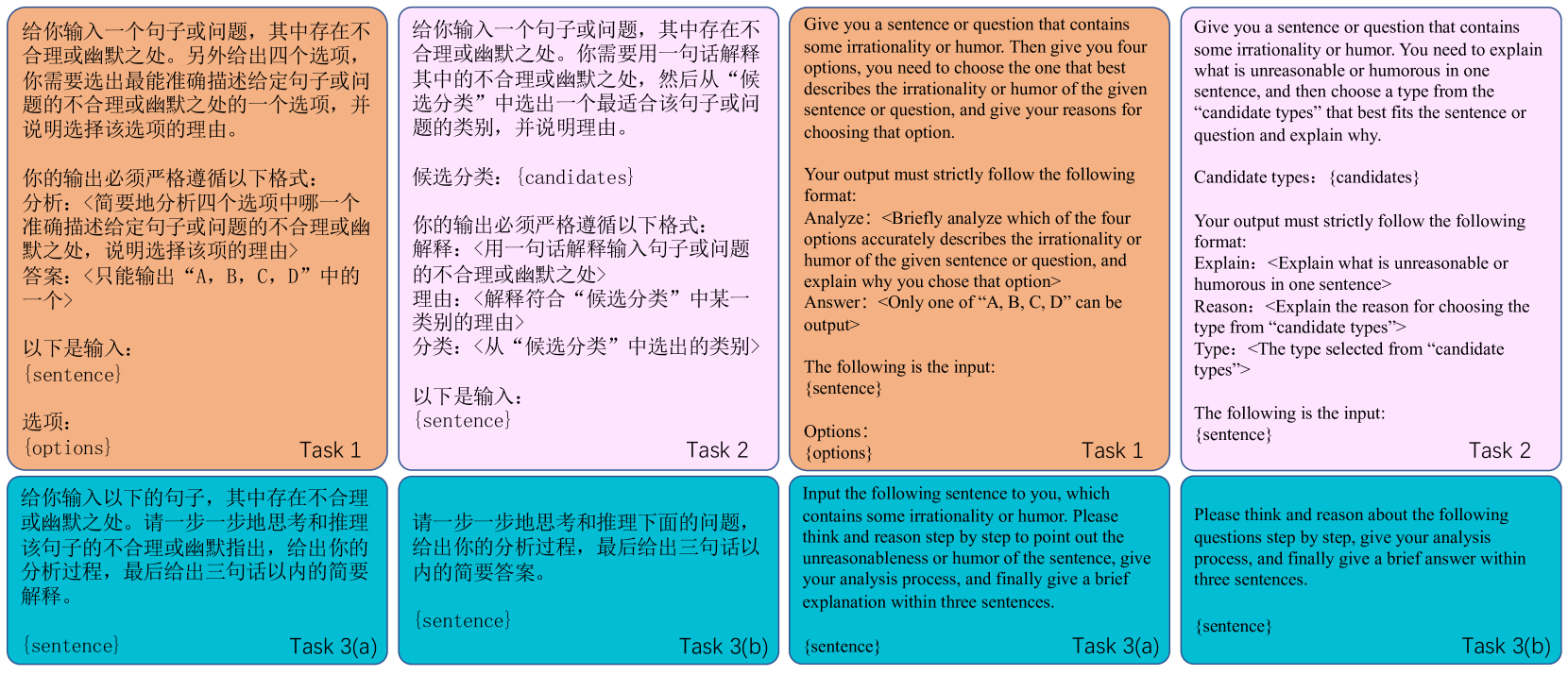
The image presents a multi-part task sheet, primarily in Chinese, focused on evaluating reasoning and identifying irrationality or humor in sentences. It appears to be a test or exercise with multiple sections, each presenting a different type of challenge. The sheet is divided into four distinct task areas, each with instructions and example formats.
### Components/Axes
The sheet is structured into four main task blocks, labeled "Task 1", "Task 2", "Task 3", and "Task 4" arranged in a 2x2 grid. Each task block contains:
* **Instructions (Chinese):** Detailed instructions for the task.
* **Example Format (Chinese & English):** A demonstration of the expected output format, with some parts in English.
* **Input (Chinese):** The sentence or question to be analyzed.
* **Options (Chinese):** A set of choices for the task.
The sheet also includes a header with general instructions in Chinese.
### Detailed Analysis or Content Details
**Header (Top of Image):**
The header text (Chinese) states: "给您输入一个句子或问题,其中存在不合理或幽默之处。另外给出四个选项,你需要选出最能准确描述这句话或问题的合理或幽默之处的选项,并说明理由。"
*Translation:* "You will be given a sentence or question containing some irrationality or humor. Also given are four options. You need to choose the option that most accurately describes the irrationality or humor of the sentence or question and explain your reasoning."
**Task 1 (Top-Left):**
* **Instructions (Chinese):** "分析:(简要地分析四个选项中哪一个能准确描述这句话或问题的合理或幽默之处。)"
*Translation:* "Analyze: (Briefly analyze which of the four options most accurately describes the irrationality or humor of the sentence or question.)"
* **Example Format (Chinese & English):**
* Chinese: "Answer: “Only one of “A, B, C, D” can be output”"
* English: "Your output must strictly follow the following format: Analyze: Briefly analyze which of the four options, you need to choose the one that best describes the irrationality or humor of the given sentence or question, and explain why you chose that option?"
* **Input (Chinese):** "以下是输入:(sentence)"
*Translation:* "The following is the input: (sentence)"
* **Options (Chinese):** "选项:"
*Translation:* "Options:"
**Task 2 (Top-Right):**
* **Instructions (Chinese):** "你输出结果必须严格遵循以下格式:解释:(用“句”解释这句话或问题的合理或幽默之处)”
*Translation:* "Your output must strictly follow the following format: Explain: (Use a “sentence” to explain the irrationality or humor of the sentence or question)"
* **Example Format (Chinese & English):**
* Chinese: "Type: “The type selected from “candidate types””"
* English: "The following is the input: (sentence)"
* **Input (Chinese):** "以下是输入:(sentence)"
*Translation:* "The following is the input: (sentence)"
* **Options (Chinese):** "选项:"
*Translation:* "Options:"
**Task 3 (Bottom-Left):**
* **Instructions (Chinese):** "给您输入以下句子,其中存在不合理或幽默之处。请一步一步地分析这句话的合理性或幽默性,给出您的分析过程,最后给出一个简要的结论。"
*Translation:* "You will be given a sentence containing some irrationality or humor. Please analyze the rationality or humor of the sentence step by step, provide your analysis process, and finally give a brief conclusion."
* **Input (Chinese):** "请一步一步地分析这句话的合理性或幽默性的分析过程,最后给出一个简要的结论。"
*Translation:* "Please analyze the rationality or humor of the sentence step by step, provide your analysis process, and finally give a brief conclusion."
**Task 4 (Bottom-Right):**
* **Instructions (Chinese):** "请一步一步地分析这句话的合理性或幽默性的分析过程,最后给出一个简要的结论。"
*Translation:* "Please analyze the rationality or humor of the sentence step by step, provide your analysis process, and finally give a brief conclusion."
* **Input (Chinese):** "Give you a sentence or question that contains some irrationality or humor. Then give you four options, you need to choose the one that best describes the irrationality or humor of the given sentence or question, and give your reasons for choosing that option."
* **Options (Chinese):** "Candidate types: (candidates)"
### Key Observations
* The sheet is heavily focused on analytical reasoning and the ability to identify and explain subtle nuances in language.
* The inclusion of both Chinese instructions and English example formats suggests the sheet is intended for learners of English or for bilingual individuals.
* The repetitive nature of the instructions across tasks suggests a standardized testing format.
* The tasks progressively increase in complexity, moving from simple selection to detailed step-by-step analysis.
### Interpretation
The task sheet is designed to assess a person's ability to critically evaluate language, identify logical fallacies or humorous elements, and articulate their reasoning in a clear and structured manner. The sheet emphasizes both the *what* (identifying the irrationality/humor) and the *why* (explaining the reasoning behind the identification). The use of a standardized format encourages consistent and comparable responses. The sheet appears to be a component of a larger language or reasoning assessment, potentially used in educational or professional settings. The repetition of instructions across tasks suggests a focus on reinforcing the expected analytical process. The presence of both Chinese and English indicates a potential target audience of bilingual individuals or those learning English as a second language.