## Screenshot: Task Instructions for Sentence Analysis
### Overview
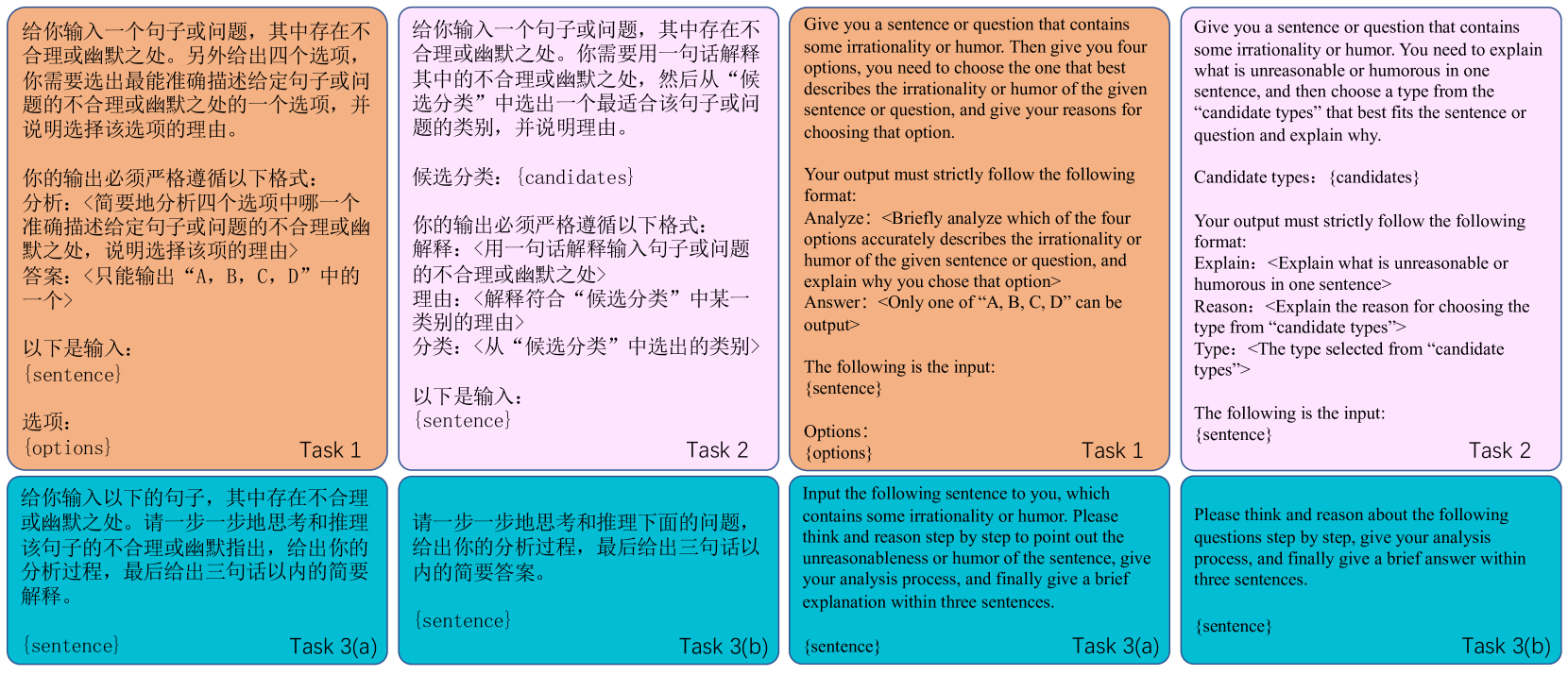
The image contains eight text blocks arranged in a 2x4 grid, each presenting a task description in both Chinese and English. The blocks alternate between orange/purple (top row) and teal (bottom row) backgrounds. Each block includes a task number (Task 1, Task 2, Task 3(a), Task 3(b)) and instructions for analyzing sentences containing irrationality or humor.
### Components/Axes
- **Block Structure**:
- Top row: Orange (Task 1), Purple (Task 2), Orange (Task 1), Purple (Task 2)
- Bottom row: Teal (Task 3(a)), Teal (Task 3(b)), Teal (Task 3(a)), Teal (Task 3(b))
- **Text Content**:
- Chinese text (left side of each block) provides translated instructions
- English text (right side of each block) provides original instructions
- Task numbers positioned at bottom-right corner of each block
### Detailed Analysis
#### Block 1 (Orange, Task 1)
**Chinese**: 给你输入一个句子或问题,其中存在不合理或幽默之处。另外给出四个选项,你需要选择该选项的理由。
**English**: "Give you a sentence or question that contains some irrationality or humor. Then give you four options, you need to choose the one that best describes the irrationality or humor of the given sentence or question, and give your reasons for choosing that option."
#### Block 2 (Purple, Task 2)
**Chinese**: 候选分类:{candidates}
**English**: "Analyze: <Briefly analyze which of the four options accurately describes the irrationality or humor of the given sentence or question, and explain why you chose that option>"
#### Block 3 (Orange, Task 1)
**Chinese**: 以下是输入:{sentence}
**English**: "The following is the input: {sentence}"
#### Block 4 (Purple, Task 2)
**Chinese**: 选项:{options}
**English**: "Options: {options}"
#### Block 5 (Teal, Task 3(a))
**Chinese**: 请一步一步地思考和推理下面的问题,给出你的分析过程,最后给出三句话以内的简要答案。
**English**: "Input the following sentence to you, which contains some irrationality or humor. Please think and reason step by step to point out the unreasonableness or humor of the sentence, give your analysis process, and finally give a brief answer within three sentences."
#### Block 6 (Teal, Task 3(b))
**Chinese**: 给你输入以下的句子,其中存在不合理或幽默之处。请一步一步地思考和推理该句子的不合理或幽默,给出你的分析过程,最后给出三句话以内的简要答案。
**English**: "Please think and reason about the following question step by step, give your analysis process, and finally give a brief answer within three sentences."
#### Block 7 (Teal, Task 3(a))
**Chinese**: {sentence}
**English**: "{sentence}"
#### Block 8 (Teal, Task 3(b))
**Chinese**: {sentence}
**English**: "{sentence}"
### Key Observations
1. **Repetition**: Tasks 1 and 2 appear twice in the top row, while Tasks 3(a) and 3(b) repeat in the bottom row.
2. **Language Duality**: All instructions are provided in both Chinese and English, suggesting a bilingual evaluation framework.
3. **Task Progression**:
- Task 1 focuses on identifying irrationality/humor
- Task 2 involves selecting the best descriptive option
- Task 3(a) emphasizes step-by-step reasoning
- Task 3(b) requires concise three-sentence answers
### Interpretation
This image represents a structured evaluation framework for assessing a model's ability to:
1. Detect irrationality/humor in text
2. Select appropriate descriptive categories
3. Provide reasoned explanations
4. Summarize findings concisely
The bilingual presentation indicates a cross-lingual evaluation system, possibly for multilingual AI models. The progression from identification (Task 1) to explanation (Task 3) suggests a layered assessment of comprehension and reasoning capabilities. The repetition of tasks implies standardized testing protocols, while the color-coded blocks may represent different evaluation phases or difficulty levels.