## Diagram: Image Processing Pipeline
### Overview
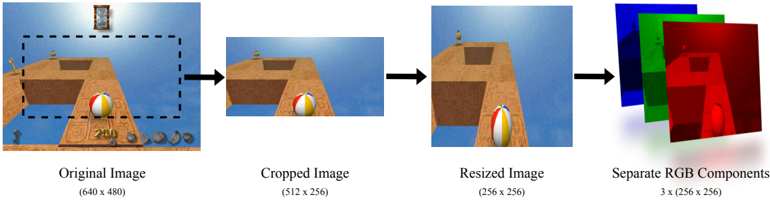
The image illustrates a four-stage sequential image processing pipeline, commonly used in computer vision or graphics preprocessing. It visually demonstrates the transformation of a source image through cropping, resizing, and color channel separation. The flow is indicated by black arrows pointing from left to right, connecting each stage.
### Components/Axes
The diagram consists of four distinct panels arranged horizontally, each with a descriptive label and dimensional data below it.
1. **Panel 1 (Far Left):**
* **Label:** `Original Image`
* **Dimensions:** `(640 x 480)`
* **Visual Content:** A 3D rendered scene featuring a sandy platform against a blue sky. Key objects include a multi-colored beach ball (red, yellow, blue, white segments) in the foreground, a small clock on a post in the background, and several small, indistinct objects along the front edge. A black dashed rectangle is superimposed on the image, indicating the region of interest for the next step.
2. **Panel 2 (Center-Left):**
* **Label:** `Cropped Image`
* **Dimensions:** `(512 x 256)`
* **Visual Content:** This panel shows the result of applying the crop defined in Panel 1. It contains only the portion of the scene within the dashed rectangle, focusing on the beach ball and the immediate sandy platform area. The clock and peripheral objects are no longer visible.
3. **Panel 3 (Center-Right):**
* **Label:** `Resized Image`
* **Dimensions:** `(256 x 256)`
* **Visual Content:** The cropped image from Panel 2 has been resized to a square format. The aspect ratio has been altered, causing a slight vertical compression or horizontal stretch of the scene elements compared to the previous panel.
4. **Panel 4 (Far Right):**
* **Label:** `Separate RGB Components`
* **Dimensions:** `3 x (256 x 256)`
* **Visual Content:** Three separate, monochromatic images are stacked with a slight offset to show depth. Each represents one color channel from the resized image:
* **Top/Back Layer:** A blue-tinted version of the scene.
* **Middle Layer:** A green-tinted version of the scene.
* **Bottom/Front Layer:** A red-tinted version of the scene.
This visually decomposes the full-color image into its constituent Red, Green, and Blue channels.
### Detailed Analysis
* **Process Flow:** The pipeline follows a strict linear sequence: `Original (640x480)` -> `Crop to 512x256 region` -> `Resize to 256x256 square` -> `Split into 3 separate 256x256 RGB channels`.
* **Spatial Relationships:** The dashed crop rectangle in the "Original Image" is positioned centrally, encompassing the beach ball and a significant portion of the platform. Its defined area directly corresponds to the content of the "Cropped Image."
* **Dimensional Transformation:** The image undergoes two spatial transformations. First, a non-uniform crop reduces the width from 640 to 512 pixels and the height from 480 to 256 pixels. Second, a resize operation changes the width from 512 to 256 pixels while maintaining the height at 256 pixels, resulting in a square output.
* **Color Decomposition:** The final stage explicitly shows that the color image is composed of three primary channels. The red channel appears brightest in the sandy areas, the green channel is prominent in the mid-tones, and the blue channel is strongest in the sky region, which is consistent with typical RGB encoding.
### Key Observations
1. **Aspect Ratio Change:** The resize operation from a 512x256 rectangle to a 256x256 square is a non-isotropic scaling, which would distort the original scene's proportions.
2. **Information Loss:** Each step involves irreversible data reduction. Cropping discards pixels outside the region of interest. Resizing discards spatial resolution. Channel separation discards the color composite information, though it is reversible.
3. **Visual Consistency:** The core subject (the beach ball) remains the focal point throughout the first three stages, confirming the crop was centered on the primary object.
### Interpretation
This diagram serves as a clear, pedagogical visualization of fundamental image preprocessing steps. It demonstrates how raw visual data is systematically transformed into a standardized format suitable for computational analysis.
* **Purpose:** The pipeline likely prepares an image for a machine learning model or a graphics algorithm that requires fixed-size, single-channel inputs. The crop isolates the subject, the resize standardizes dimensions, and the channel split provides access to raw color data.
* **Relationships:** Each stage is dependent on the output of the previous one. The crop region is defined on the original, the resize operates on the crop, and the channel split operates on the resized result. This highlights the importance of order in processing pipelines.
* **Underlying Message:** The process emphasizes that digital images are manipulable data structures. The final panel demystifies color representation, showing that a full-color image is merely a composite of three grayscale intensity maps. This is a foundational concept in digital imaging and computer vision.