\n
## Line Chart: RL Training Performance
### Overview
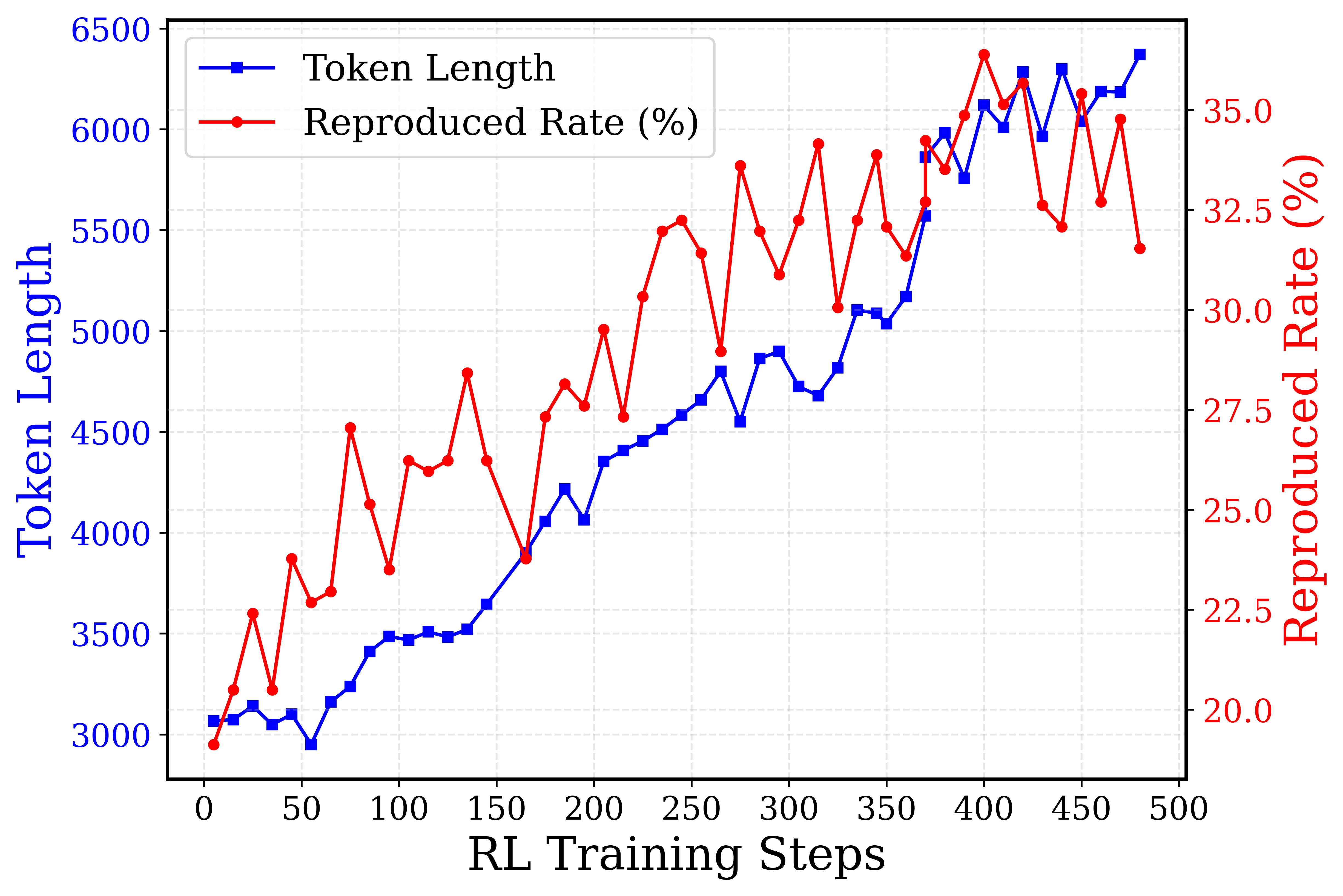
This line chart depicts the relationship between RL Training Steps and two metrics: Token Length and Reproduced Rate (%). The chart visualizes how these metrics change as the RL training progresses from 0 to 500 steps. The Token Length is plotted on the left y-axis, while the Reproduced Rate (%) is plotted on the right y-axis.
### Components/Axes
* **X-axis:** RL Training Steps (Scale: 0 to 500, increments of 50)
* **Left Y-axis:** Token Length (Scale: 3000 to 6500, increments of 500)
* **Right Y-axis:** Reproduced Rate (%) (Scale: 20.0 to 35.0, increments of 2.5)
* **Legend:**
* Blue Line: Token Length
* Red Line: Reproduced Rate (%)
### Detailed Analysis
**Token Length (Blue Line):**
The blue line representing Token Length generally slopes upward, indicating an increasing token length as RL training steps increase.
* At 0 RL Training Steps, the Token Length is approximately 3000.
* At 50 RL Training Steps, the Token Length is approximately 3100.
* At 100 RL Training Steps, the Token Length is approximately 3400.
* At 150 RL Training Steps, the Token Length is approximately 3600.
* At 200 RL Training Steps, the Token Length is approximately 4000.
* At 250 RL Training Steps, the Token Length is approximately 4300.
* At 300 RL Training Steps, the Token Length is approximately 4600.
* At 350 RL Training Steps, the Token Length is approximately 4900.
* At 400 RL Training Steps, the Token Length is approximately 5400.
* At 450 RL Training Steps, the Token Length is approximately 5800.
* At 500 RL Training Steps, the Token Length is approximately 6100.
**Reproduced Rate (%) (Red Line):**
The red line representing Reproduced Rate (%) exhibits a fluctuating pattern with peaks and valleys.
* At 0 RL Training Steps, the Reproduced Rate (%) is approximately 31%.
* At 50 RL Training Steps, the Reproduced Rate (%) is approximately 22%.
* At 100 RL Training Steps, the Reproduced Rate (%) is approximately 26%.
* At 150 RL Training Steps, the Reproduced Rate (%) is approximately 30%.
* At 200 RL Training Steps, the Reproduced Rate (%) is approximately 34%.
* At 250 RL Training Steps, the Reproduced Rate (%) is approximately 32%.
* At 300 RL Training Steps, the Reproduced Rate (%) is approximately 30%.
* At 350 RL Training Steps, the Reproduced Rate (%) is approximately 33%.
* At 400 RL Training Steps, the Reproduced Rate (%) is approximately 35%.
* At 450 RL Training Steps, the Reproduced Rate (%) is approximately 32%.
* At 500 RL Training Steps, the Reproduced Rate (%) is approximately 33%.
### Key Observations
* The Token Length consistently increases with RL Training Steps, suggesting the model is learning to generate longer sequences.
* The Reproduced Rate (%) fluctuates, indicating variability in the model's ability to reproduce the desired output. There is a general trend of increasing reproduction rate, but it is not monotonic.
* The peak Reproduced Rate (%) occurs around 400 RL Training Steps, while the Token Length continues to increase beyond this point.
* There appears to be a correlation between the two metrics, with increases in Token Length sometimes coinciding with increases in Reproduced Rate (%).
### Interpretation
The chart suggests that as the RL training progresses, the model learns to generate longer token sequences (Token Length). However, the ability to accurately reproduce the desired output (Reproduced Rate %) is not consistently improving and exhibits significant fluctuations. The peak in Reproduced Rate (%) around 400 training steps could indicate a point of optimal performance, after which further increases in Token Length do not necessarily translate to improved reproduction accuracy. This could be due to overfitting or the model encountering more complex patterns that are harder to reproduce. The fluctuating nature of the Reproduced Rate (%) suggests that the training process is not entirely stable and may benefit from further optimization or regularization techniques. The relationship between the two metrics warrants further investigation to understand whether there is a trade-off between sequence length and reproduction accuracy.