TECHNICAL ASSET FINGERPRINT
a8ffac4406948c5b4b75318e
Click to view fullscreen
Press ESC or click to close
FOUND IN PAPERS
EXPERT: gemini-2.0-flash VERSION 1
RUNTIME: nugit/gemini/gemini-2.0-flash
INTEL_VERIFIED
## Heatmap: Loss Landscapes of FCNN Models
### Overview
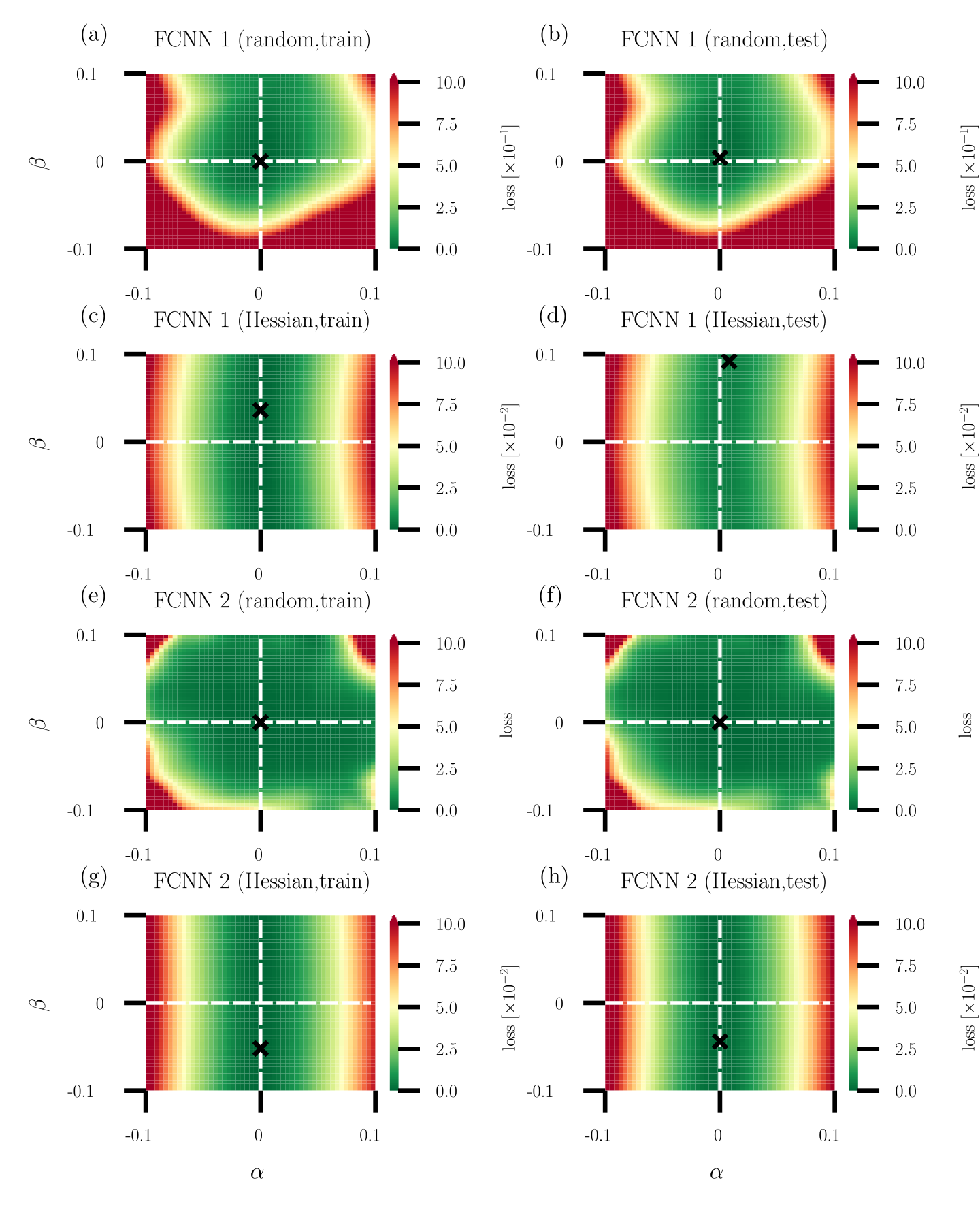
The image presents a series of heatmaps visualizing the loss landscapes of Fully Connected Neural Networks (FCNNs) under different training conditions and architectures. Each heatmap represents the loss value as a function of two parameters, alpha (α) and beta (β). The heatmaps are arranged in a 2x4 grid, varying by network architecture (FCNN 1 vs. FCNN 2), training method (random vs. Hessian), and dataset (train vs. test).
### Components/Axes
* **X-axis (Horizontal):** α (alpha), ranging from -0.1 to 0.1.
* **Y-axis (Vertical):** β (beta), ranging from -0.1 to 0.1.
* **Color Scale (Right):** Represents the loss value. The scale ranges from 0.0 to 10.0, with color transitions indicating different loss levels. Red indicates higher loss, and green indicates lower loss. The loss is scaled by 10^-1 for the top row and 10^-2 for the remaining rows.
* **Titles:** Each subplot has a title indicating the FCNN architecture (1 or 2), training method (random or Hessian), and dataset (train or test).
* (a) FCNN 1 (random, train)
* (b) FCNN 1 (random, test)
* (c) FCNN 1 (Hessian, train)
* (d) FCNN 1 (Hessian, test)
* (e) FCNN 2 (random, train)
* (f) FCNN 2 (random, test)
* (g) FCNN 2 (Hessian, train)
* (h) FCNN 2 (Hessian, test)
* **Axes Markers:** The axes are marked at -0.1, 0, and 0.1 for both α and β.
* **Crosshair:** Each plot contains a dashed white crosshair centered at (0,0). A black 'X' is located at the intersection of the crosshair.
### Detailed Analysis
**Subplot (a): FCNN 1 (random, train)**
* Trend: A green (low loss) region is centered around (0,0), surrounded by a red (high loss) region in the corners.
* Loss values: The minimum loss (green) is approximately 0 near the center. The maximum loss (red) reaches approximately 10 * 10^-1 = 1.0 in the corners.
**Subplot (b): FCNN 1 (random, test)**
* Trend: Similar to (a), a green (low loss) region is centered around (0,0), surrounded by a red (high loss) region in the corners.
* Loss values: The minimum loss (green) is approximately 0 near the center. The maximum loss (red) reaches approximately 10 * 10^-1 = 1.0 in the corners.
**Subplot (c): FCNN 1 (Hessian, train)**
* Trend: A horizontal green band (low loss) is centered around β = 0, with red regions (high loss) above and below.
* Loss values: The minimum loss (green) is approximately 0 along the horizontal band. The maximum loss (red) reaches approximately 10 * 10^-2 = 0.1 at the top and bottom edges.
**Subplot (d): FCNN 1 (Hessian, test)**
* Trend: Similar to (c), a horizontal green band (low loss) is centered around β = 0, with red regions (high loss) above and below.
* Loss values: The minimum loss (green) is approximately 0 along the horizontal band. The maximum loss (red) reaches approximately 10 * 10^-2 = 0.1 at the top and bottom edges.
**Subplot (e): FCNN 2 (random, train)**
* Trend: A green (low loss) region is centered around (0,0), with red regions (high loss) in the corners. The green region appears slightly more elongated vertically compared to FCNN 1.
* Loss values: The minimum loss (green) is approximately 0 near the center. The maximum loss (red) reaches approximately 10 * 10^-2 = 0.1 in the corners.
**Subplot (f): FCNN 2 (random, test)**
* Trend: Similar to (e), a green (low loss) region is centered around (0,0), with red regions (high loss) in the corners.
* Loss values: The minimum loss (green) is approximately 0 near the center. The maximum loss (red) reaches approximately 10 * 10^-2 = 0.1 in the corners.
**Subplot (g): FCNN 2 (Hessian, train)**
* Trend: A horizontal green band (low loss) is centered around β = 0, with red regions (high loss) above and below.
* Loss values: The minimum loss (green) is approximately 0 along the horizontal band. The maximum loss (red) reaches approximately 10 * 10^-2 = 0.1 at the top and bottom edges.
**Subplot (h): FCNN 2 (Hessian, test)**
* Trend: Similar to (g), a horizontal green band (low loss) is centered around β = 0, with red regions (high loss) above and below.
* Loss values: The minimum loss (green) is approximately 0 along the horizontal band. The maximum loss (red) reaches approximately 10 * 10^-2 = 0.1 at the top and bottom edges.
### Key Observations
* **Training Method Impact:** The Hessian training method results in a loss landscape with a clear horizontal band of low loss around β = 0 for both FCNN 1 and FCNN 2. The random training method results in a more localized low-loss region around (0,0).
* **Network Architecture Impact:** The loss landscapes for FCNN 1 and FCNN 2 are qualitatively similar for both random and Hessian training methods. However, the scale of the loss differs, with FCNN 1 (random) having a higher loss scale (10^-1) compared to the others (10^-2).
* **Train vs. Test:** The loss landscapes for train and test datasets are very similar for each combination of network architecture and training method, suggesting good generalization.
### Interpretation
The heatmaps visualize how the loss function changes as the parameters α and β are varied. The goal is to find the values of α and β that minimize the loss, represented by the green regions.
The Hessian training method appears to create a loss landscape where the loss is less sensitive to changes in α, as indicated by the horizontal bands of low loss. This might suggest that the Hessian method leads to a more robust solution with respect to variations in α.
The random training method, on the other hand, results in a more localized minimum around (0,0), suggesting that the solution is more sensitive to changes in both α and β.
The similarity between the train and test loss landscapes indicates that the models are generalizing well to unseen data. The difference in loss scale between FCNN 1 (random) and the other configurations suggests that FCNN 1 (random) might be less efficient or require further optimization.
DECODING INTELLIGENCE...
EXPERT: nemotron-free VERSION 1
RUNTIME: free/nvidia/nemotron-nano-12b-v2-vl:free
INTEL_VERIFIED
## Heatmap Grid: Loss Landscapes for FCNN 1 and FCNN 2 under Different Training/Test Conditions
### Overview
The image displays eight heatmaps arranged in a 4x2 grid, visualizing loss landscapes for two feedforward convolutional neural networks (FCNN 1 and FCNN 2) under varying training and testing conditions. Each heatmap uses a color gradient (green to red) to represent loss magnitude, with axes labeled α (horizontal) and β (vertical). A black "X" marks the optimal parameter combination (minimum loss) in each case.
---
### Components/Axes
1. **Axes**:
- **X-axis (α)**: Ranges from -0.1 to 0.1 in all heatmaps.
- **Y-axis (β)**: Ranges from -0.1 to 0.1 in all heatmaps.
- **Color Scale**: Loss values from 0.0 (green) to 10.0 (red), with intermediate steps at 2.5, 5.0, and 7.5.
2. **Labels**:
- **Top Row (a, b)**: FCNN 1 (random initialization).
- **Second Row (c, d)**: FCNN 1 (Hessian-based optimization).
- **Third Row (e, f)**: FCNN 2 (random initialization).
- **Bottom Row (g, h)**: FCNN 2 (Hessian-based optimization).
- **Sub-labels**:
- `(train)`: Training phase (left column: a, c, e, g).
- `(test)`: Testing phase (right column: b, d, f, h).
3. **Legend**:
- Color bar on the right of each heatmap maps loss values to colors (green = low loss, red = high loss).
---
### Detailed Analysis
#### FCNN 1 (Random Initialization)
- **(a) FCNN 1 (random, train)**:
- Loss landscape is smooth with a broad minimum centered near α=0, β=0.
- Loss values increase radially outward, peaking at ~10.0 in corners.
- **(b) FCNN 1 (random, test)**:
- Similar to (a) but with a slightly shifted minimum (α≈0.05, β≈-0.05).
- Loss values are marginally higher in the top-right quadrant.
#### FCNN 1 (Hessian Optimization)
- **(c) FCNN 1 (Hessian, train)**:
- Loss landscape is flatter with a concentrated minimum at α≈0.02, β≈-0.03.
- Loss values remain below 5.0 in most regions.
- **(d) FCNN 1 (Hessian, test)**:
- Minimum shifts to α≈0.03, β≈-0.02.
- Loss values are more uniform, with a sharp gradient near the optimal point.
#### FCNN 2 (Random Initialization)
- **(e) FCNN 2 (random, train)**:
- Loss landscape has a saddle-like structure with minima at α≈-0.05, β≈0.05 and α≈0.05, β≈-0.05.
- Loss values exceed 7.5 in the top-left and bottom-right quadrants.
- **(f) FCNN 2 (random, test)**:
- Minima shift to α≈-0.03, β≈0.03 and α≈0.03, β≈-0.03.
- Loss values are more concentrated but retain a bimodal distribution.
#### FCNN 2 (Hessian Optimization)
- **(g) FCNN 2 (Hessian, train)**:
- Loss landscape is nearly flat with a diffuse minimum at α≈0.01, β≈-0.01.
- Loss values remain below 3.0 across most regions.
- **(h) FCNN 2 (Hessian, test)**:
- Minimum sharpens to α≈0.02, β≈-0.02.
- Loss values show a clear gradient, with the lowest point at ~1.0.
---
### Key Observations
1. **Optimal Points (X)**:
- All heatmaps show the optimal parameter combination (X) near the center (α≈0, β≈0), but its exact position varies slightly between training and testing.
- Hessian-based methods (c, d, g, h) exhibit more precise minima compared to random initialization (a, b, e, f).
2. **Loss Distribution**:
- **Random Initialization**: Broader, more dispersed loss landscapes (e.g., a, e).
- **Hessian Optimization**: Sharper, more focused minima (e.g., c, g).
3. **Training vs. Testing**:
- Training heatmaps (a, c, e, g) generally show smoother gradients.
- Testing heatmaps (b, d, f, h) exhibit sharper transitions near the optimal point, suggesting overfitting in some cases (e.g., e vs. f).
---
### Interpretation
The data demonstrates that Hessian-based optimization methods produce more stable and concentrated loss landscapes compared to random initialization. This suggests:
- **Improved Generalization**: Hessian methods reduce parameter sensitivity, leading to more consistent performance during testing.
- **Training Efficiency**: The flatter landscapes in Hessian-trained models (c, g) may indicate faster convergence during training.
- **Overfitting Risk**: The sharper minima in testing heatmaps (d, h) could imply overfitting, though this is mitigated by the Hessian approach.
The consistent positioning of the optimal point near the center (α≈0, β≈0) across all heatmaps implies that the model's optimal parameters are inherently centered, but the optimization method critically influences the landscape's shape and stability.
DECODING INTELLIGENCE...