## Diagram: Rose Wheel of Virtues
### Overview
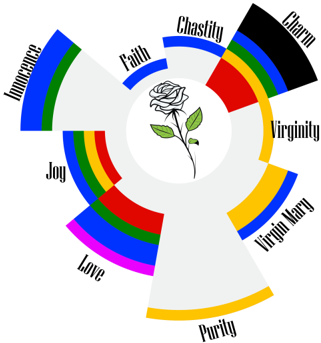
The image is a circular diagram resembling a wheel, with a rose at the center. The wheel is divided into eight segments, each associated with a virtue and a corresponding color. The virtues are arranged around the central rose, with each virtue's name written in a stylized font. The color associated with each virtue is displayed as an arc extending outward from the center.
### Components/Axes
* **Center:** A black and white drawing of a rose with green leaves.
* **Segments:** Eight segments arranged in a circle around the rose. Each segment is associated with a virtue and a color.
* **Virtues and Colors (arranged clockwise):**
* Charm (Black)
* Virginity (Red)
* Virgin Mary (Yellow)
* Purity (Gold/Yellow)
* Love (Pink/Magenta)
* Joy (Orange)
* Innocence (Blue)
* Faith (White)
* Chastity (White)
### Detailed Analysis
The diagram is structured as a wheel, with the rose at the center acting as a focal point. Each virtue is assigned a specific color, and the color is displayed as an arc extending from the center towards the outer edge of the wheel. The names of the virtues are written in a stylized font and arranged around the wheel.
* **Charm:** Represented by the color black. Located at the top-right of the diagram.
* **Virginity:** Represented by the color red. Located to the right of Charm.
* **Virgin Mary:** Represented by the color yellow. Located at the bottom-right of the diagram.
* **Purity:** Represented by the color gold/yellow. Located at the bottom of the diagram.
* **Love:** Represented by the color pink/magenta. Located at the bottom-left of the diagram.
* **Joy:** Represented by the color orange. Located to the left of Love.
* **Innocence:** Represented by the color blue. Located at the top-left of the diagram.
* **Faith:** Represented by the color white. Located at the top of the diagram.
* **Chastity:** Represented by the color white. Located at the top of the diagram.
### Key Observations
* The diagram uses a circular layout to represent the virtues and their associated colors.
* The rose at the center serves as a visual anchor and may symbolize the core of these virtues.
* The colors are used to visually distinguish each virtue.
* Some colors are repeated (e.g., white for Faith and Chastity).
### Interpretation
The diagram appears to be a symbolic representation of virtues, with each virtue associated with a specific color. The rose at the center may symbolize the essence or source of these virtues. The circular layout suggests a cyclical or interconnected relationship between the virtues. The choice of colors may have symbolic meanings as well, such as red for passion (Virginity), blue for purity (Innocence), and white for faith and chastity. The diagram could be used to illustrate the importance of these virtues or to explore their relationships to one another. The repetition of white for Faith and Chastity suggests a close connection between these two virtues.