## Circular Diagram: Virtues and Symbolic Representation
### Overview
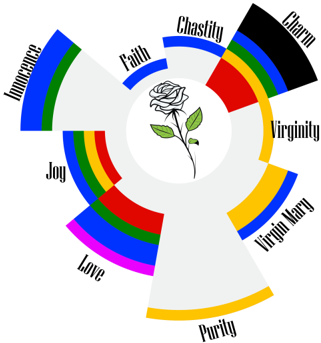
The image depicts a circular diagram centered on a white rose with a green stem and leaves. Surrounding the rose are eight colored segments, each labeled with a virtue. The diagram uses a gradient of colors (blue, green, yellow, red, purple) to differentiate the segments. A legend on the right side maps colors to labels. The design emphasizes symbolic relationships between virtues and the central rose.
### Components/Axes
- **Central Element**: A white rose with a green stem and leaves, positioned at the center of the circle.
- **Segments**: Eight radial sections radiating outward from the rose, each labeled with a virtue.
- **Legend**: Located on the right side of the diagram, associating colors with labels.
- **Color Gradient**: Each segment uses a distinct color (e.g., blue, green, yellow, red, purple) to differentiate virtues.
### Detailed Analysis
- **Labels and Colors**:
- **Innocence**: Top-left segment, blue and green gradient.
- **Faith**: Adjacent to Innocence, blue gradient.
- **Chastity**: Red gradient, positioned clockwise from Faith.
- **Virginity**: Yellow gradient, next clockwise.
- **Virgin Mary**: Blue gradient, adjacent to Virginity.
- **Purity**: Yellow gradient, next clockwise.
- **Love**: Purple gradient, positioned opposite Innocence.
- **Joy**: Red and green gradient, adjacent to Love.
- **Spatial Grounding**:
- The legend is placed on the right side, with colors matching the segments (e.g., red for Chastity, yellow for Virginity).
- The rose is centrally located, with segments arranged clockwise around it.
### Key Observations
- No numerical data or quantitative values are present. The diagram is purely symbolic.
- The rose’s central placement suggests it is the focal point, with virtues radiating outward.
- Color choices (e.g., red for Chastity, purple for Love) may reflect traditional symbolic associations.
### Interpretation
The diagram appears to represent a conceptual or philosophical framework, possibly rooted in religious or moral symbolism. The rose, often associated with purity or love, anchors the diagram, while the surrounding virtues (e.g., Innocence, Faith, Chastity) suggest a hierarchy or interconnected system of values. The absence of numerical data implies the diagram is not meant for quantitative analysis but rather for illustrative or educational purposes. The color coding and spatial arrangement emphasize the relationship between the central symbol (rose) and the virtues, potentially reflecting cultural or theological interpretations of moral or spiritual ideals.
**Note**: The image contains no numerical data, trends, or anomalies. The analysis focuses on symbolic structure and color-label relationships.