## Heatmap: MIND - Long-to-Short - Qwen-2.5 3B
### Overview
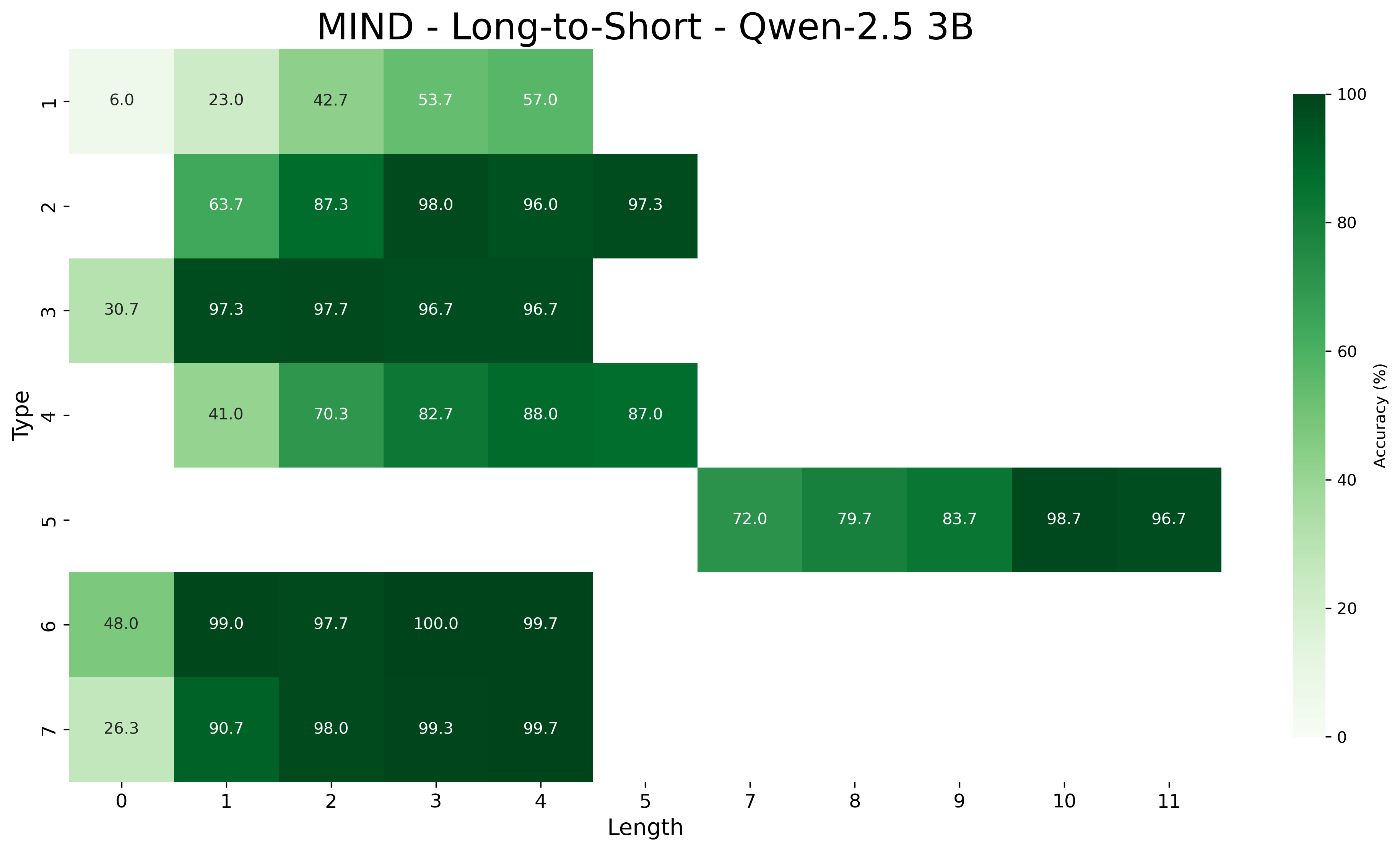
This image presents a heatmap visualizing the accuracy of the Qwen-2.5 3B model on the MIND (presumably a dataset or task) for long-to-short generation, categorized by 'Type' and 'Length'. The heatmap uses a color gradient to represent accuracy, ranging from approximately 0% (lightest color) to 100% (darkest color).
### Components/Axes
* **Title:** MIND - Long-to-Short - Qwen-2.5 3B (positioned at the top-center)
* **X-axis:** Length (ranging from 0 to 11, with integer values as markers).
* **Y-axis:** Type (ranging from 1 to 7, with integer values as markers).
* **Color Scale/Legend:** A vertical color bar on the right side of the heatmap, representing Accuracy (%) from 0 to 100.
* **Data Points:** Each cell in the heatmap represents the accuracy for a specific combination of Type and Length. The accuracy value is displayed within each cell.
### Detailed Analysis
The heatmap displays accuracy values for 7 Types (1-7) across 12 Lengths (0-11). The color intensity corresponds to the accuracy percentage, as indicated by the legend.
Here's a breakdown of the data, reading row by row (Type 1 to Type 7):
* **Type 1:** Accuracy increases with length. Values are approximately: 6.0 (Length 0), 23.0 (Length 1), 42.7 (Length 2), 53.7 (Length 3), 57.0 (Length 4).
* **Type 2:** Accuracy is generally high and increases with length. Values are approximately: 63.7 (Length 0), 87.3 (Length 1), 98.0 (Length 2), 96.0 (Length 3), 97.3 (Length 4).
* **Type 3:** Accuracy is high and relatively stable. Values are approximately: 30.7 (Length 0), 97.3 (Length 1), 97.7 (Length 2), 96.7 (Length 3), 96.7 (Length 4).
* **Type 4:** Accuracy increases with length, but starts at a lower value. Values are approximately: 41.0 (Length 0), 70.3 (Length 1), 82.7 (Length 2), 88.0 (Length 3), 87.0 (Length 4).
* **Type 5:** Accuracy is low for shorter lengths and increases significantly for longer lengths. Values are approximately: 72.0 (Length 7), 79.7 (Length 8), 83.7 (Length 9), 98.7 (Length 10), 96.7 (Length 11).
* **Type 6:** Accuracy is very high across all lengths. Values are approximately: 48.0 (Length 0), 99.0 (Length 1), 97.7 (Length 2), 100.0 (Length 3), 99.7 (Length 4).
* **Type 7:** Accuracy is high and increases with length. Values are approximately: 26.3 (Length 0), 90.7 (Length 1), 98.0 (Length 2), 99.3 (Length 3), 99.7 (Length 4).
### Key Observations
* **Length Dependence:** For most Types, accuracy generally increases with increasing length. This suggests the model performs better with longer input sequences.
* **Type Variation:** Accuracy varies significantly between Types. Type 6 consistently exhibits the highest accuracy, while Type 1 and Type 4 start with lower accuracy values.
* **Type 5 Anomaly:** Type 5 shows a distinct pattern of low accuracy for lengths 0-6, followed by a rapid increase to high accuracy for lengths 7-11. This suggests a threshold effect where the model requires a certain minimum length to perform well.
* **High Accuracy:** Many combinations of Type and Length achieve very high accuracy (close to 100%).
### Interpretation
The heatmap demonstrates the performance of the Qwen-2.5 3B model on the MIND task for long-to-short generation. The strong positive correlation between length and accuracy for most Types indicates that the model benefits from longer input sequences. The variation in accuracy across Types suggests that the task is not uniformly easy for the model; some Types are inherently more challenging. The anomaly observed in Type 5 could be due to a specific characteristic of that Type that requires longer sequences for the model to effectively process. The overall high accuracy achieved for many combinations suggests that the Qwen-2.5 3B model is generally effective at this task, particularly when provided with sufficient input length. The data suggests that the model is more confident and accurate when dealing with longer sequences, potentially because it has more context to work with. Further investigation into the nature of each 'Type' would be needed to understand why some are more challenging than others.