\n
## Code Snippets: Neural Network Implementations
### Overview
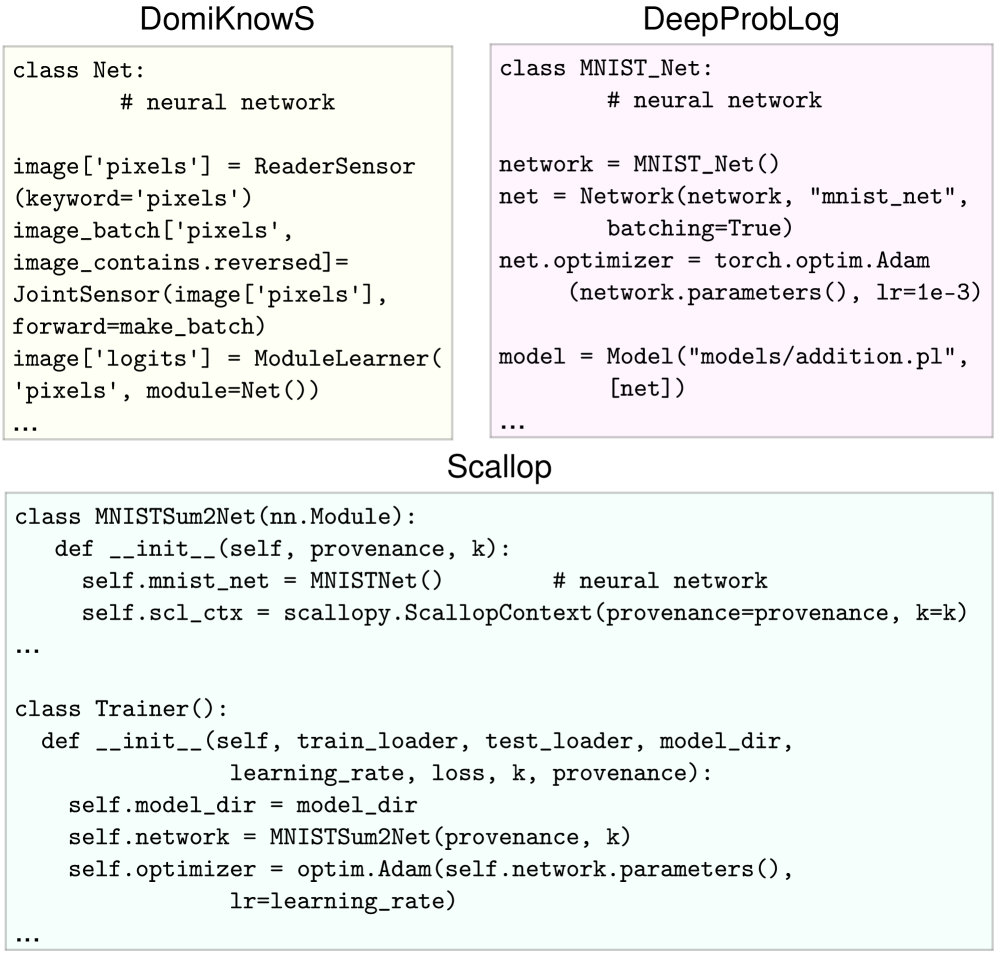
The image presents three code snippets, likely from Python, showcasing different implementations related to neural networks. The snippets are labeled "DomiKnows", "DeepProbLog", and "Scallop". Each snippet defines classes and functions related to network creation, training, and data handling. The code appears to be focused on image processing, specifically with MNIST datasets, and utilizes libraries like `torch` and `scallopy`.
### Components/Axes
The image does not contain axes or charts. It consists entirely of code blocks. The snippets are visually separated by rectangular borders. Each snippet includes class definitions, function definitions, and comments indicating the purpose of the code.
### Detailed Analysis or Content Details
**DomiKnows:**
```python
class Net:
# neural network
image['pixels'] = ReaderSensor(keyword='pixels')
image_batch['pixels', image_contains.reversed] = JointSensor(image['pixels'], forward=make_batch)
image['logits'] = ModuleLearner('pixels', module=Net())
...
```
This snippet defines a class `Net` representing a neural network. It uses `ReaderSensor` to read pixel data, `JointSensor` to create batches, and `ModuleLearner` to learn from the pixel data using the `Net` module itself. The `...` indicates omitted code.
**DeepProbLog:**
```python
class MNIST_Net:
# neural network
network = MNIST_Net()
net = Network(network, "mnist_net", batching=True)
net.optimizer = torch.optim.Adam(network.parameters(), lr=1e-3)
model = Model("models/addition.pl", [net])
```
This snippet defines a class `MNIST_Net`. It creates an instance of `MNIST_Net`, then wraps it in a `Network` object with batching enabled. It sets the optimizer to `torch.optim.Adam` with a learning rate of 1e-3. Finally, it creates a `Model` object, referencing a file "models/addition.pl" and including the `net` object.
**Scallop:**
```python
class MNISTSUM2Net(nn.Module):
def __init__(self, provenance, k):
self.mnist_net = MNISTNet() # neural network
self.scl_ctx = scallopy.ScallopContext(provenance=provenance, k=k)
...
class Trainer():
def __init__(self, train_loader, test_loader, model_dir, learning_rate, loss, k, provenance):
self.model_dir = model_dir
self.network = MNISTSUM2Net(provenance, k)
self.optimizer = optim.Adam(self.network.parameters(), lr=learning_rate)
...
```
This snippet defines two classes: `MNISTSUM2Net` and `Trainer`. `MNISTSUM2Net` inherits from `nn.Module` and initializes a `mnist_net` and a `scallopy.ScallopContext`. `Trainer` initializes a `model_dir`, a `network` (of type `MNISTSUM2Net`), and an optimizer using `optim.Adam`. The `...` indicates omitted code.
### Key Observations
* All three snippets relate to neural network implementations.
* The "DomiKnows" snippet appears to focus on data loading and batching.
* The "DeepProbLog" snippet focuses on network creation and optimization using `torch`.
* The "Scallop" snippet introduces a `ScallopContext` and a `Trainer` class, suggesting a more complex training framework.
* The use of `provenance` and `k` in the "Scallop" snippet suggests a focus on data lineage or some form of probabilistic modeling.
* The snippets use different libraries and approaches, indicating potentially different stages or aspects of a larger project.
### Interpretation
The image presents a fragmented view of a larger system for neural network development and training. The snippets suggest a workflow that involves data loading ("DomiKnows"), network definition and optimization ("DeepProbLog"), and a more sophisticated training process with provenance tracking ("Scallop"). The use of different libraries (e.g., `torch`, `scallopy`) indicates a modular design, where different components are responsible for specific tasks. The presence of "models/addition.pl" suggests the use of probabilistic logic programming alongside traditional neural networks. The overall system appears to be geared towards building and training neural networks, potentially for image recognition or other machine learning tasks, with a strong emphasis on data provenance and reproducibility. The `...` in each snippet indicates that the full context and functionality are not visible, making a complete understanding of the system difficult without additional information.