## Diagram: Closed-Source Tests
### Overview
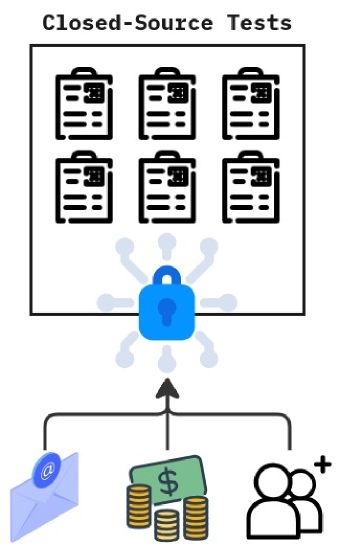
The image is a diagram illustrating the concept of closed-source tests. It depicts a process where tests, represented by clipboard icons, are secured by a lock and then lead to outcomes such as email communication, monetary gain, and user acquisition.
### Components/Axes
* **Title:** "Closed-Source Tests" at the top of the image.
* **Tests:** Six clipboard icons arranged in a 2x3 grid within a rectangular box. Each clipboard has a document with lines on it.
* **Lock:** A blue padlock icon positioned below the tests, connected to them by light blue lines emanating from the lock.
* **Arrow:** A black arrow pointing upwards from the bottom of the image towards the lock.
* **Outcomes:** Three icons at the bottom of the image, representing potential outcomes:
* An envelope with an "@" symbol, representing email communication.
* A stack of coins and a dollar bill, representing monetary gain.
* Two figures with a "+" sign, representing user acquisition.
### Detailed Analysis or Content Details
The diagram visually represents a process flow. The "Closed-Source Tests" are the initial input. These tests are secured, as indicated by the lock. The secured tests then lead to three potential outcomes: email communication, monetary gain, and user acquisition.
### Key Observations
* The lock symbolizes the security aspect of closed-source testing.
* The arrow indicates the direction of the process, from outcomes to the secured tests.
* The three icons at the bottom represent the potential benefits or results of conducting closed-source tests.
### Interpretation
The diagram suggests that closed-source tests are a secure method that can lead to positive outcomes for a company or organization. The lock emphasizes the proprietary nature of the tests, and the outcomes highlight the potential benefits of using this approach. The diagram implies a causal relationship between the tests, their security, and the resulting outcomes.