## Conceptual Diagram: Inputs to Closed-Source Testing
### Overview
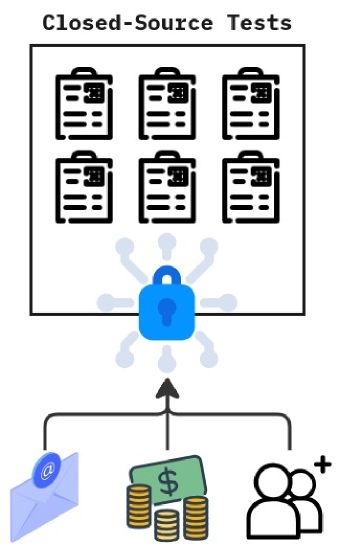
The image is a conceptual diagram illustrating the dependencies and inputs required to conduct "Closed-Source Tests." It utilizes a bottom-up flow, where three distinct resource categories (communication, capital, and human resources) converge to support a restricted, proprietary testing environment.
### Components/Axes
* **Header (Top):** A rectangular container labeled "Closed-Source Tests." Inside are six clipboard icons, each featuring a small grid or chart graphic.
* **Central Hub (Middle):** A blue, closed padlock icon. This acts as a central node, connected to the "Closed-Source Tests" box above via radiating lines, symbolizing security, restriction, or proprietary control.
* **Inputs (Bottom):** Three distinct icons arranged horizontally, representing the resources feeding into the central hub:
* **Left:** An envelope icon with an "@" symbol.
* **Center:** A stack of gold coins and a green dollar bill.
* **Right:** An icon depicting two human figures with a "+" sign.
* **Flow:** A central arrow points upward from the bottom inputs toward the padlock, indicating that these three elements are the drivers or requirements for the testing process.
### Detailed Analysis
* **Closed-Source Tests (Top):** The box contains six identical clipboard icons. The presence of these icons suggests a structured, perhaps bureaucratic, testing phase. The "Closed-Source" label implies that the methodology, results, or the software itself is proprietary and not accessible to the public.
* **The Padlock (Center):** The blue padlock is the focal point of the diagram. It serves as a gatekeeper. The radiating lines connecting it to the clipboard box suggest that the testing process is "locked" or protected.
* **Input Icons (Bottom):**
* **Communication/Outreach (Left):** The envelope with the "@" symbol represents the need for communication, email outreach, or perhaps user feedback loops within a closed environment.
* **Financial Capital (Center):** The stack of coins and dollar bill represents the necessity of funding, budget, or financial investment to sustain the testing process.
* **Human Resources (Right):** The two figures with a "+" sign represent the need for team expansion, hiring, or the involvement of specific personnel to conduct the tests.
### Key Observations
* **Resource Dependency:** The diagram explicitly links the "Closed-Source" nature of the tests to three specific, tangible inputs: communication, money, and people.
* **Centralization:** The padlock acts as the central point of convergence, emphasizing that the testing process is a controlled, restricted activity.
* **Symmetry:** The three bottom icons are presented with equal visual weight, suggesting that these three pillars are equally critical to the operation of the closed-source testing model.
### Interpretation
This diagram serves as a critique or a structural breakdown of the closed-source development model. It suggests that proprietary testing is not an organic or decentralized process; rather, it is a resource-intensive operation that requires specific, traditional corporate inputs.
By placing the "Closed-Source Tests" behind a padlock, the diagram implies a "black box" approach. The inputs (money, people, communication) are consumed by the process, but the output or the internal workings of the tests remain restricted. This contrasts with open-source models, which typically rely on community contribution rather than the specific combination of capital and hiring depicted here. The diagram effectively communicates that closed-source testing is a gated, managed, and funded endeavor.