\n
## Diagram: Closed-Source Tests and Access
### Overview
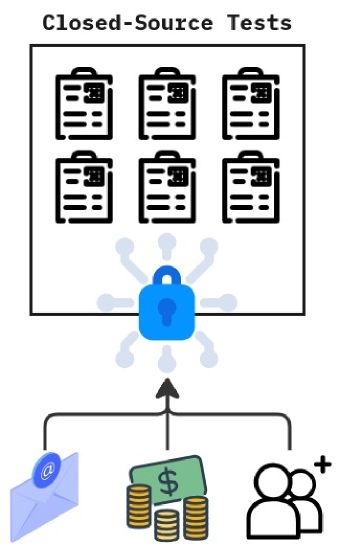
The image is a diagram illustrating the access to "Closed-Source Tests" through various means. It depicts a central locked icon representing restricted access, with arrows indicating input from three sources: email, money (represented by a stack of coins), and people (represented by a figure with a plus sign). Above the lock are six document icons, suggesting multiple tests or reports.
### Components/Axes
The diagram consists of the following components:
* **Header:** "Closed-Source Tests"
* **Central Element:** A blue padlock icon.
* **Input Sources:**
* An envelope icon (representing email).
* A stack of gold coins with a dollar sign (representing money).
* A figure with a plus sign (representing people/users).
* **Output:** Six document icons arranged in a 3x2 grid.
* **Arrows:** Curved arrows connecting the input sources to the padlock and the padlock to the document icons.
### Detailed Analysis or Content Details
The diagram does not contain numerical data or precise values. It is a conceptual representation of access control.
* **Closed-Source Tests:** The title indicates the subject of the diagram.
* **Padlock:** The padlock symbolizes restricted access to the tests.
* **Email:** The envelope suggests that access can be granted or triggered via email.
* **Money:** The coins indicate that financial transactions may be involved in gaining access.
* **People:** The figure with a plus sign suggests that user accounts or a growing user base are related to access.
* **Documents:** The six document icons represent the closed-source tests themselves. The documents all appear to have a similar layout, with a table or grid-like structure.
### Key Observations
The diagram highlights that access to closed-source tests is not freely available and is controlled by at least three factors: email, money, and user accounts. The multiple document icons suggest a collection of tests or reports. The arrows indicate a flow of influence from the input sources to the tests, mediated by the padlock.
### Interpretation
The diagram illustrates a gated access model for closed-source tests. This suggests that the tests are valuable or proprietary, and access is granted based on specific conditions. The presence of money as an access factor implies a potential commercial aspect, such as paid subscriptions or licensing. The email and user account components suggest that access may be managed through user registration, authentication, and potentially email-based verification or notifications. The diagram implies a system where access is not automatic but requires some form of interaction or transaction. The tests themselves are likely reports or evaluations that are not publicly available. The diagram is a high-level conceptual overview and does not provide details about the specific mechanisms of access control.