## Grid-Based Configuration Diagram: Stage Layout Analysis
### Overview
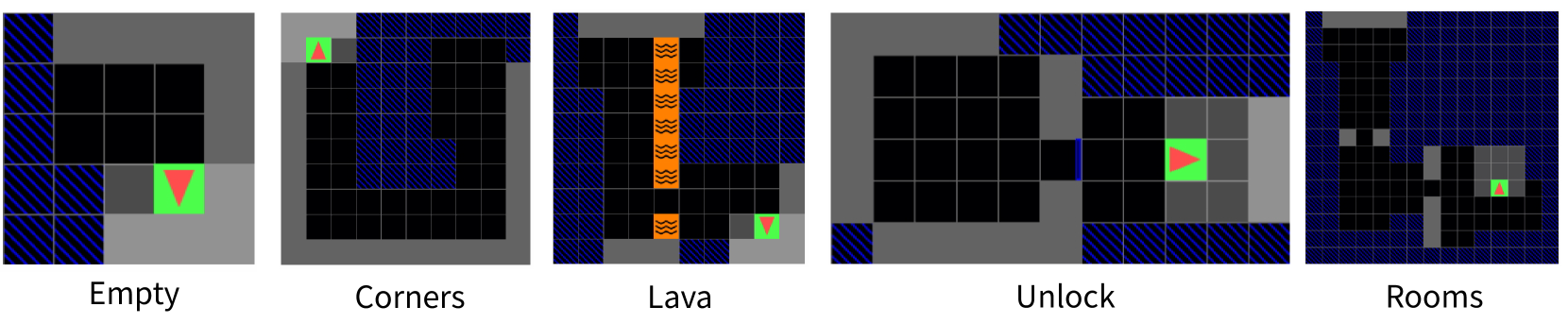
The image presents five distinct grid-based configurations labeled "Empty," "Corners," "Lava," "Unlock," and "Rooms." Each panel features a 5x5 grid with colored blocks (blue diagonal stripes, black, gray) and symbolic markers (green squares with red triangles). The configurations appear to represent progressive stages or environmental states in a spatial puzzle or game environment.
### Components/Axes
1. **Grid Structure**:
- All panels use a 5x5 cell grid
- Cells contain:
- Blue diagonal stripes (likely walls/obstacles)
- Black solid blocks (solid barriers)
- Gray areas (empty/neutral space)
- Green squares with red triangles (dynamic markers)
- Orange wavy lines (hazard indicators)
2. **Marker System**:
- Green squares with red triangles consistently appear in specific positions across panels
- Triangle orientation varies (pointing up/down/left/right)
3. **Color Legend** (inferred):
- Blue diagonal stripes: Permanent walls
- Black blocks: Unbreakable barriers
- Gray areas: Traversable space
- Green squares: Objective points
- Orange wavy lines: Lava/hazard zones
- Red triangles: Directional indicators
### Detailed Analysis
1. **Empty Panel**:
- 3x3 black block cluster in center
- Green square with downward-pointing triangle at bottom-right
- Blue stripes form a border pattern
2. **Corners Panel**:
- L-shaped black barrier in top-left quadrant
- Green square with upward-pointing triangle at top-left
- Blue stripes concentrated in bottom-right quadrant
3. **Lava Panel**:
- Vertical orange wavy lines in center column (cells 3-4)
- Green square with downward-pointing triangle at bottom-right
- Blue stripes form a U-shape around hazard zone
4. **Unlock Panel**:
- Central black block cluster (cells 3-4)
- Green square with upward-pointing triangle at center
- Blue stripes form a cross pattern
5. **Rooms Panel**:
- Complex black barrier configuration forming multiple chambers
- Green square with downward-pointing triangle at bottom-right
- Blue stripes create a maze-like perimeter
### Key Observations
1. **Marker Consistency**: Green squares with red triangles appear in bottom-right quadrant across all panels except "Corners" (top-left) and "Unlock" (center)
2. **Hazard Pattern**: Orange wavy lines only appear in "Lava" panel, suggesting environmental state change
3. **Barrier Evolution**: Black block clusters increase in complexity from "Empty" to "Rooms" panel
4. **Directional Indicators**: Triangle orientation changes correlate with panel progression
5. **Spatial Constraints**: Blue diagonal stripes increase in density from "Empty" to "Rooms" panel
### Interpretation
This diagram appears to represent a level progression system in a spatial puzzle game. The green squares with red triangles likely represent objectives that must be reached while navigating evolving environmental constraints:
1. **Progression Logic**:
- "Empty" → Basic navigation
- "Corners" → Introduces directional challenges
- "Lava" → Adds hazard avoidance
- "Unlock" → Requires central objective activation
- "Rooms" → Complex maze navigation
2. **Design Patterns**:
- The consistent bottom-right placement of markers suggests a primary objective location
- Increasing barrier complexity correlates with panel progression
- Orange hazard lines in "Lava" panel indicate temporary environmental state
3. **Anomalies**:
- "Corners" panel's top-left marker placement breaks the bottom-right pattern
- "Unlock" panel's central marker suggests a different interaction mechanic
4. **Technical Implications**:
- The grid-based system implies discrete movement mechanics
- Color-coded elements suggest a rule-based interaction system
- The progression from simple to complex configurations indicates increasing difficulty
This visualization effectively demonstrates how spatial constraints and environmental states evolve in a procedural generation system, with clear visual cues for player navigation and objective tracking.