## Chart: Accuracy vs. Time for Different Parameters
### Overview
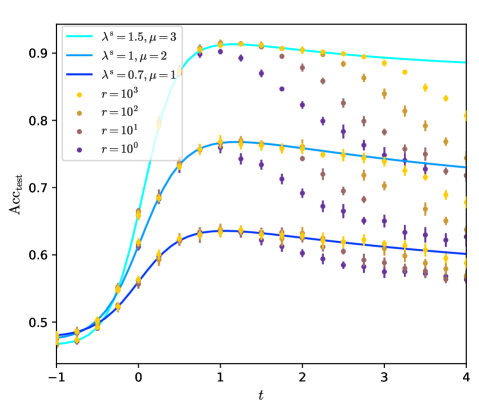
The image is a line chart showing the test accuracy (Acc_test) as a function of time (t) for different values of parameters lambda (λ), mu (μ), and r. The chart includes three solid lines representing different combinations of λ and μ, and scattered data points with error bars representing different values of r.
### Components/Axes
* **X-axis:** Time (t), ranging from -1 to 4.
* **Y-axis:** Test Accuracy (Acc_test), ranging from 0.5 to 0.9.
* **Legend (Top-Left):**
* Cyan line: λ^s = 1.5, μ = 3
* Light Blue line: λ^s = 1, μ = 2
* Dark Blue line: λ^s = 0.7, μ = 1
* Yellow dots: r = 10^3
* Olive dots: r = 10^2
* Brown dots: r = 10^1
* Purple dots: r = 10^0
### Detailed Analysis
* **Cyan Line (λ^s = 1.5, μ = 3):** The line starts at approximately 0.47 at t = -1, increases rapidly to approximately 0.91 at t = 1, and then decreases slightly to approximately 0.89 at t = 4.
* **Light Blue Line (λ^s = 1, μ = 2):** The line starts at approximately 0.47 at t = -1, increases rapidly to approximately 0.77 at t = 1, and then decreases slightly to approximately 0.73 at t = 4.
* **Dark Blue Line (λ^s = 0.7, μ = 1):** The line starts at approximately 0.47 at t = -1, increases rapidly to approximately 0.64 at t = 1, and then decreases slightly to approximately 0.57 at t = 4.
* **Yellow Dots (r = 10^3):** The yellow dots closely follow the light blue line (λ^s = 1, μ = 2).
* **Olive Dots (r = 10^2):** The olive dots are generally above the dark blue line (λ^s = 0.7, μ = 1).
* **Brown Dots (r = 10^1):** The brown dots are generally below the light blue line (λ^s = 1, μ = 2).
* **Purple Dots (r = 10^0):** The purple dots are generally below the light blue line (λ^s = 1, μ = 2).
### Key Observations
* The test accuracy increases rapidly between t = -1 and t = 1 for all parameter combinations.
* The test accuracy tends to decrease slightly after t = 1 for all parameter combinations.
* Higher values of λ and μ result in higher test accuracy.
* The scattered data points (r values) show more variance than the lines.
### Interpretation
The chart demonstrates the relationship between test accuracy and time for different parameter settings. The parameters λ and μ appear to have a significant impact on the maximum achievable test accuracy. The parameter 'r' introduces variance in the test accuracy, with different values of 'r' resulting in different distributions of accuracy around the lines defined by λ and μ. The initial increase in accuracy likely represents the learning phase of the model, while the subsequent decrease may indicate overfitting or a decline in the model's ability to generalize as time progresses. The data suggests that optimizing λ and μ is crucial for achieving high test accuracy, while the choice of 'r' may influence the stability and variance of the model's performance.