\n
## Diagram: Safety Capability Framework
### Overview
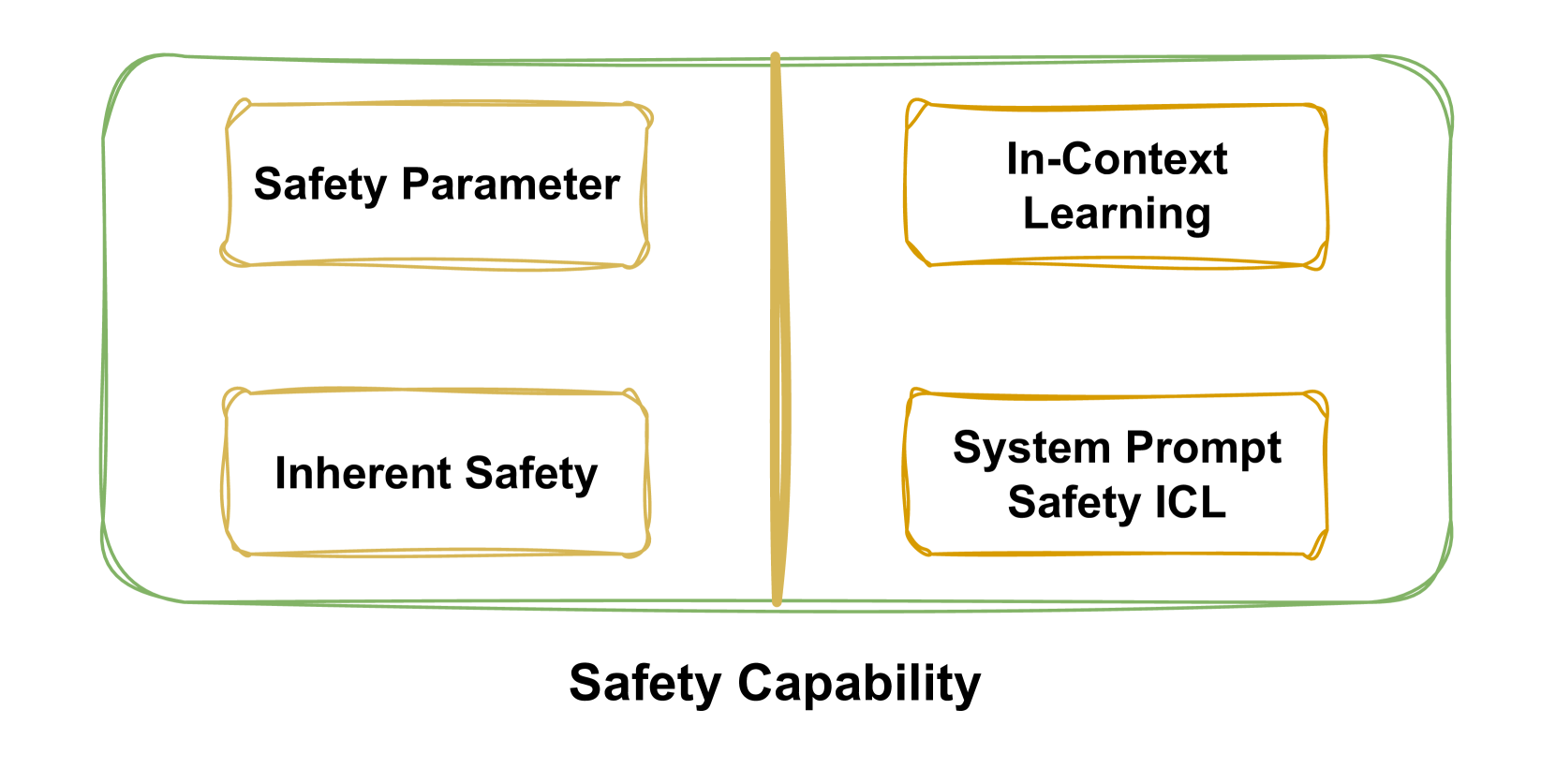
The image presents a 2x2 matrix diagram outlining a framework for "Safety Capability". The diagram categorizes different approaches to safety within a system, likely related to AI or large language models, based on two dimensions. The diagram is enclosed in a green rounded rectangle.
### Components/Axes
The diagram is structured as a matrix with the following categories:
* **Top-Left:** "Safety Parameter"
* **Top-Right:** "In-Context Learning"
* **Bottom-Left:** "Inherent Safety"
* **Bottom-Right:** "System Prompt Safety ICL"
Below the matrix, centered, is the label: "Safety Capability".
### Detailed Analysis or Content Details
The diagram consists of four rectangular blocks, each containing a label. The blocks are arranged in a 2x2 grid. Each block is outlined with a thin black line and has rounded corners. The entire diagram is enclosed in a thicker green rounded rectangle.
* **Safety Parameter:** Located in the top-left quadrant.
* **In-Context Learning:** Located in the top-right quadrant.
* **Inherent Safety:** Located in the bottom-left quadrant.
* **System Prompt Safety ICL:** Located in the bottom-right quadrant. This label is longer and appears to be a combination of "System Prompt" and "In-Context Learning" (ICL).
### Key Observations
The diagram presents a categorization of safety approaches. The terms suggest a progression or different levels of safety implementation. "In-Context Learning" and "System Prompt Safety ICL" both include "ICL", indicating a reliance on this technique. "Inherent Safety" suggests a foundational approach, while "Safety Parameter" implies a more adjustable or configurable safety mechanism.
### Interpretation
This diagram likely represents a framework for evaluating or implementing safety measures in a system, potentially an AI model. The four categories represent different strategies for ensuring safe operation.
* **Safety Parameter** could refer to adjustable settings or constraints that limit the system's behavior.
* **In-Context Learning** suggests leveraging examples provided during runtime to guide the system towards safe responses.
* **Inherent Safety** implies designing the system with safety as a core principle, potentially through architectural choices or training data selection.
* **System Prompt Safety ICL** combines the use of carefully crafted system prompts with in-context learning to steer the model towards safe outputs.
The diagram suggests that these approaches are not mutually exclusive and can be used in combination to achieve a robust safety capability. The arrangement in a matrix implies that the categories may represent different levels or types of safety, or different trade-offs between them. The diagram doesn't provide quantitative data or specific details about each approach, but it offers a conceptual overview of a safety framework.