## Diagram: Safety Capability Framework
### Overview
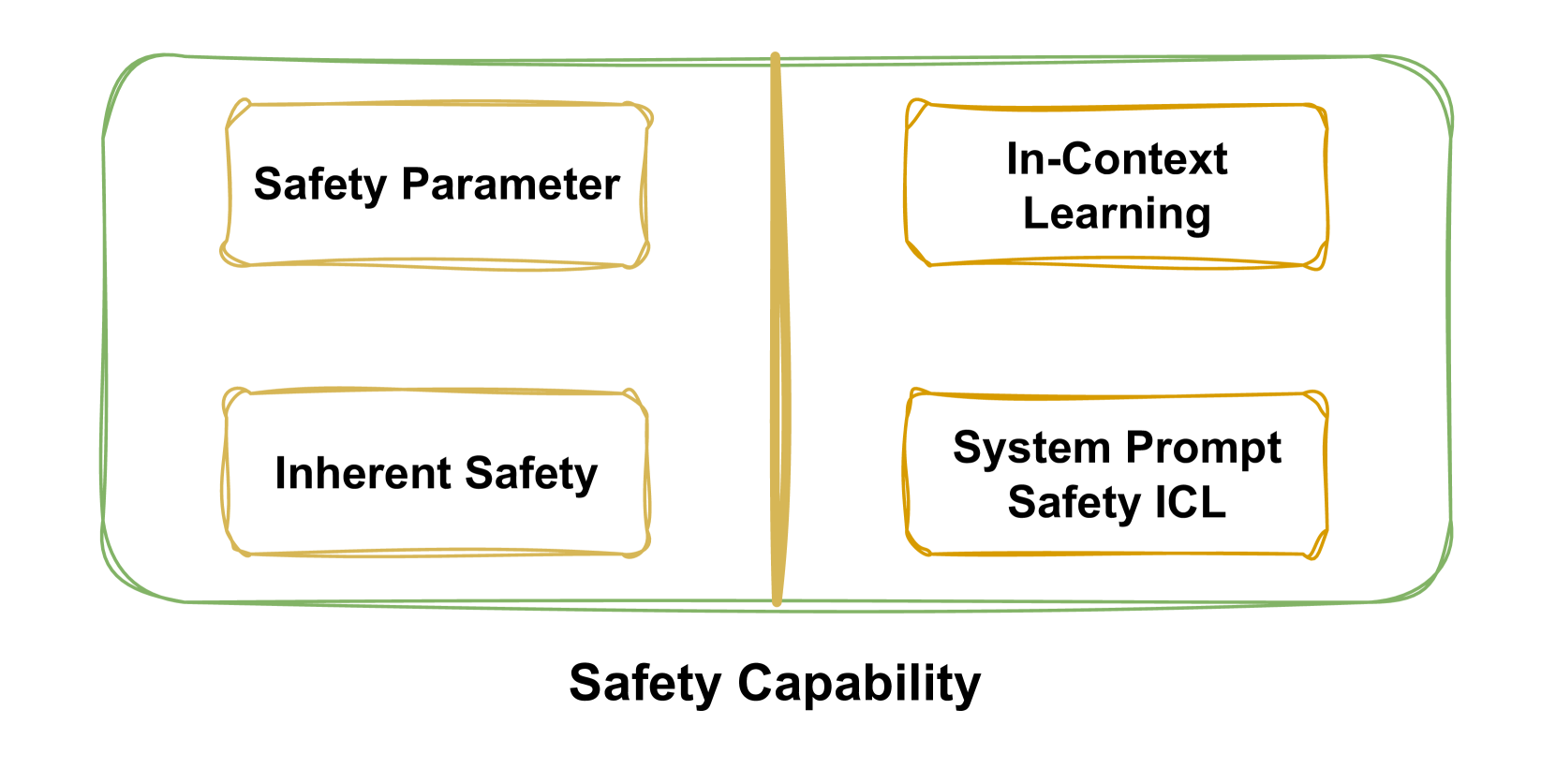
The diagram illustrates a conceptual framework for "Safety Capability" divided into two primary columns separated by a vertical line. The left column focuses on foundational safety elements, while the right column emphasizes adaptive learning-based safety mechanisms. All components are enclosed in yellow boxes with green outlines against a white background, framed by a green border.
### Components/Axes
- **Title**: "Safety Capability" (bold black text at the bottom center).
- **Left Column**:
1. **Safety Parameter** (top-left box).
2. **Inherent Safety** (bottom-left box).
- **Right Column**:
1. **In-Context Learning** (top-right box).
2. **System Prompt Safety ICL** (bottom-right box).
- **Visual Structure**:
- Vertical line divides the diagram into two equal halves.
- Green outline around all boxes and border.
- No numerical data, legends, or scales present.
### Detailed Analysis
- **Left Column (Foundational Safety)**:
- **Safety Parameter**: Likely refers to predefined metrics or thresholds for safety evaluation.
- **Inherent Safety**: Suggests built-in, non-adaptive safety features or protocols.
- **Right Column (Adaptive Safety)**:
- **In-Context Learning**: Implies safety mechanisms that learn from contextual data during operation.
- **System Prompt Safety ICL**: Combines system-level prompts with In-Context Learning for safety-critical tasks.
### Key Observations
- The separation by the vertical line indicates a dichotomy between static (left) and dynamic (right) safety approaches.
- Yellow boxes with green outlines may symbolize critical components within the broader safety framework.
- No explicit connections (e.g., arrows, dependencies) are shown between components, leaving relationships implicit.
### Interpretation
The diagram positions **Safety Capability** as a dual-axis system:
1. **Foundational Elements** (left): Establish baseline safety through predefined parameters and inherent safeguards.
2. **Adaptive Mechanisms** (right): Enhance safety through context-aware learning and prompt-based interventions.
The lack of explicit linkages suggests these components may operate in parallel or as complementary layers. The use of distinct colors (yellow boxes, green outlines) could imply modularity or prioritization. This framework likely addresses safety in AI/ML systems, where static rules (inherent safety) and dynamic learning (in-context adaptation) are both critical for robust performance.