## Diagram: Symbolic Reasoning Modules
### Overview
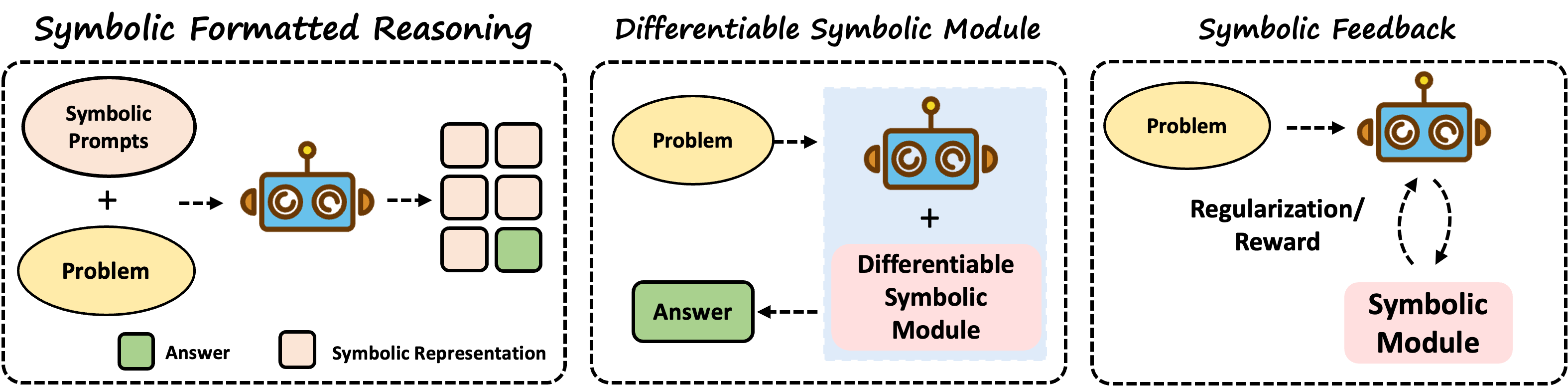
The image presents a diagram illustrating three different approaches to symbolic reasoning: Symbolic Formatted Reasoning, Differentiable Symbolic Module, and Symbolic Feedback. Each approach is depicted within a dashed-line box, showing the flow of information and the interaction between different components.
### Components/Axes
* **Titles:**
* Symbolic Formatted Reasoning (top-left)
* Differentiable Symbolic Module (top-center)
* Symbolic Feedback (top-right)
* **Shapes:**
* Ovals: Representing "Symbolic Prompts," "Problem," and "Answer."
* Rounded Rectangles: Representing "Symbolic Representation" and "Differentiable Symbolic Module" and "Symbolic Module".
* Robot Icon: Represents a reasoning agent or module.
* **Arrows:** Dashed arrows indicate the flow of information or processing steps.
* **Legend:** Located at the bottom-left:
* Green Square: "Answer"
* Peach Square: "Symbolic Representation"
### Detailed Analysis
**1. Symbolic Formatted Reasoning (Left)**
* **Input:** "Symbolic Prompts" (yellow oval) + "Problem" (yellow oval)
* **Process:** The "Symbolic Prompts" and "Problem" are fed into a robot icon.
* **Output:** The robot's output is transformed into a set of symbolic representations (peach rounded rectangles). These representations lead to a final "Answer" (green rounded rectangle).
* **Flow:** Symbolic Prompts + Problem -> Robot -> Symbolic Representations -> Answer
**2. Differentiable Symbolic Module (Center)**
* **Input:** "Problem" (yellow oval)
* **Process:** The "Problem" is fed into a robot icon. The robot is combined with a "Differentiable Symbolic Module" (pink rounded rectangle).
* **Output:** "Answer" (green rounded rectangle)
* **Flow:** Problem -> Robot + Differentiable Symbolic Module -> Answer
**3. Symbolic Feedback (Right)**
* **Input:** "Problem" (yellow oval)
* **Process:** The "Problem" is fed into a robot icon. The robot's output is used to generate "Regularization/Reward" which is fed back into a "Symbolic Module" (pink rounded rectangle). The "Symbolic Module" then influences the robot.
* **Flow:** Problem -> Robot -> Regularization/Reward <-> Symbolic Module -> Robot (feedback loop)
### Key Observations
* The diagram highlights three distinct approaches to symbolic reasoning, each with a different architecture and flow of information.
* The "Differentiable Symbolic Module" integrates a differentiable component, likely for learning or optimization.
* The "Symbolic Feedback" approach incorporates a feedback loop, suggesting an iterative refinement process.
### Interpretation
The diagram illustrates different ways to integrate symbolic reasoning with other techniques, such as differentiable learning and feedback mechanisms. The "Symbolic Formatted Reasoning" approach relies on pre-defined symbolic representations, while the "Differentiable Symbolic Module" allows for learning and adaptation. The "Symbolic Feedback" approach suggests a more dynamic and iterative reasoning process, where the system learns from its mistakes and refines its reasoning strategies. The choice of approach depends on the specific problem and the desired trade-offs between interpretability, adaptability, and performance.