\n
## Diagram: Symbolic Reasoning Framework
### Overview
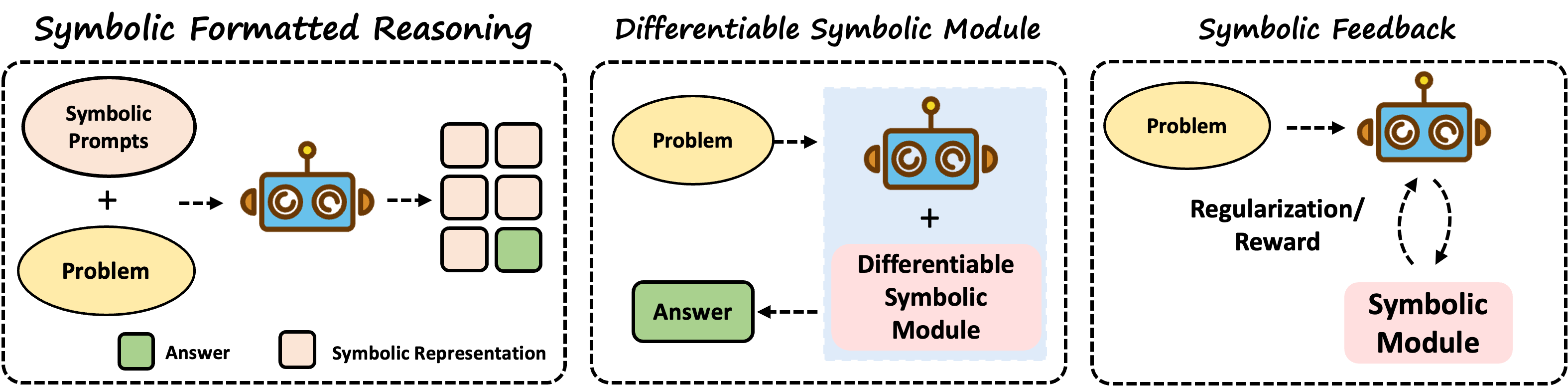
The image depicts a diagram illustrating a symbolic reasoning framework composed of three interconnected modules: Symbolic Formatted Reasoning, Differentiable Symbolic Module, and Symbolic Feedback. The diagram uses circles and rectangles to represent components and arrows to indicate the flow of information between them. The overall structure suggests an iterative process where symbolic prompts are processed, refined through a differentiable module, and then evaluated with feedback.
### Components/Axes
The diagram is divided into three main sections, each representing a module. Each module contains circles labeled "Problem" and a series of connected circles with a "key" symbol. Rectangles represent "Answer" and "Symbolic Representation". The diagram also includes a legend at the bottom-left corner:
* Solid Black Border: Answer
* Dashed Black Border: Symbolic Representation
### Detailed Analysis or Content Details
**1. Symbolic Formatted Reasoning (Left Module):**
* Contains a circle labeled "Problem".
* An arrow points from "Symbolic Prompts" to the "Problem" circle, indicated by a "+" symbol.
* The "Problem" circle is connected to a series of four circles with a "key" symbol.
* An arrow points from these four circles to a set of four rectangles: two with solid black borders (representing "Answer") and two with dashed black borders (representing "Symbolic Representation").
**2. Differentiable Symbolic Module (Center Module):**
* Contains a circle labeled "Problem".
* An arrow points from the "Problem" circle to a series of four circles with a "key" symbol.
* An arrow points from these four circles to the "Differentiable Symbolic Module" component.
* An arrow points from the "Differentiable Symbolic Module" to a rectangle labeled "Answer".
**3. Symbolic Feedback (Right Module):**
* Contains a circle labeled "Problem".
* The "Problem" circle is connected to a series of four circles with a "key" symbol.
* An arrow points from these four circles to the "Symbolic Module".
* A dashed arrow points from the "Symbolic Module" back to the "Symbolic Module", labeled "Regularization/Reward".
### Key Observations
* The "Problem" circle appears in all three modules, suggesting it is a central element of the framework.
* The "key" symbol circles are consistently connected to the "Problem" circles, potentially representing intermediate steps or variables in the reasoning process.
* The "Symbolic Feedback" module introduces a feedback loop, indicating an iterative refinement process.
* The use of solid and dashed borders for rectangles distinguishes between "Answer" and "Symbolic Representation".
### Interpretation
The diagram illustrates a framework for symbolic reasoning that combines symbolic and differentiable approaches. The "Symbolic Formatted Reasoning" module likely represents the initial stage where symbolic prompts are used to define a problem. The "Differentiable Symbolic Module" then processes this problem using differentiable techniques, potentially for optimization or learning. Finally, the "Symbolic Feedback" module uses the results to refine the process through regularization or reward signals. The iterative nature of the framework, as indicated by the feedback loop, suggests a continuous improvement process. The diagram doesn't provide specific data or numerical values, but rather a conceptual overview of the framework's architecture and information flow. The consistent use of the "Problem" and "key" symbol circles across modules suggests a standardized representation of the reasoning process.