## Diagram: Symbolic Reasoning Architecture
### Overview
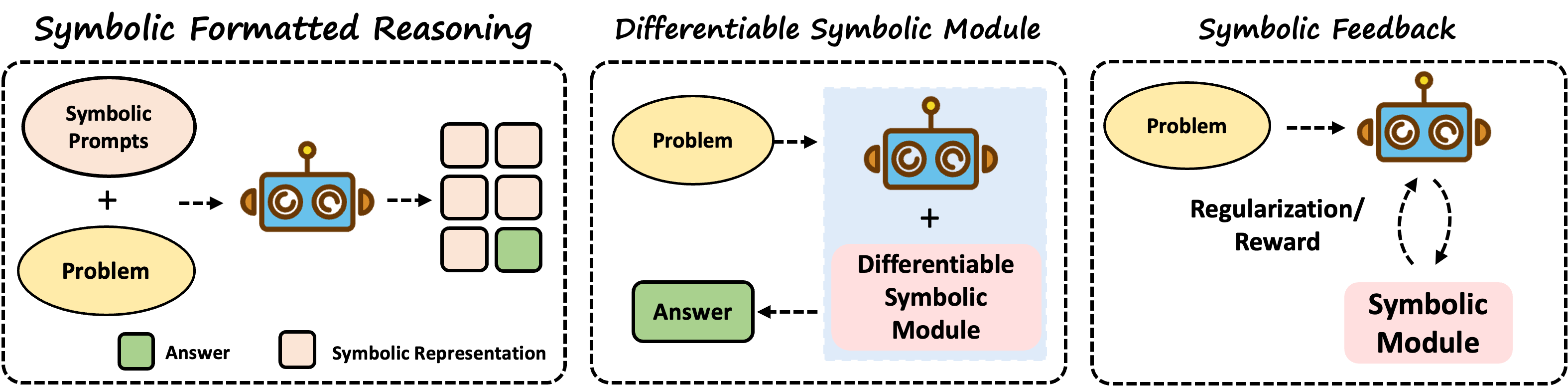
The diagram illustrates three interconnected components of a symbolic reasoning system:
1. **Symbolic Formatted Reasoning** (left)
2. **Differentiable Symbolic Module** (center)
3. **Symbolic Feedback** (right)
Each section uses color-coded elements (pink, yellow, green, peach) to represent inputs, processes, and outputs, with a central robot icon symbolizing the AI system.
---
### Components/Axes
#### Legend (bottom-left):
- **Green**: Answer
- **Pink**: Symbolic Prompts / Symbolic Module
- **Yellow**: Problem
- **Peach**: Symbolic Representation
#### Key Elements:
1. **Robot Icon**:
- Blue body with brown accents (ears, antenna, eyes).
- Appears in all three sections as a central processing unit.
2. **Flow Arrows**:
- Dashed lines indicate input/output relationships.
- Solid arrows denote direct connections (e.g., feedback loop).
---
### Detailed Analysis
#### 1. Symbolic Formatted Reasoning (Left)
- **Inputs**:
- **Symbolic Prompts** (pink oval, top-left).
- **Problem** (yellow oval, bottom-left).
- **Process**:
- Robot icon processes inputs → **Symbolic Representation** (peach squares, 6 total).
- **Output**:
- **Answer** (green square, bottom-right).
#### 2. Differentiable Symbolic Module (Center)
- **Inputs**:
- **Problem** (yellow oval, top-left).
- **Process**:
- Robot icon + **Differentiable Symbolic Module** (pink rectangle, bottom-right).
- **Output**:
- **Answer** (green rectangle, bottom-left).
#### 3. Symbolic Feedback (Right)
- **Inputs**:
- **Problem** (yellow oval, top-left).
- **Process**:
- Robot icon → **Symbolic Module** (pink rectangle, bottom-right).
- **Feedback Loop**:
- Dashed circular arrow labeled **"Regularization/Reward"** connects Symbolic Module back to the robot.
---
### Key Observations
1. **Robot as Central Node**:
- The robot icon is consistently positioned as the intermediary between inputs, modules, and outputs across all sections.
2. **Differentiable Module Integration**:
- The center section introduces a **Differentiable Symbolic Module** (pink), suggesting a bridge between symbolic reasoning and gradient-based optimization.
3. **Feedback Mechanism**:
- The right section emphasizes iterative improvement via **Regularization/Reward**, indicating adaptive learning.
4. **Color Consistency**:
- **Pink** is used for both Symbolic Prompts and the Symbolic Module, implying shared symbolic processing roles.
- **Green** (Answer) and **Yellow** (Problem) are distinct across all sections.
---
### Interpretation
This diagram demonstrates a hybrid AI architecture where:
- **Symbolic reasoning** (left) provides structured, rule-based problem-solving.
- A **differentiable module** (center) enables learning from data while preserving symbolic logic.
- **Feedback loops** (right) allow the system to refine its reasoning through rewards/regularization, akin to reinforcement learning.
The robot icon symbolizes the AI agent integrating these components, while the color-coded elements clarify the flow of information. The feedback loop highlights the system’s capacity for self-improvement, critical for dynamic environments.
**Notable Design Choice**: The use of dashed lines for feedback contrasts with solid arrows for direct connections, visually emphasizing the iterative nature of the feedback process.