## Line Graph: Gating Ablation Study
### Overview
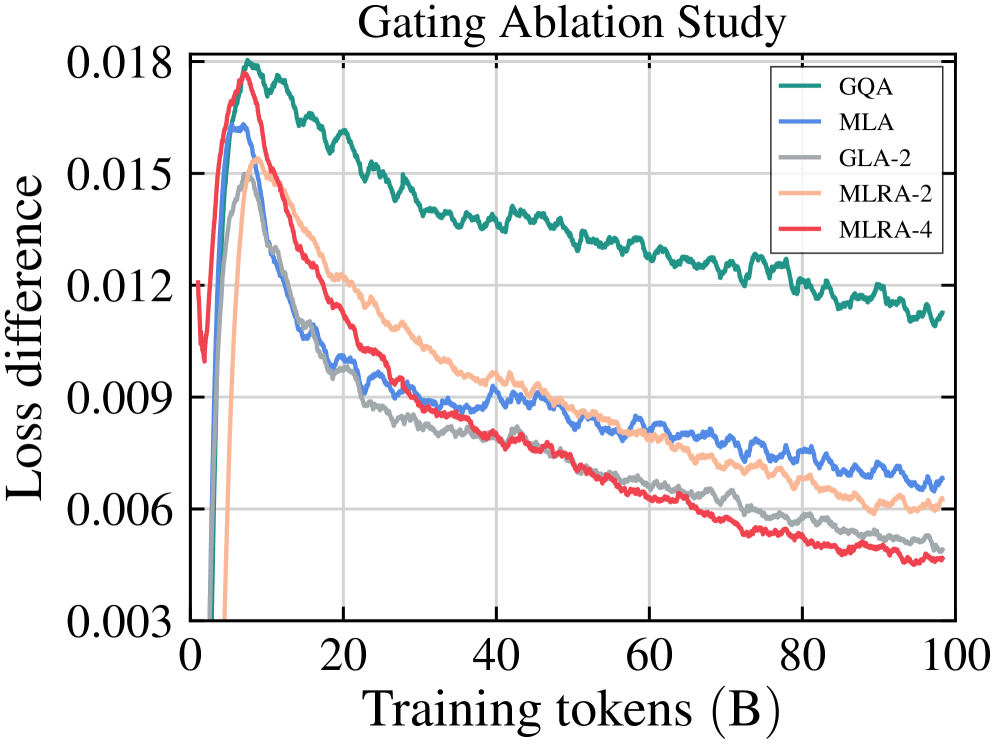
The chart illustrates the relationship between training tokens (B) and loss difference across five gating mechanisms: GQA, MLA, GLA-2, MLRA-2, and MLRA-4. All lines originate near 0.018 loss difference at 0 tokens and exhibit distinct decay patterns as training tokens increase to 100.
### Components/Axes
- **X-axis**: Training tokens (B) [0, 20, 40, 60, 80, 100]
- **Y-axis**: Loss difference [0.003, 0.006, 0.009, 0.012, 0.015, 0.018]
- **Legend**: Located in top-right corner with color-coded labels:
- Teal: GQA
- Blue: MLA
- Gray: GLA-2
- Orange: MLRA-2
- Red: MLRA-4
### Detailed Analysis
1. **GQA (Teal)**:
- Starts at ~0.018 loss difference
- Gradual linear decline to ~0.012 by 100 tokens
- Maintains highest loss difference throughout
2. **MLA (Blue)**:
- Sharp initial drop from ~0.018 to ~0.009 in first 20 tokens
- Slower decay to ~0.007 by 100 tokens
- Second-highest loss difference after GQA
3. **GLA-2 (Gray)**:
- Steep decline from ~0.018 to ~0.008 in first 20 tokens
- Gradual decay to ~0.006 by 100 tokens
- Third-highest loss difference
4. **MLRA-2 (Orange)**:
- Sharp drop from ~0.018 to ~0.009 in first 20 tokens
- Slower decay to ~0.007 by 100 tokens
- Overlaps with MLA after 40 tokens
5. **MLRA-4 (Red)**:
- Steepest initial drop from ~0.018 to ~0.008 in first 20 tokens
- Rapid decay to ~0.006 by 40 tokens
- Lowest loss difference by 100 tokens (~0.005)
### Key Observations
- All methods show rapid initial loss reduction (first 20 tokens)
- GQA maintains consistently higher loss difference than other methods
- MLRA-4 demonstrates fastest convergence to lowest loss difference
- Lines converge toward similar values after 60 tokens
- No outliers or anomalies detected
### Interpretation
The data suggests that gating mechanism architecture significantly impacts loss reduction efficiency during training. MLRA-4's steepest decay curve indicates superior early-stage performance, while GQA's sustained higher loss difference may reflect different optimization characteristics. The convergence of lines after 60 tokens implies diminishing returns on gating mechanism effectiveness beyond mid-training stages. These findings could inform architectural choices for balancing training speed and model performance in sequence modeling tasks.