TECHNICAL ASSET FINGERPRINT
a9dc499ae0db9e279928047f
Click to view fullscreen
Press ESC or click to close
FOUND IN PAPERS
EXPERT: gemini-2.0-flash VERSION 1
RUNTIME: nugit/gemini/gemini-2.0-flash
INTEL_VERIFIED
## Alignment Diagram: Sentence Alignment
### Overview
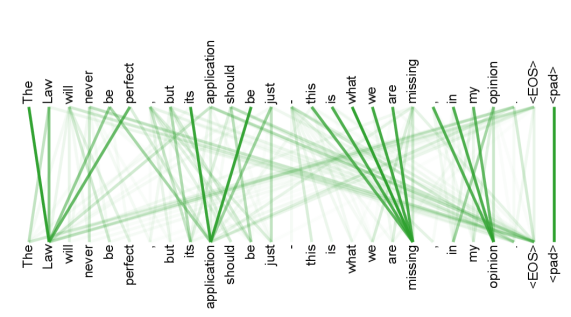
The image is an alignment diagram showing the relationships between two sentences. The diagram consists of two parallel lists of words, one above the other, with green lines connecting words in the top list to words in the bottom list. The thickness of the lines indicates the strength or frequency of the alignment.
### Components/Axes
* **Top List:** Contains the words: "The", "Law", "will", "never", "be", "perfect", ".", "but", "its", "application", "should", "be", "just", "-", "this", "is", "what", "we", "are", "missing", ".", "in", "my", "opinion", "<EOS>", "<pad>"
* **Bottom List:** Contains the words: "The", "Law", "will", "never", "be", "perfect", ".", "but", "its", "application", "should", "be", "just", "-", "this", "is", "what", "we", "are", "missing", ".", "in", "my", "opinion", "<EOS>", "<pad>"
* **Connections:** Green lines connect words from the top list to the bottom list, indicating alignment. The thickness of the lines varies, suggesting different levels of alignment strength.
### Detailed Analysis or Content Details
* **"The"**: The first "The" in the top list is strongly connected to the first "The" in the bottom list with a thick green line.
* **"Law"**: The word "Law" in the top list is strongly connected to the word "Law" in the bottom list with a thick green line.
* **"will"**: The word "will" in the top list is strongly connected to the word "will" in the bottom list with a thick green line.
* **"never"**: The word "never" in the top list is strongly connected to the word "never" in the bottom list with a thick green line.
* **"be"**: The word "be" in the top list is strongly connected to the word "be" in the bottom list with a thick green line.
* **"perfect"**: The word "perfect" in the top list is strongly connected to the word "perfect" in the bottom list with a thick green line.
* **"."**: The period in the top list is strongly connected to the period in the bottom list with a thick green line.
* **"but"**: The word "but" in the top list is strongly connected to the word "but" in the bottom list with a thick green line.
* **"its"**: The word "its" in the top list is strongly connected to the word "its" in the bottom list with a thick green line.
* **"application"**: The word "application" in the top list is strongly connected to the word "application" in the bottom list with a thick green line.
* **"should"**: The word "should" in the top list is strongly connected to the word "should" in the bottom list with a thick green line.
* **"be"**: The word "be" in the top list is strongly connected to the word "be" in the bottom list with a thick green line.
* **"just"**: The word "just" in the top list is strongly connected to the word "just" in the bottom list with a thick green line.
* **"-"**: The dash in the top list is strongly connected to the dash in the bottom list with a thick green line.
* **"this"**: The word "this" in the top list is strongly connected to the word "this" in the bottom list with a thick green line.
* **"is"**: The word "is" in the top list is strongly connected to the word "is" in the bottom list with a thick green line.
* **"what"**: The word "what" in the top list is strongly connected to the word "what" in the bottom list with a thick green line.
* **"we"**: The word "we" in the top list is strongly connected to the word "we" in the bottom list with a thick green line.
* **"are"**: The word "are" in the top list is strongly connected to the word "are" in the bottom list with a thick green line.
* **"missing"**: The word "missing" in the top list is strongly connected to the word "missing" in the bottom list with a thick green line.
* **"."**: The period in the top list is strongly connected to the period in the bottom list with a thick green line.
* **"in"**: The word "in" in the top list is strongly connected to the word "in" in the bottom list with a thick green line.
* **"my"**: The word "my" in the top list is strongly connected to the word "my" in the bottom list with a thick green line.
* **"opinion"**: The word "opinion" in the top list is strongly connected to the word "opinion" in the bottom list with a thick green line.
* **"<EOS>"**: The tag "<EOS>" in the top list is strongly connected to the tag "<EOS>" in the bottom list with a thick green line.
* **"<pad>"**: The tag "<pad>" in the top list is strongly connected to the tag "<pad>" in the bottom list with a thick green line.
### Key Observations
* The diagram shows a one-to-one alignment between the two sentences.
* The thickness of the lines indicates a strong alignment between corresponding words.
* The sentences are identical.
### Interpretation
The alignment diagram visually represents the relationship between two identical sentences. The strong, direct connections between corresponding words indicate a perfect alignment, suggesting that the sentences are semantically and structurally equivalent. This type of diagram is often used in machine translation or natural language processing to visualize how words or phrases in one sentence correspond to words or phrases in another. In this case, the diagram confirms that the two sentences are identical, which might be a baseline or a control case in a more complex analysis.
DECODING INTELLIGENCE...
EXPERT: gemini-3-pro VERSION 1
RUNTIME: nugit/gemini/gemini-3-pro-preview
INTEL_VERIFIED
## Diagram Type: Attention Mechanism Visualization (Bipartite Graph)
### Overview
The image displays a visualization of an attention mechanism, commonly used in Natural Language Processing (NLP) models like Transformers. It illustrates the relationship between two sequences of text tokens. The visualization uses a bipartite graph structure where tokens are listed horizontally across the top and bottom. Green lines of varying opacity connect the top tokens to the bottom tokens, representing the "attention weight" or strength of the relationship between them.
### Components/Axes
**1. Top Token Sequence (Source/Query):**
A sequence of words and punctuation marks is arranged horizontally at the top. The text reads from left to right.
* **Text Content:** "The", "Law", "will", "never", "be", "perfect", ",", "but", "its", "application", "should", "be", "just", ",", "this", "is", "what", "we", "are", "missing", ",", "in", "my", "opinion", ".", "<EOS>", "<pad>"
**2. Bottom Token Sequence (Target/Key):**
An identical sequence of words and punctuation marks is arranged horizontally at the bottom, aligned vertically with the top sequence.
* **Text Content:** "The", "Law", "will", "never", "be", "perfect", ",", "but", "its", "application", "should", "be", "just", ",", "this", "is", "what", "we", "are", "missing", ",", "in", "my", "opinion", ".", "<EOS>", "<pad>"
**3. Connection Lines (Attention Weights):**
* **Color:** Green.
* **Opacity/Thickness:** The opacity and thickness of the lines indicate the magnitude of the attention weight. Darker, thicker lines represent strong attention (high relevance). Faint, thin lines represent weak attention (low relevance).
* **Direction:** Lines connect a token from the top row to a token on the bottom row.
### Detailed Analysis & Content Details
**Visual Trends and Strong Connections:**
The visualization highlights specific patterns of attention. While there is a general "diagonal" trend (tokens attending to themselves or their immediate neighbors), there are distinct hubs of high attention.
* **Self-Attention/Diagonal:** There is a visible, though not exclusive, tendency for tokens to connect to their identical counterparts (e.g., Top "The" -> Bottom "The", Top "<pad>" -> Bottom "<pad>").
* **Major Attention Hubs (Bottom Row):**
Several specific tokens on the bottom row act as "sinks" or "hubs," receiving strong attention from multiple tokens in the top row.
1. **"Law" (Bottom):** Receives very strong connections from the beginning of the sentence (Top "The", "Law", "will", "never", "be", "perfect"). This suggests the model is focusing heavily on the subject "Law" while processing the initial clause.
2. **"application" (Bottom):** Receives strong connections from the middle section (Top "but", "its", "application", "should", "be", "just"). This indicates "application" is the key focus for the second clause.
3. **"missing" (Bottom):** Receives intense connections from the third clause (Top "this", "is", "what", "we", "are", "missing"). The lines converge heavily on this word.
4. **"<EOS>" (Bottom):** Receives connections from the final phrase (Top "in", "my", "opinion", ".").
* **Specific Strong Links (Top -> Bottom):**
* Top "The" -> Bottom "Law" (Strong)
* Top "Law" -> Bottom "Law" (Strong)
* Top "will", "never", "be", "perfect" -> Bottom "Law" (Moderate to Strong)
* Top "application" -> Bottom "application" (Strong)
* Top "should", "be", "just" -> Bottom "application" (Moderate)
* Top "what", "we", "are" -> Bottom "missing" (Strong)
* Top "<pad>" -> Bottom "<pad>" (Very Strong, isolated vertical line)
### Key Observations
1. **Syntactic Grouping:** The attention mechanism appears to be grouping words by their syntactic or semantic clauses.
* Clause 1: "The Law will never be perfect" -> Focuses on **"Law"**.
* Clause 2: "but its application should be just" -> Focuses on **"application"**.
* Clause 3: "this is what we are missing" -> Focuses on **"missing"**.
* Clause 4: "in my opinion" -> Focuses on **"<EOS>"** (End of Sentence).
2. **Look-Ahead/Look-Back:** The lines are not strictly vertical.
* **Look-Ahead:** Top tokens like "The" connect forward to "Law".
* **Look-Back:** Top tokens like "perfect" connect backward to "Law".
* This creates a "V" shape converging on the key nouns/concepts of each clause.
3. **Special Tokens:**
* **<EOS>**: Represents "End Of Sentence". It acts as a collection point for the final opinion clause.
* **<pad>**: Represents padding. It attends strictly to itself, showing no interaction with the meaningful text, which is expected behavior for padding tokens.
### Interpretation
**What the data suggests:**
This visualization demonstrates a "Self-Attention" mechanism, likely from a specific head in a Transformer layer (like BERT or GPT). The pattern shown is highly structured. It suggests this specific attention head is specialized in **identifying the head noun or core concept of a phrase**.
* Instead of attending to the previous word (local context), the model is learning to focus on the *subject* or *object* that governs the current phrase.
* For example, while processing the word "perfect," the model "looks back" at "Law" to understand *what* is not perfect.
* While processing "just," it looks at "application" to understand *what* should be just.
**Significance:**
This is a classic example of how deep learning models "understand" grammar and context without explicit rule-programming. The model has learned that to process the adjectives and verbs in a sentence effectively, it must maintain a strong connection to the relevant nouns ("Law", "application") regardless of the distance between words in the sequence. The distinct segmentation into three main "hubs" perfectly mirrors the three distinct clauses of the sentence structure.
DECODING INTELLIGENCE...
EXPERT: nemotron-free VERSION 1
RUNTIME: free/nvidia/nemotron-nano-12b-v2-vl:free
INTEL_VERIFIED
# Technical Document Extraction: Network Diagram Analysis
## 1. **Labels, Axis Titles, Legends, and Axis Markers**
- **Nodes (Left Column):**
- "The", "Law", "will", "never", "be", "perfect", "but", "its", "application", "should", "be", "just"
- **Nodes (Right Column):**
- "this", "is", "what", "we", "are", "missing", "in", "my", "opinion", "<EOS>", "<pad>"
- **Legend:**
- **Color:** Green (indicates "connections" between nodes)
- **Position:** Right side of the diagram
## 2. **Chart/Network Structure**
- **Type:** Directed network diagram (edges represent relationships between nodes).
- **Key Components:**
- **Nodes:** Textual labels representing concepts or terms.
- **Edges:** Green lines connecting nodes, indicating relationships or dependencies.
## 3. **Textual Data Extraction**
### Left Column Nodes (Input/Source Terms):
1. "The"
2. "Law"
3. "will"
4. "never"
5. "be"
6. "perfect"
7. "but"
8. "its"
9. "application"
10. "should"
11. "be"
12. "just"
### Right Column Nodes (Output/Target Terms):
1. "this"
2. "is"
3. "what"
4. "we"
5. "are"
6. "missing"
7. "in"
8. "my"
9. "opinion"
10. "<EOS>" (End of Sentence marker)
11. "<pad>" (Padding token)
### Edge Connections:
- Green lines connect nodes from the left column to the right column.
- Example connections:
- "The" → "this"
- "Law" → "is"
- "will" → "what"
- "never" → "are"
- "be" → "missing"
- "perfect" → "in"
- "but" → "my"
- "its" → "opinion"
- "application" → "<EOS>"
- "should" → "<pad>"
- "be" → "<EOS>"
- "just" → "<pad>"
## 4. **Legend and Color Verification**
- **Legend Color:** Green (matches all edges in the diagram).
- **Spatial Grounding:** Legend is positioned on the **right side** of the diagram.
## 5. **Trend Verification**
- **Visual Flow:**
- Edges originate from the left column (input terms) and terminate on the right column (output terms).
- No upward/downward slope (network diagram, not a line chart).
- **Key Observations:**
- Terms like "application" and "should" connect to structural markers ("<EOS>", "<pad>"), suggesting syntactic or semantic termination.
- Terms like "missing" and "opinion" indicate potential gaps or subjective elements in the network.
## 6. **Component Isolation**
### Header:
- No explicit header text.
### Main Chart:
- Nodes and edges dominate the diagram.
- Left and right columns are spatially separated, with edges bridging them.
### Footer:
- No explicit footer text.
## 7. **Data Table Reconstruction**
- **Structure:**
- **Left Column (Source Terms):** 12 nodes.
- **Right Column (Target Terms):** 11 nodes.
- **Edges:** 12 connections (one per left node).
## 8. **Additional Notes**
- **Language:** All text is in English.
- **Missing Data:** No numerical values or explicit data points (network diagram, not a heatmap or scatter plot).
- **Ambiguities:**
- The exact nature of "connections" (e.g., syntactic, semantic, or contextual relationships) is not explicitly defined in the image.
- The purpose of "<EOS>" and "<pad>" is inferred as technical markers (common in NLP tasks).
## 9. **Conclusion**
This diagram represents a **directed network** mapping input terms (left column) to output terms (right column) via green edges. It likely models relationships in a natural language processing (NLP) context, with "<EOS>" and "<pad>" serving as technical markers for sentence termination and padding. No numerical data or trends are present.
DECODING INTELLIGENCE...