\n
## Diagram: Dependency Graph of Words
### Overview
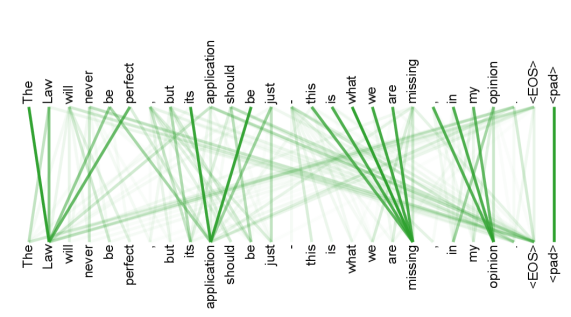
The image depicts a dependency graph visualizing relationships between words in a sentence or sequence. The words are arranged horizontally, and lines connect them, indicating dependencies. The graph appears to represent a linguistic structure, potentially from a natural language processing task.
### Components/Axes
The diagram consists of the following components:
* **Words:** The words are listed along the horizontal axis, from left to right: "The", "Law", "will", "never", "be", "perfect", "but", "its", "application", "should", "just", "this", "is", "what", "we", "are", "missing", "in", "my", "opinion", "<EOS>", "pad".
* **Lines:** Green lines connect the words, representing dependencies. The lines originate from words on the bottom row and terminate on words in the top row.
* **Vertical Axis:** The vertical position of the words and lines indicates the dependency relationships.
* **Legend:** A vertical green bar on the far right labeled "<EOS>" and "pad".
### Detailed Analysis
The diagram shows a complex network of dependencies. Here's a breakdown of the connections:
* "The" connects to "Law".
* "Law" connects to "will".
* "will" connects to "never".
* "never" connects to "be".
* "be" connects to "perfect".
* "perfect" connects to "but".
* "but" connects to "its".
* "its" connects to "application".
* "application" connects to "should".
* "should" connects to "just".
* "just" connects to "this".
* "this" connects to "is".
* "is" connects to "what".
* "what" connects to "we".
* "we" connects to "are".
* "are" connects to "missing".
* "missing" connects to "in".
* "in" connects to "my".
* "my" connects to "opinion".
* "opinion" connects to "<EOS>".
* "<EOS>" connects to "pad".
The lines are not strictly one-to-one; some words have multiple incoming connections. For example, "be" receives a connection from "never" and "perfect".
### Key Observations
The diagram illustrates a sequential dependency structure. The connections suggest a grammatical or semantic relationship between the words. The presence of "<EOS>" (End of Sentence) and "pad" suggests this is a representation of a sentence or a sequence of tokens used in a language model. The lines are relatively dense, indicating a high degree of interconnectedness between the words.
### Interpretation
This diagram likely represents the output of a dependency parser, a component of many natural language processing systems. Dependency parsing aims to identify the grammatical relationships between words in a sentence. The lines in the diagram represent these relationships, showing which words modify or depend on others.
The sequence of words suggests a statement about the law: "The Law will never be perfect, but its application should just this is what we are missing in my opinion." The diagram visually represents how the parser has broken down this sentence into its constituent parts and identified the relationships between them.
The "<EOS>" and "pad" tokens are common in NLP tasks, where "<EOS>" marks the end of a sentence and "pad" is used to fill shorter sequences to a uniform length for batch processing. The diagram's structure suggests it could be part of a larger system for analyzing or generating text. The density of connections indicates a complex sentence structure. The diagram is a visual representation of the syntactic structure of the sentence.