## Line Chart: Proportion of Flips in SmolLM2-1.7B Across Iterations
### Overview
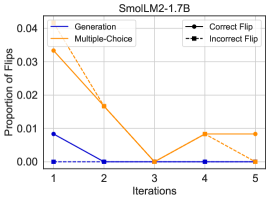
The chart visualizes the proportion of "flips" (changes in model predictions) for two methods—**Generation** and **Multiple-Choice**—across five iterations of the SmolLM2-1.7B model. It distinguishes between **Correct Flips** (solid circles) and **Incorrect Flips** (dashed squares) using color-coded lines and markers.
### Components/Axes
- **X-axis**: Labeled "Iterations" with discrete values 1–5.
- **Y-axis**: Labeled "Proportion of Flips" with a scale from 0.00 to 0.04.
- **Legend**: Located in the top-right corner, with:
- **Blue line**: Represents **Generation** method.
- **Orange line**: Represents **Multiple-Choice** method.
- **Solid circles**: Denote **Correct Flips**.
- **Dashed squares**: Denote **Incorrect Flips**.
### Detailed Analysis
#### Generation Method (Blue Line)
- **Iteration 1**: Proportion of flips ≈ 0.008 (Correct Flip: solid circle).
- **Iteration 2**: Proportion ≈ 0.000 (no flips).
- **Iterations 3–5**: Remains at 0.000 (no flips).
- **Trend**: Sharp decline from iteration 1 to 2, then stable.
#### Multiple-Choice Method (Orange Line)
- **Iteration 1**: Proportion ≈ 0.035 (Correct Flip: solid circle).
- **Iteration 2**: Proportion ≈ 0.015 (Correct Flip: solid circle).
- **Iteration 3**: Proportion ≈ 0.000 (no flips).
- **Iteration 4**: Proportion ≈ 0.008 (Correct Flip: solid circle).
- **Iteration 5**: Proportion ≈ 0.008 (Correct Flip: solid circle).
- **Trend**: Initial drop from 0.035 to 0.015, then stabilization with a minor uptick at iteration 4.
#### Incorrect Flips (Dashed Squares)
- **Generation**: No visible dashed squares (proportion ≈ 0.000 across all iterations).
- **Multiple-Choice**:
- **Iteration 1**: Proportion ≈ 0.027 (dashed square).
- **Iteration 2**: Proportion ≈ 0.000 (no dashed square).
- **Iterations 3–5**: Proportion ≈ 0.008 (dashed square).
- **Trend**: Persistent incorrect flips in later iterations for Multiple-Choice.
### Key Observations
1. **Generation Method**: Rapid improvement in accuracy, with flips dropping to zero by iteration 2.
2. **Multiple-Choice Method**: Higher initial flips but inconsistent performance, with incorrect flips resurfacing in later iterations.
3. **Incorrect Flips**: Dominant in Multiple-Choice, particularly in iterations 1 and 4–5, suggesting potential errors in this method.
### Interpretation
The data suggests that the **Generation** method achieves faster convergence and stability, while the **Multiple-Choice** method exhibits higher variability and persistent errors (incorrect flips). The sharp decline in flips for Generation indicates improved model confidence over iterations, whereas Multiple-Choice’s fluctuating performance may reflect challenges in handling ambiguous or complex inputs. The resurgence of incorrect flips in later iterations for Multiple-Choice raises questions about its reliability in dynamic scenarios. This aligns with the hypothesis that iterative refinement benefits simpler methods like Generation more effectively than heuristic approaches like Multiple-Choice.