## Diagram: Comparison of Attention Mechanisms in Transformer Architectures
### Overview
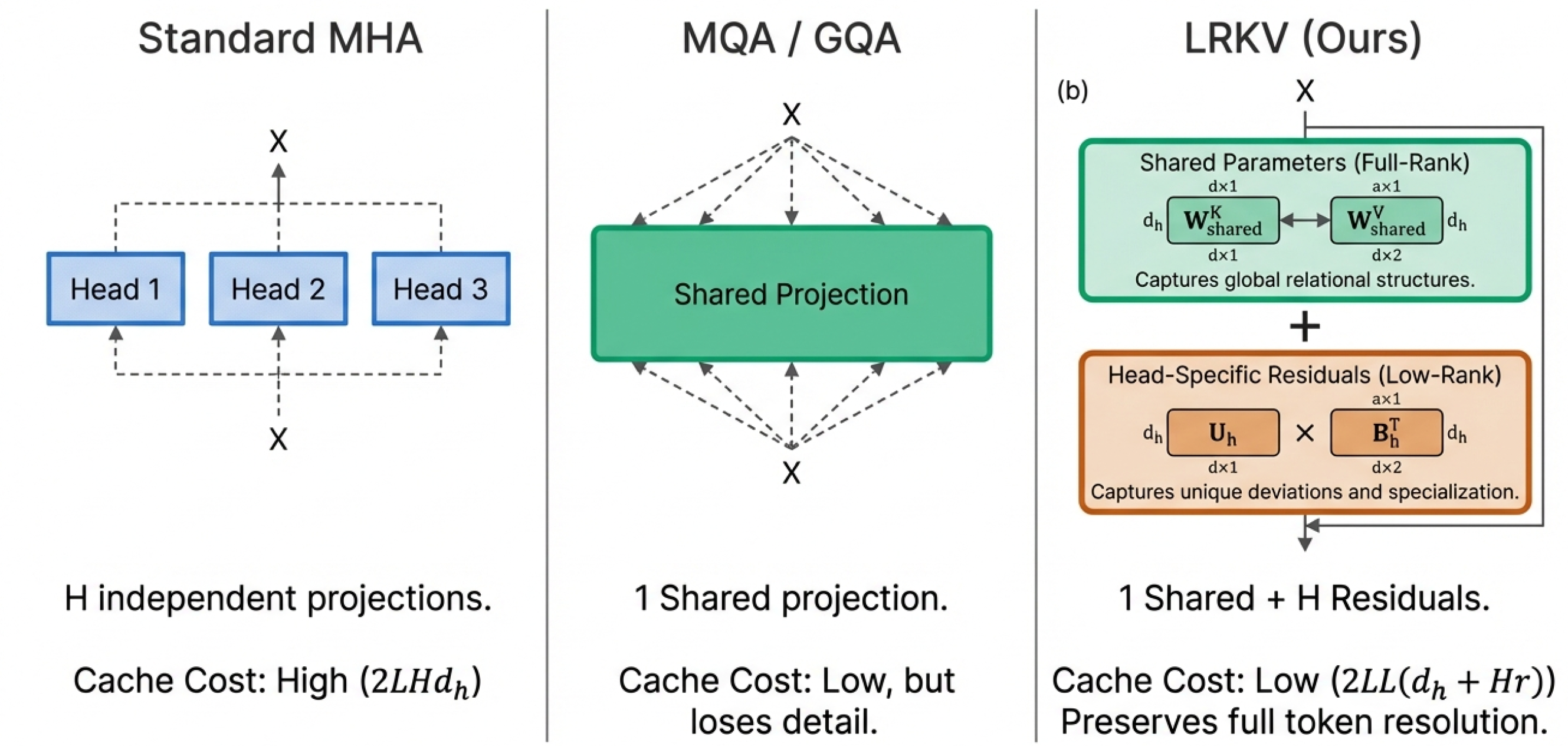
The diagram compares three attention mechanisms: **Standard MHA**, **MQA/GQA**, and **LRKV (Ours)**. Each section includes a visual workflow, labels, and textual descriptions of computational costs and design principles.
---
### Components/Axes
1. **Standard MHA**
- **Visual Components**:
- Three parallel "Head" blocks (Head 1, Head 2, Head 3) with dashed bidirectional arrows connecting to a central "X" node.
- Text: "H independent projections. Cache Cost: High (2LHd_h)".
- **Key Labels**:
- "Head 1", "Head 2", "Head 3" (blue boxes).
- "X" (central node).
2. **MQA/GQA**
- **Visual Components**:
- A central "Shared Projection" block (green) with dashed arrows connecting to multiple "X" nodes.
- Text: "1 Shared projection. Cache Cost: Low, but loses detail."
- **Key Labels**:
- "Shared Projection" (green rectangle).
3. **LRKV (Ours)**
- **Visual Components**:
- Two stacked blocks:
- **Shared Parameters (Full-Rank)** (green): Contains matrices `W_K_shared`, `W_V_shared`, and text "Captures global relational structures."
- **Head-Specific Residuals (Low-Rank)** (orange): Contains matrices `U_h`, `B_h^T`, and text "Captures unique deviations and specialization."
- Text: "1 Shared + H Residuals. Cache Cost: Low (2LL(d_h + Hr)) Preserves full token resolution."
- **Key Labels**:
- "Shared Parameters (Full-Rank)", "Head-Specific Residuals (Low-Rank)".
---
### Detailed Analysis
1. **Standard MHA**
- **Structure**: Three independent attention heads process input `X` and aggregate results via bidirectional connections.
- **Cache Cost**: Explicitly labeled as "High (2LHd_h)", where `L` and `H` likely represent sequence length and number of heads, respectively.
2. **MQA/GQA**
- **Structure**: A single shared projection layer processes all heads, reducing redundancy.
- **Cache Cost**: Labeled "Low", but notes a trade-off: "loses detail" due to shared parameters.
3. **LRKV (Ours)**
- **Structure**: Combines a shared full-rank parameter layer (global structures) with low-rank head-specific residuals (local deviations).
- **Cache Cost**: Labeled "Low (2LL(d_h + Hr))", where `d_h` is head dimension and `Hr` is residual rank.
- **Key Advantage**: "Preserves full token resolution" by balancing shared and residual components.
---
### Key Observations
1. **Cache Cost Trade-offs**:
- Standard MHA has the highest cache cost due to independent projections.
- MQA/GQA reduces cost via shared projections but sacrifices detail.
- LRKV optimizes cost further while retaining resolution through residual learning.
2. **Design Philosophy**:
- LRKV explicitly separates global (shared) and local (residual) features, unlike MQA/GQA’s monolithic shared layer.
3. **Mathematical Notation**:
- LRKV’s cache cost formula `2LL(d_h + Hr)` suggests linear scaling with sequence length (`L`) and residual rank (`Hr`), contrasting with Standard MHA’s quadratic dependency on heads (`H`).
---
### Interpretation
- **Efficiency vs. Fidelity**: The diagram highlights a spectrum from computationally expensive but detailed (Standard MHA) to efficient but coarse (MQA/GQA). LRKV bridges this gap by decomposing attention into shared and residual components.
- **Practical Implications**: LRKV’s design suggests suitability for tasks requiring both global context (e.g., long-range dependencies) and fine-grained local patterns (e.g., token-level nuances).
- **Unresolved Questions**: The diagram does not quantify performance metrics (e.g., accuracy, latency) or specify hardware constraints, leaving implementation trade-offs ambiguous.
This structured breakdown captures all textual and visual elements, emphasizing technical trade-offs and design principles. The LRKV method’s innovation lies in its hybrid approach, balancing efficiency and resolution—a critical insight for transformer architecture optimization.