## Box Plot: NSGA-II Performance on OneMinMax
### Overview
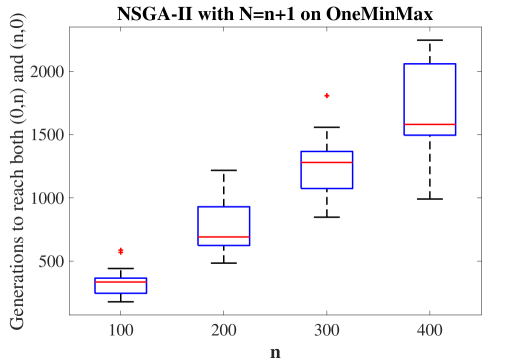
The image is a box plot comparing the number of generations required for the NSGA-II algorithm to reach both (0,n) and (n,0) solutions on the OneMinMax problem. The x-axis represents the problem size 'n', and the y-axis represents the number of generations. The plot shows the distribution of generations for different values of 'n' (100, 200, 300, and 400).
### Components/Axes
* **Title:** NSGA-II with N=n+1 on OneMinMax
* **X-axis:**
* Label: n
* Categories: 100, 200, 300, 400
* **Y-axis:**
* Label: Generations to reach both (0,n) and (n,0)
* Scale: Approximately 0 to 2200
* **Box Plot Elements:** Each box plot shows the median (red line), the interquartile range (IQR, blue box), and whiskers extending to 1.5 times the IQR. Outliers are marked with red asterisks.
### Detailed Analysis
The box plots show an increasing trend in the number of generations required as 'n' increases.
* **n = 100:**
* Median: Approximately 350
* IQR: Approximately 250 to 400
* Outlier: Around 600
* **n = 200:**
* Median: Approximately 700
* IQR: Approximately 600 to 950
* **n = 300:**
* Median: Approximately 1300
* IQR: Approximately 1100 to 1550
* Outlier: Around 1800
* **n = 400:**
* Median: Approximately 1600
* IQR: Approximately 1500 to 2100
### Key Observations
* The median number of generations increases significantly as 'n' increases.
* The spread (IQR) of the number of generations also increases with 'n'.
* There are outliers for n=100 and n=300, indicating some runs required significantly more generations.
### Interpretation
The data suggests that the NSGA-II algorithm requires more generations to find both (0,n) and (n,0) solutions as the problem size 'n' increases for the OneMinMax problem. This is expected, as the search space grows exponentially with 'n'. The increasing IQR indicates that the algorithm's performance becomes more variable as 'n' increases. The outliers suggest that in some cases, the algorithm may struggle to converge quickly for smaller 'n' values, but this is less pronounced for larger 'n' values.